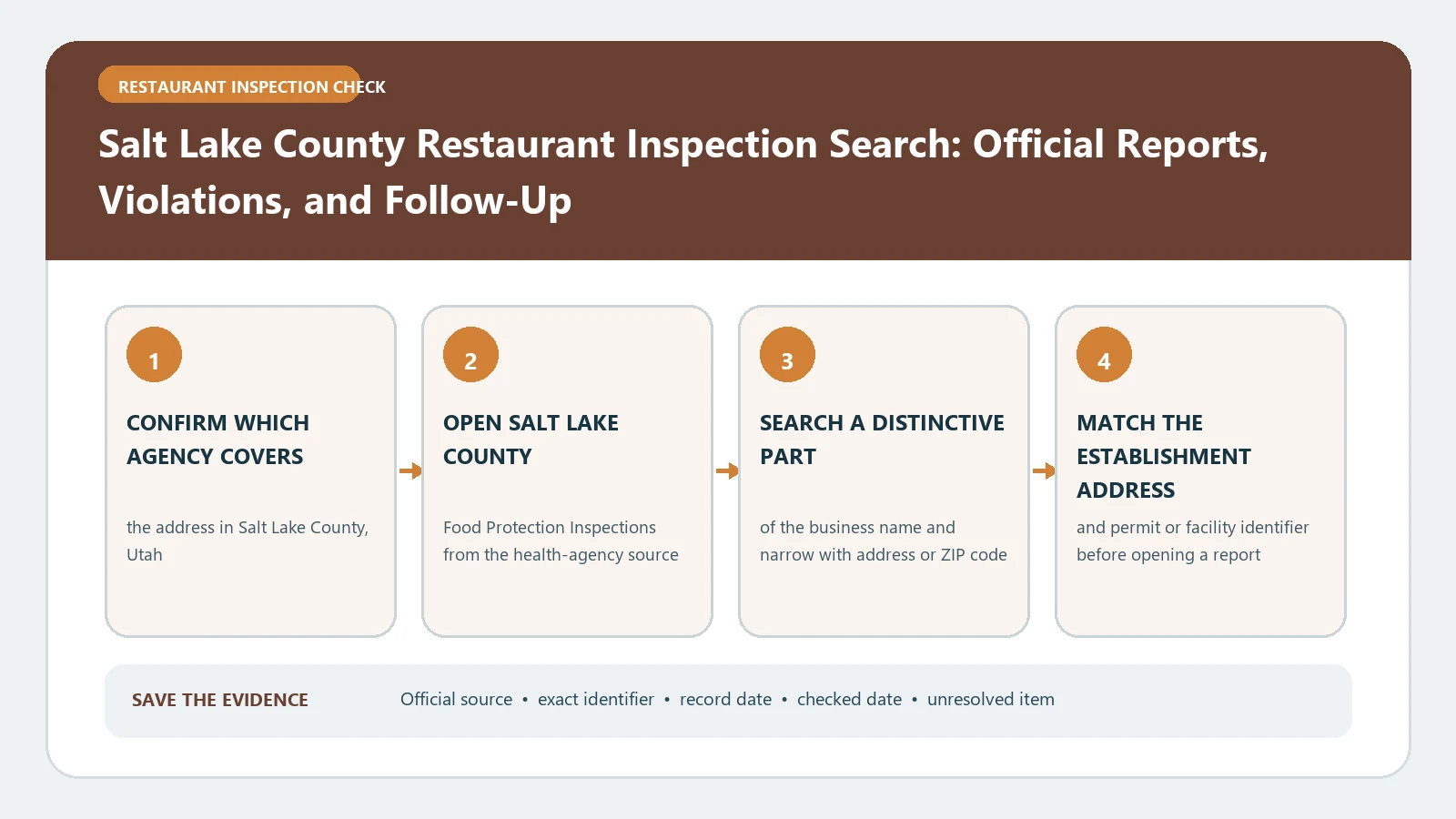
Search Salt Lake County Food Protection Inspections by establishment name and address, then open the dated inspection report rather than relying on a standalone score or grade. A past inspection describes conditions observed at that visit and does not guarantee the restaurant's current condition.
Start on the county's Food Protection Inspection Reports page and use its Inspection Reports button. Salt Lake County identifies that button as its only official source for county health-department inspection information. The public search is not a letter-grade directory: it exposes inspection scores, a risk-level ranking, recent inspection history, and the violations recorded for a selected visit.
Search the Salt Lake County inspection tool
The county button opens the Salt Lake Health Inspection Reports search. Its current form requires an inspection area and lets you enter all or part of the establishment name, all or part of the street address, or select a city. Results display an Inspections link beside the establishment name, address, and city.
- Select the food-service inspection area offered by the form.
- Enter a distinctive part of the business name. If the name is common or has changed, try part of the street address instead.
- Use the city selector to separate branches with similar names.
- Match the result's establishment name, street address, and city before opening Inspections.
- Read the inspection history, then open the individual inspection that answers your question.
A name-only match is weak evidence when a chain has several locations or the same kitchen appears under more than one operation. Preserve the displayed address and city with the inspection date you rely on.
Read the score, risk level, and rank as different measures
Salt Lake County uses a risk-based scoring and ranking system. Violations observed during an inspection carry 1, 3, or 6 points based on severity, and those points make up the inspection score. Lower scores are better. That score belongs to a particular inspection; it is not the same thing as the establishment's risk level or current percentile rank.
| Displayed measure | What it means in Salt Lake County | How to use it |
|---|---|---|
| Inspection score | The total of violation points recorded for that inspection; lower is better. | Open the visit and read the violations behind the total. |
| Risk level 1–4 | A category based on menu complexity and meal volume; higher-risk operations receive routine inspections more often. | Do not compare businesses as though different risk levels were equivalent. |
| Percentile rank | A comparison with establishments in the same risk-level category. | A 25% rank means the establishment scores better than 25% of businesses in that risk level, not that it earned 25 points. |
| Critical violations | Violations that may pose an immediate public-health risk. | Read the cited item and any later inspection rather than relying only on the count. |
| Noncritical violations | Violations that may lead to problems over time if not corrected. | Check whether the same issue recurs across later visits. |
The history shows the current rank within the establishment's risk level and a summary of its 10 most recent inspections. Each summary includes the score and counts of critical and noncritical violations; open an inspection to see the specific violations. Rankings can change between inspections because the county adds new inspections every business day and recalculates rankings weekly on Friday evenings.
Use the history, not one favorable visit
Begin with the newest dated inspection, but compare it with the prior visits in the 10-inspection summary. A useful review separates three questions: what was observed on the selected date, whether the cited issue was critical or noncritical, and whether the same type of issue appears again later. A low score on one visit does not erase an earlier pattern, and an older high score does not describe conditions after a later inspection.
| Record to retain | Why it matters |
|---|---|
| Establishment name, address, and city | Shows that the result belongs to the intended location. |
| Inspection date and score | Keeps the numeric result tied to one visit. |
| Critical and noncritical counts | Distinguishes the types of findings summarized for that visit. |
| Specific violation text | Explains what produced the score and what should be checked in later reports. |
| Later inspection or closure entry | Prevents an earlier result from being presented as the latest county record. |
Check closures separately
The county's embedded inspection window has a Closures button in the upper-right corner. Check that list separately from the establishment's inspection history. If a facility appears, match the name and address and read the displayed closure or reopening information. Do not infer current operating status from an older inspection score alone.
Know which businesses the county does not regulate
The Salt Lake County Food Protection Bureau regulates food-service establishments such as restaurants, cafés, food trucks, cafeterias, caterers, and concession operations. The county states that grocery stores, butchers, bakeries, and food manufacturing or processing businesses are regulated by the Utah Department of Agriculture and Food. If the business is in one of those categories, a no-result in the county restaurant tool may be a jurisdiction issue rather than a missing inspection.
If the establishment does not appear
- Try a shorter distinctive name and then part of the street address.
- Check the city and look for a former or alternate establishment name at the same address.
- Confirm that the operation is a county-regulated food-service establishment rather than a grocery, bakery, butcher, or processor.
- For a material gap, contact the Salt Lake County Food Protection Bureau and provide the exact name, address, city, and search terms used. The county lists 385-468-3845 for the bureau.
Food workers at the establishments the county regulates need a Utah Food Handler Permit within 30 days of starting work. The 14-day certificate step and the $15 permit fee are explained in our Utah food handler permit guide.