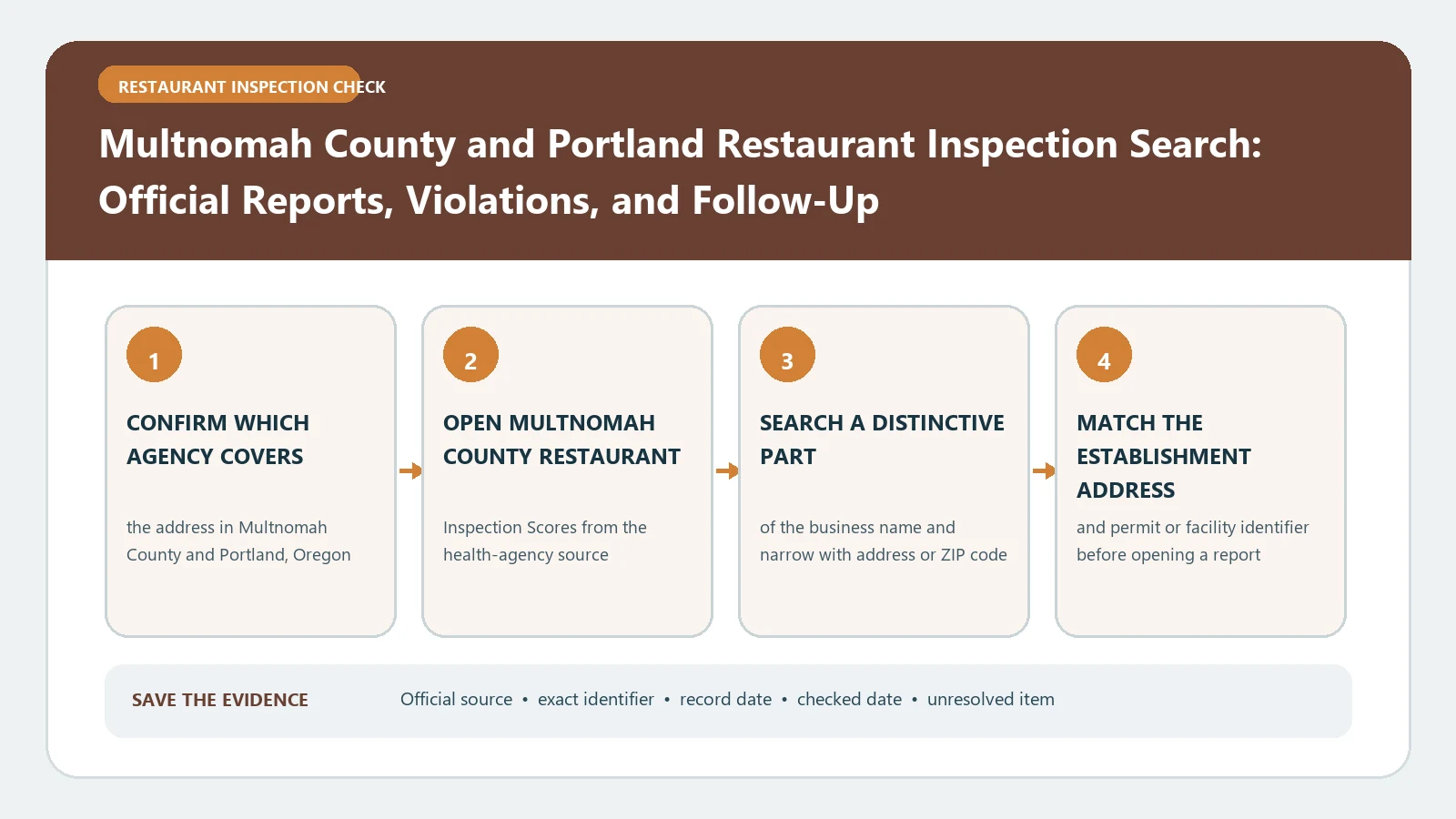
For a Portland restaurant, use Multnomah County’s current restaurant score service, match the licensed facility by address, and connect the most recent scored routine inspection to any later unscored reinspection. The searchable history is limited, so an absent older report is not evidence that no older inspection exists.
The county’s current restaurant scores page states the database period, visit frequency, placard meaning, unscored reinspection rule, and correction path. The Multnomah County restaurant license page confirms licensing and inspection ownership, public posting, and the role of ownership changes. These official pages were reviewed August 26, 2026.
Start with the county facility record
Portland is inside Multnomah County, and the county health program owns the restaurant inspection record. Enter through the county page even when the search interface opens on a vendor domain. The referring government page establishes the official chain.
Search by a distinctive name, then verify the full street address and facility identifier. County records can include restaurants, food carts, hotels, and pools, so filter the facility type before reading a result. A food-cart pod or shared commercial address may show several separately licensed operations.
Respect the one-year search boundary
Multnomah County says inspection reports are maintained in the searchable database for one year. Record that boundary in any research note. If a restaurant operated longer than a year, the online view may show only part of its history.
For an older transaction, dispute, or historical comparison, save the exact date range visible and contact the county for the appropriate records route. Do not label an older visit nonexistent because it falls outside the public window. The right statement is that it was not available in the one-year online collection checked on a named date.
Separate the scored routine from the reinspection
All licensed establishments receive two routine, unannounced inspections each year, according to the county. A routine visit receives a score. Reinspections are not scored. This means a later blank score is not a failed or zero result; it may be a different visit type with a different job.
Create a paired record rather than an average:
- Save the routine inspection date, score, and critical findings.
- Record corrections noted during that visit.
- Note any deadline or expected reinspection stated by the county record.
- Open the later unscored reinspection and attach it to the correct routine visit.
- Preserve the outcome and any unresolved item without rewriting the original score.
The Portland result-fields guide explains how to keep score, visit type, and violation fields separate. The county source supplies the actual values.
Treat a blank score as a visit-type question
When the newest row has no score, inspect its visit label before deciding anything. If it is a reinspection, attach it to the earlier scored routine visit and read the correction outcome. If the row is another unscored event, preserve the agency’s label and ask what that event is intended to show.
Never convert a blank to zero, failed, or not inspected. Those replacements change the public record. A simple Portland comparison should show the scored routine event on one line and the later unscored event on another, with dates and findings kept intact.
The facility filter matters here. A restaurant, food cart, and temporary operation can follow different operational patterns even inside the same county database. Use the facility name, type, address, and license identity together. If a mobile unit moved or changed commissary, the current search may require a different identifier from the one used on an older report.
Read the entrance placard narrowly
The county says a placard at the restaurant entrance indicates whether the facility passed its last inspection. Treat that placard as a pointer to the latest inspection status, not as a complete history or a permanent safety certificate. Confirm that it belongs to the same licensed establishment and check the online report date.
A recently displayed placard can coexist with an older scored report and a later unscored reinspection. Put all three pieces on the same timeline. If the placard and database appear inconsistent, record the observation date and ask the county to resolve the conflict rather than deciding which one is authoritative by appearance alone.
Follow critical violations through the 14-day path
Multnomah County explains that critical violations which cannot be corrected during the inspection receive 14 days for correction while a safe alternative procedure must be used. A reinspection then occurs. The later visit is the evidence for what the inspector found next.
Use the Portland reinspection timeline to track the routine report, the correction period, and the unscored return visit. Do not say corrected merely because 14 days passed. Say what the later county report documents, or mark the outcome unresolved if no later public event is visible.
Repair an absent or mismatched result
Try the address without unit punctuation, a shorter business name, and any legal or previous name. Verify that the location is in Multnomah County and that the result is the right facility type. A change of ownership can produce a new license record, separating one operator’s inspections from another’s.
If the report is older than one year, if a mobile operation changed location, or if the search still has no match, use the contact path on the county score page. Save the search terms, lookup date, and candidate addresses first. That gives staff a precise records question.
Preserve a Portland inspection sequence
The finished sequence should contain the licensed name, address, routine inspection date and score, reported critical violations, correction language, later unscored reinspection, placard observation date if relevant, and official URLs. Identify Multnomah County as the record owner.
This sequence describes dated agency observations. It does not establish the restaurant’s condition now, confirm that every correction remained in place, or replace the county’s current record. This does not mean the restaurant is safe today. Reopen the official source before a visit or public claim. If the target address is outside the county, return to the inspection lookup by city and identify the actual regulator before searching again.