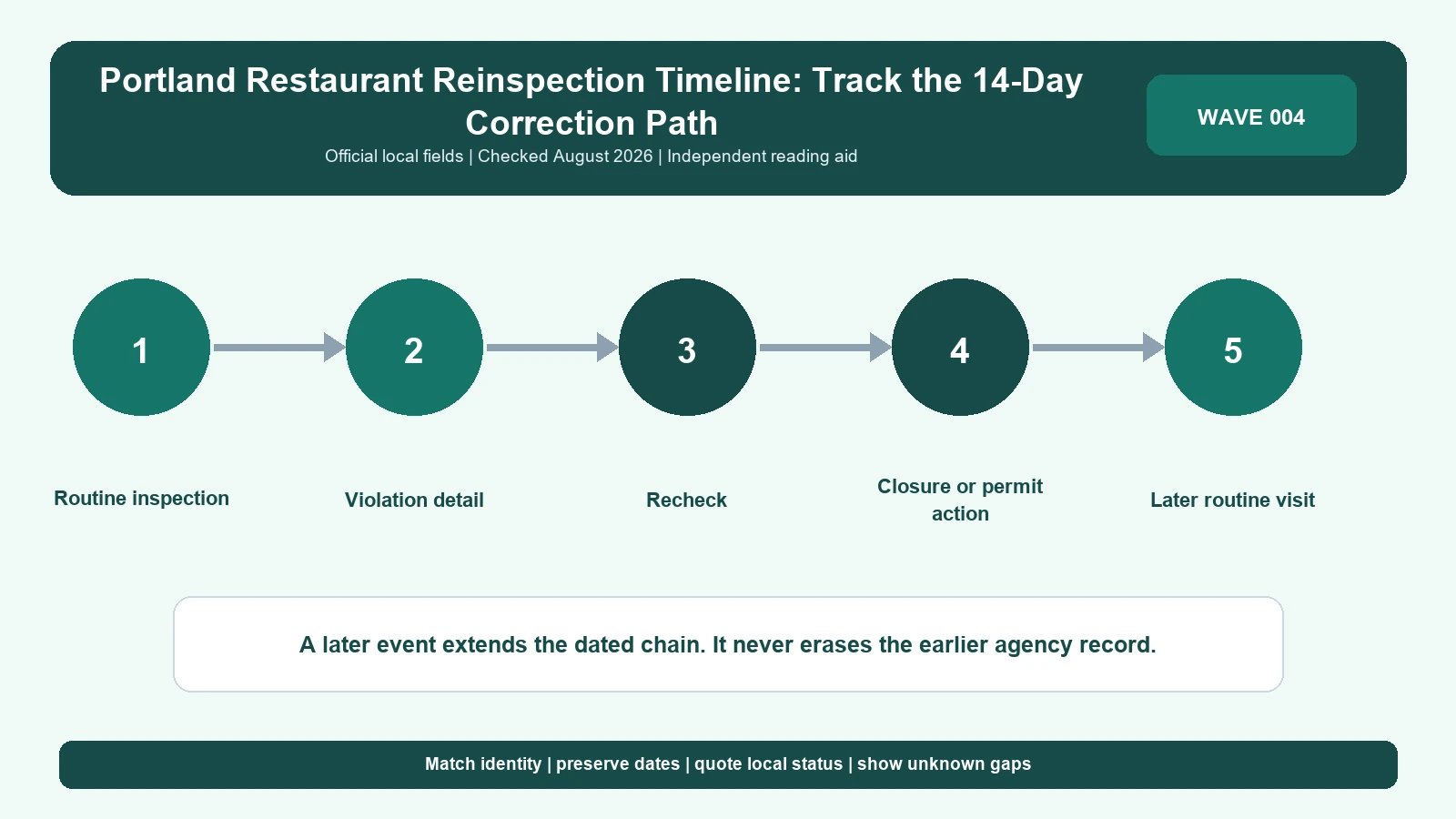
A Portland reinspection chain is built from a scored routine inspection, the specific serious violations left uncorrected, and an unscored return visit. Multnomah County says qualifying items generally receive 14 days for correction before reinspection. That is a verification path, not a second grade.
Last checked: August 7, 2026.
Retrieve the dated reports through Multnomah County current restaurant scores. Confirm program rules at Multnomah County restaurant licensing and inspections, then use Multnomah County food-service operator resources for the Oregon rule categories behind the findings. The useful timeline connects those sources row by row: report, item, required correction, return visit, and any separately published permit or closure action.
Start with the routine report that created the follow-up question
Freeze the original routine inspection before opening the newest result. Copy the facility name, address, inspection date, numeric score, and every serious violation that was not corrected during the visit. This prevents the reinspection from rewriting history and identifies which items the return visit was expected to examine.
| Baseline field | Timeline role | Connection test | Mistake to avoid |
|---|---|---|---|
| Facility and address | Defines the licensed operation | Same coherent location across visits | Combining branches |
| Routine date | Starts the correction clock when the report supports it | Date printed on the county report | Using the page-access date |
| Routine score | Records the original scored snapshot | Keep with its violation list | Carrying the score onto the reinspection |
| Uncorrected serious item | Explains why verification is needed | Same rule and condition in follow-up | Assuming every deduction triggers a return |
| Onsite correction | Closes that item within the visit if documented | Item-specific notation | Calling the whole report corrected |
Apply the 14-day rule only to the county's stated lane
Multnomah County says serious violations not corrected onsite must be corrected within 14 days and are followed by reinspection. The wording matters. Do not attach that deadline to every minor observation, every point deduction, or every restaurant in the search. The selected report and the county’s classification determine whether the lane applies.
| Possible path | Evidence needed | Proper timeline wording | Unsupported wording |
|---|---|---|---|
| Corrected during routine visit | Item marked corrected onsite | Correction recorded on the routine date | No other action was possible |
| Fourteen-day correction lane | Qualifying serious item left uncorrected | County procedure calls for correction and reinspection | The restaurant was closed for 14 days |
| Reinspection | Later county visit tied to the item | County returned to verify selected corrections | The restaurant received a new score |
| Permit or closure action | Separate county action and date | Quote the published term | A low routine score automatically closed it |
A deadline is not proof of breach. If the later report is absent, the chronology should say that a qualifying item entered the county correction path and that no public follow-up was located at the checked time. It should not say the operator ignored the county or that the item remained unresolved after day 14.
Do not invent a score for the reinspection
The county explicitly distinguishes the two visit types: routine inspections are scored, reinspections are not. In a dataset or table, use ‘not applicable—reinspection’ rather than zero or blank when the visit type is known. Keep the earlier routine score on its original row so readers can understand why the follow-up occurred.
The restaurant reinspection guide supplies a general event vocabulary, but this Portland page must preserve the local distinction between a scored routine visit and an unscored verification visit. Mixing them creates a false trend line and can make a successful correction look like a catastrophic score drop.
Compare violations item by item at the return visit
A reinspection can be narrower than the original routine review. Build a crosswalk using the rule reference, category, observation, and correction state. If the later wording changes, document the connection rather than relying on a keyword match. An item not mentioned in the return report is not automatically passed; it may have been outside the recorded scope.
| Crosswalk outcome | What the record supports | What remains unknown |
|---|---|---|
| Same item now compliant | The later report records correction for that requirement | Conditions after the return visit |
| Same item still noncompliant | The county again documents the condition | Any later administrative response |
| Different wording, same rule | A possible continuation that needs explanation | Whether the inspector treated it as the same condition |
| Item absent | The selected follow-up does not display it | Whether it was reviewed or omitted |
| New item appears | The return visit documents another condition | Whether it changes the scope of later action |
Keep the entrance placard on its own evidence track
Restaurants receive a visible placard showing whether the latest inspection passed. A dated photograph can help establish what was displayed at that moment, but the county report is the stronger source for the event chain. Note the photo date and never use an old image to contradict a newer county result.
A placard transition can be listed only when the before-and-after evidence is dated. If one side is missing, write ‘placard state not documented.’ The timeline is more trustworthy when it shows a gap than when it supplies a plausible but unverified color or status.
Separate health-hazard action from routine scoring
Closure, permit suspension, and reopening are operational actions. A numeric score and violation count do not establish them. Add an operational-status row only when Multnomah County publishes that action or confirms it through the responsible program. Likewise, a reinspection report does not prove reopening unless the agency connects the visit to restored authority to operate.
| Operational row | Minimum citation fields | Safe statement |
|---|---|---|
| Action | County term, facility, and effective date | The agency recorded this action on the stated date |
| Reason | Finding or hazard named by the county | The source attributes the action to that condition |
| Correction | Documented remedial step | The source records the named step |
| Follow-up | Visit date and scope | The county performed a later verification |
| Reopening or reinstatement | Explicit county clearance or status | Authority to operate was restored on that date |
When an operational event appears, consult the closure and permit-suspension guide. The internal guide helps organize sources; it does not supply a Portland status. Only the local agency record can support the dated action.
Preserve the history before the public window moves
The current-score page says reports are retained for about a year. That rolling window can remove the routine report that explains a visible reinspection. Save report identifiers, URLs, retrieval dates, and quoted item fields in a source ledger. If the original becomes unavailable, keep its metadata and mark the document unavailable rather than recreating its findings from memory.
- Search by address and licensed name.
- Save the routine report before opening the reinspection.
- List only qualifying uncorrected items in the 14-day lane.
- Mark the follow-up score not applicable.
- Add operational actions only from county evidence.
- Append new events and preserve old rows.
Create the Portland correction ledger
The most useful link asset is a two-level table. The event level stores visit date, type, routine score or not-applicable marker, facility identity, placard evidence, and source. Child rows store each rule, priority class, observation, onsite correction, due date, reinspection outcome, and uncertainty note. Readers can audit a claim without accepting an editor’s summary.
Give every version a retrieval date. A new routine inspection begins another snapshot; it does not replace the previous correction chain. If a business changes names or operators at the same address, open a new identity section and explain the evidence that links—or does not link—the histories.
Limits of a reinspection chronology
The chronology shows what the county published about specific visits. It does not certify current sanitation, prove that a diner became ill, reveal every complaint, or guarantee that no unpublished enforcement step exists. A completed correction is evidence about a named item on a named date, not a lifetime safety promise.
Use the Portland and Multnomah County lookup guide when the initial facility is still uncertain. Once the report is found, keep the final conclusion procedural: routine score, uncorrected serious item, 14-day correction path where applicable, unscored reinspection, and any independently documented action.
Portland follow-up questions
Does every violation get 14 days?
No. The county’s statement concerns serious violations not corrected onsite. Use the classification and report directions for the selected item.
Is a better later routine score proof the earlier item was corrected on time?
No. It is a newer snapshot. Locate the reinspection or correction record before making a deadline claim.
Can an absent reinspection be treated as a pass?
No. Record the search date and gap, then ask the county if the missing event changes the conclusion.
Audit the Portland 14-day lane before release
The timeline should show why an item entered the county’s correction pathway. Confirm that it was a serious violation left uncorrected onsite, then preserve the original routine report and its score. The 14-day statement describes county procedure; it is not a closure period or a substitute for the return-visit date. The reinspection row must be explicitly unscored and tied to the selected item rather than to every observation in the routine report.
- Retain the original routine score on its original date.
- List only qualifying uncorrected serious items in the correction lane.
- Use the actual reinspection date from the county record.
- Crosswalk rule references instead of matching one shared word.
- Require a separate county source for closure or permit action.
- Preserve the roughly one-year retention limitation in the footer.
Have a reviewer trace one item from routine finding to reinspection outcome. A missing item in the later report must remain not shown, not passed. A newly cited item belongs on its own child row. If no follow-up can be located, preserve the expected procedural lane and end with an explicit public-record gap. That treatment is more accurate than presenting the operator as compliant or noncompliant without the county’s return record.
Scope: Multnomah County restaurant reports, correction procedure, and dated operational records. This independent timeline is not a live agency status or safety warranty.