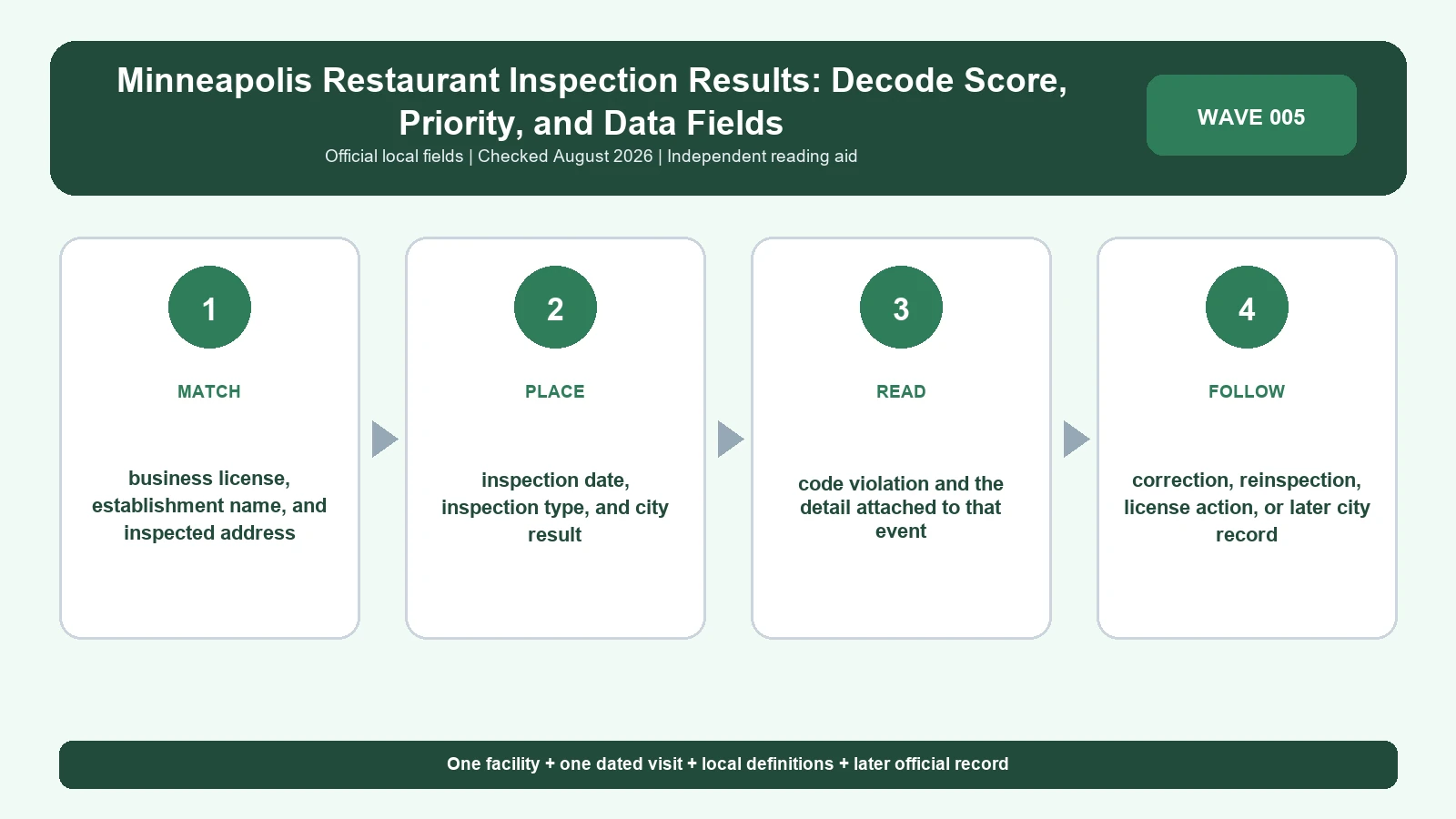
A Minneapolis health-inspection score starts at 100 and deducts four points for each Priority 1 violation, two for Priority 2, and zero for Priority 3. The number becomes useful only after you confirm the facility, inspection type, result, violation rows, and inspector comments in the city dashboard.
Last checked: August 7, 2026.
Use Minneapolis Health Inspection Reports for the city’s scoring and follow-up rules. The Minneapolis Health Inspection Lookup Dashboard explains how to filter the interactive display and open violations by clicking a score bar. The Minneapolis bulk-data field descriptions defines the underlying fields, including facility identity, RiskLevel, InspectionType, InspectionResult, FoodCodeText, InspectorComments, and ViolationPriority.
Select the correct facility inside the Minneapolis dashboard
The dashboard allows searches by business name, address, and type. Available types include Restaurant, Institution, Grocery, Food Truck, Food Shelf, and Meat Market. That distinction matters because a shared name or address can contain more than one regulated facility. Minneapolis warns that one business can have multiple facilities under one roof.
| Dashboard input | Use | Confirmation field | Common error |
|---|---|---|---|
| Business name | Find candidate records | BusinessName plus FullAddress | Selecting the first matching chain |
| Business address | Separate branches and co-located operations | HealthFacilityIDNumber | Merging every facility at the address |
| Type | Limit the regulated operation | FacilityCategory | Treating a grocery counter as the restaurant |
| Score bar | Open inspection detail | InspectionIDNumber and DateofInspection | Citing the chart without violations |
| Current and prior years | Build visible history | Exact event dates | Calling the oldest visible row the first ever |
Store HealthFacilityIDNumber as the facility key and InspectionIDNumber as the visit key. OBJECTID can identify a row in the published data but should not be treated as a license or safety credential. When two facilities share an address, keep their inspection histories separate until the city fields prove they are the same regulated operation.
Recalculate the score from violation priorities
Minneapolis publishes a transparent deduction model: begin at 100, subtract four for every Priority 1 violation and two for every Priority 2 violation; Priority 3 carries no score deduction. A useful audit table counts the violation rows and shows the arithmetic. If your calculated value differs from the dashboard, preserve both and investigate rather than silently changing the city result.
| Violation priority | Points deducted | How to read it | What it does not mean |
|---|---|---|---|
| Priority 1 | 4 per violation | Highest deduction class in this scoring model | Automatic closure by itself |
| Priority 2 | 2 per violation | Middle deduction class | The item is optional |
| Priority 3 | 0 per violation | Recorded item with no score deduction | No correction is needed |
| No violation row | No deduction can be reconstructed from that absent row | Check dashboard filters and drill-down | The facility had no findings |
A score of 92 could arise from two Priority 1 violations, four Priority 2 violations, or another combination. The score alone does not disclose which conditions were observed. Open FoodCodeText and InspectorComments for every listed row, and retain ViolationPriority beside them.
Use the exact Minneapolis data fields
The data dictionary removes guesswork about column names. DateofInspection identifies the visit date; InspectionType and InspectionResult describe the event; FoodCodeText provides the code text; InspectorComments preserves the inspector’s account; and ViolationPriority carries the deduction class. Build public tables from those fields rather than relabeling them as generic score, issue, and note.
| Official field | Meaning in the city dictionary | Citation use | Misreading to prevent |
|---|---|---|---|
| HealthFacilityIDNumber | Unique number for the health-regulated facility | Join visits for that facility | A quality ranking |
| FacilityCategory | Type of regulated facility | Separate co-located operations | Restaurant cuisine |
| RiskLevel | Level based on food-preparation processes | Explain inspection frequency context | Past performance grade |
| InspectionType | Type of inspection | Keep routine and follow-up events apart | Violation severity |
| InspectionResult | City result for the event | Quote the displayed outcome | A lifetime status |
| InspectorComments | Narrative comments on the violation | Explain what the inspector recorded | A customer review |
RiskLevel is especially easy to misuse. Minneapolis says it reflects the kind of food preparation conducted, not the establishment’s past performance. A high-risk operation may require more frequent inspection because of process complexity; the label does not announce that the restaurant has a poor record.
Read the visit type before comparing scores
The city describes routine inspection intervals of approximately 12, 18, or 24 months depending on food-preparation activity. A follow-up has a different purpose from a routine visit. Compare routine scores cautiously and keep follow-ups as separate verification events. A missing score or different display on a follow-up must not be converted into zero.
The restaurant health-score guide provides a cross-jurisdiction vocabulary, but Minneapolis offers unusually precise local fields. Preserve the city’s formula and names. Do not translate a Minneapolis score into a letter grade unless the city itself publishes that conversion.
Account for publication timing and visible years
Minneapolis says inspection reports are posted within seven business days and the public page covers the current year plus the previous three years. A very recent visit may therefore be pending publication, and an older visit may fall outside the displayed window. Record the extraction date and call an absent row unlocated, not nonexistent.
- Confirm HealthFacilityIDNumber before combining visits.
- Click the score bar to expose the violation rows.
- Copy DateofInspection, InspectionType, and InspectionResult.
- Count Priority 1 and Priority 2 deductions separately.
- Store FoodCodeText and InspectorComments without paraphrasing them into one label.
- Preserve the report URL or dashboard route and access date.
Publish a Minneapolis score audit as the citation asset
A reusable asset should let another reader recalculate the total. Put the city score at the event level and one row per violation beneath it. This offers more value than a screenshot because the formula, source fields, and uncertainty are all visible.
| Asset field | Stored value | Audit question |
|---|---|---|
| Facility | HealthFacilityIDNumber, BusinessName, FullAddress, FacilityCategory | Is this the intended operation? |
| Inspection | InspectionIDNumber, DateofInspection, InspectionType, InspectionResult | Which city event is summarized? |
| Risk context | RiskLevel | What food-preparation category applies? |
| Violation | FoodCodeItem, FoodCodeText, ViolationPriority | Which deduction class and rule appear? |
| Narrative | InspectorComments | What condition did the inspector describe? |
| Arithmetic | 100 – 4(P1 count) – 2(P2 count) | Does the reconstructed score match? |
| Provenance | Official URLs and checked date | Can the dataset be reproduced? |
Do not edit the official comment to make it shorter inside the evidence column. Place any plain-language explanation in a separate editorial column. If the calculation does not match the published score, flag the variance and verify filters, duplicate rows, inspection identifiers, and any city handling not captured in your extraction.
Understand what score 91 does—and does not—signal
The city says a score of 91 or lower triggers a follow-up. A score above 91 can still receive follow-up at inspector discretion when significant issues warrant it. Therefore 92 is not a universal no-follow-up threshold, and 91 is not a closure grade. It is a routing point in Minneapolis procedure.
If a later visit appears, move to the restaurant reinspection guide and compare item outcomes. Keep the original score and report visible. The follow-up adds evidence; it does not retroactively change the earlier calculation.
Limits of the Minneapolis public result
The city fields can show what an inspector recorded during one visit and how the local formula produced a score. They cannot guarantee current kitchen conditions, predict illness, rate taste, prove all complaints are public, or show events older than the visible period. A favorable score is not a safety warranty and an adverse old score is not a current verdict.
Minneapolis score questions
Does Priority 3 mean the finding does not matter?
No. It means the item carries zero points in this score formula. Read the code text, inspector comment, and correction requirement.
Is RiskLevel based on previous scores?
No. Minneapolis defines it through food-preparation processes, not past performance.
Why might a report from last week be absent?
The city describes a posting period of up to seven business days. Record the search date and check again before concluding the event is missing.
Reproduce the Minneapolis score before publishing
Select one inspection identifier and count its violation rows. Begin at 100, subtract four for each Priority 1 item and two for each Priority 2 item, and leave Priority 3 at zero deduction. Compare the calculation with the city’s displayed score. A mismatch should trigger a review of filters, duplicate rows, facility identity, and inspection identifiers; it should never be solved by deleting an inconvenient violation.
- Confirm HealthFacilityIDNumber and FacilityCategory.
- Keep InspectionIDNumber and DateofInspection together.
- Open the score bar to retrieve violation details.
- Store FoodCodeText, ViolationPriority, and InspectorComments.
- Treat RiskLevel as food-process context, not performance.
- Note the seven-business-day posting statement and visible-year window.
A release reviewer should be able to recalculate the number from the published child rows and identify the exact source fields used. If the dashboard changes, the data dictionary remains the semantic reference for column names. Use not displayed for absent values. Do not fill a blank with no violations, no follow-up, or zero points unless the Minneapolis record explicitly supports that value. Archive the chosen filters with the audit note so a future refresh can reproduce the same facility and inspection scope.
Scope: Minneapolis health-inspection dashboard and published field dictionary. This independent score audit does not inspect facilities or guarantee current safety.