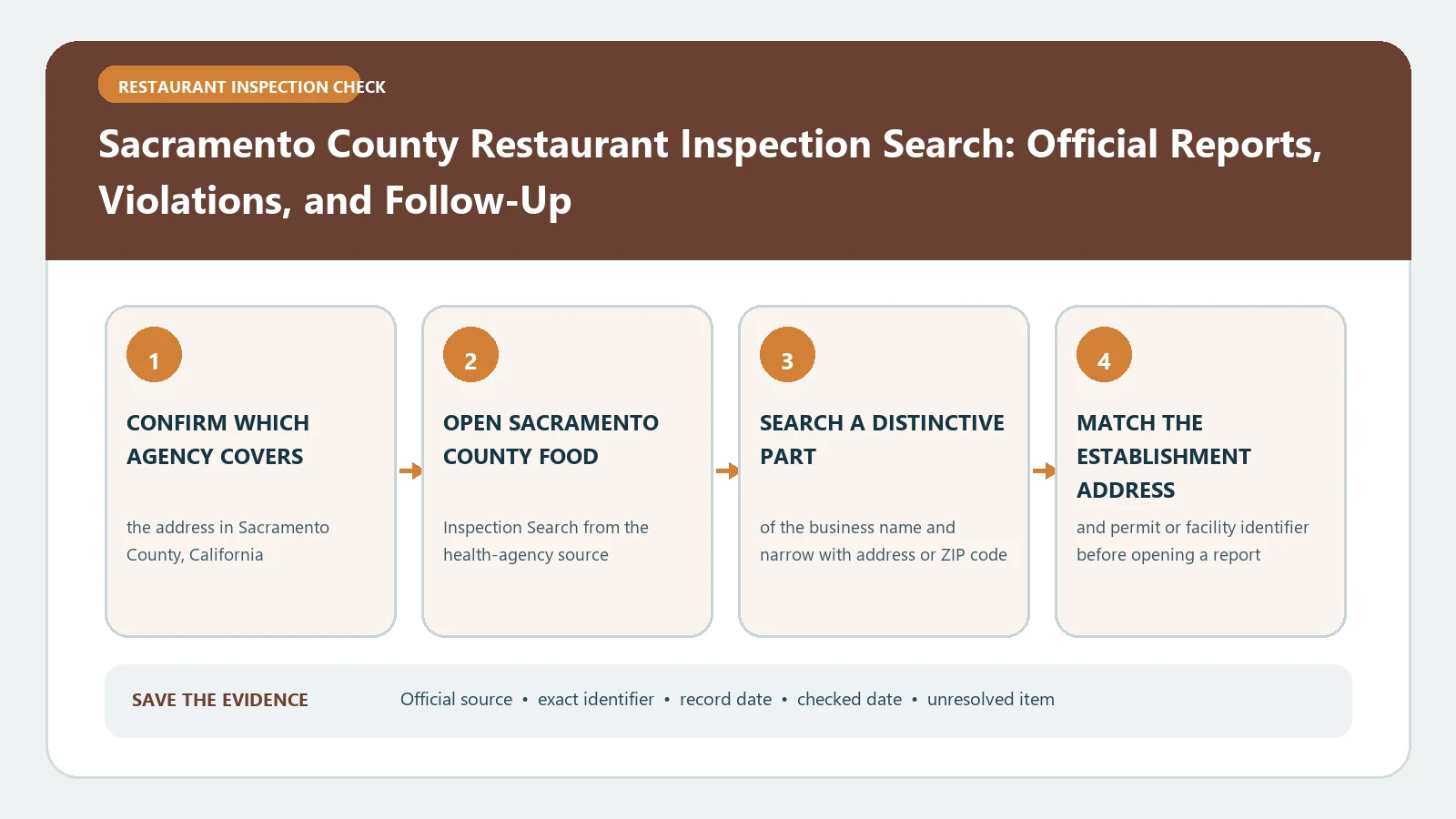
For a Sacramento County food facility, start from the Environmental Management Department’s current Retail Food Protection Program, open the inspection search it links, confirm the facility address, and attach the displayed placard to the dated report before deciding what the record shows. Treat the online result as a record checked on a specific date, not a guarantee of present conditions.
The current Sacramento County Retail Food Protection Program is the official starting point and links to the county’s online food-inspection search. The program page explains the green Pass, yellow Conditional Pass, and red Closed placards. An updated Sacramento County 311 answer says the latest inspection report must be available at the facility on request and directs readers to current online reports. Sources were checked August 26, 2026.
Account for the posting interval first
The current county program and 311 pages do not state a fixed deadline for a completed inspection to appear in the public search. Compare the inspection date shown with the date you retrieved the record. If you know a later visit occurred but the search shows an older report, describe it as the latest report visible on the retrieval date, not automatically the latest inspection.
Record three dates when possible: the inspection date, the online retrieval date, and the date any follow-up occurred. If an expected report is not visible, mark the online status unresolved. Ask the facility for its latest report or contact EMD through the current county route instead of inventing an upload deadline.
Use the restaurant report guide to keep dates attached to their source, but preserve Sacramento County’s own inspection and placard language.
Lock the facility identity before opening the report
Search by the most distinctive part of the business name and confirm the address. If several results appear, compare street number, unit, city, ZIP code, and facility identifier. Markets, school cafeterias, bars, food halls, and other operations can appear beside restaurants in the same system.
Write an identity header containing:
- facility name as displayed by EMD;
- exact street address and unit;
- facility or permit identifier;
- facility category when available;
- operator or ownership clue if shown;
- first and last inspection dates visible in the result.
Do not join histories across two permit identifiers just because the storefront name matches. If the facility lies outside Sacramento County EMD’s jurisdiction, find the correct authority through the inspection directory.
Attach the placard color to the underlying visit
Sacramento County uses green for Pass, yellow for Conditional Pass, and red for Closed in its food-inspection placard system. The color is useful only when tied to the correct facility and inspection date. Open the report that generated the displayed placard and copy its observations, corrections, and next action.
A green result records the outcome of that inspection; it is not a promise about conditions after the visit. A yellow result requires attention to the follow-up path. A red result requires a closure and reopening chronology. Never assign a color from memory or from a third-party map marker when the official report is available.
The latest report also must be available at the food facility on request under the county’s published guidance. If the online report fails to open, asking the manager for that dated report is a separate verification route, not permission to photograph private work areas.
Put the routine visit and reinspections on one timeline
When the current search displays a routine inspection and later follow-up or reinspection entries, read them as a chain rather than isolated scores. Start with the dated routine visit, then add each displayed follow-up in order and compare the specific items that required correction.
For the timeline, note:
- routine inspection date and placard result;
- cited major or other violations as described;
- correction made during the visit, if stated;
- deadline or reason for reinspection;
- each reinspection date and resulting placard;
- final visible disposition or unresolved gap.
A later green placard can show the result recorded at that follow-up. It does not erase the original report. If an inspection indicates that follow-up was required but no later entry is visible on the retrieval date, use the reinspection follow-up check and ask EMD whether another record exists.
Distinguish the web summary from a full report copy
An online facility page can summarize visits while the full inspection report contains the detailed observations. Save the PDF or printable report when the portal provides it. Keep the report date, facility identity, and URL together so a later reader can reproduce the lookup.
If an older event is not available in the current public search, request the record from EMD rather than assuming the earliest visible online date is the beginning of the facility’s inspection history. Ask for a narrow facility and date range and include the address and identifier.
When a report appears to belong to the wrong address, contains an identity conflict, or disappears between checks, preserve the facility identifier, URL, displayed dates, and retrieval date. Send that narrow discrepancy to EMD through its current contact route instead of silently editing the record in your notes.
Keep complaints outside the routine sequence
The Retail Food Protection Program performs routine inspections and responds to public complaints. A complaint is not itself proof of a violation, and a complaint-driven inspection should not be mislabeled as a routine visit. Record the inspection type and the official findings that followed.
If you observed a current sanitation problem or suspect foodborne illness, use Sacramento County’s complaint and illness-reporting route. An old inspection search cannot diagnose illness or trigger an investigation. The public record can provide context, but the complaint program owns the current response.
Resolve a no-result search methodically
Try the legal name, shortened trade name, street number and street name, and a former name. Remove punctuation and suite formatting. If a restaurant recently changed owners, search each operator separately. If a mobile vendor or temporary facility does not appear where expected, ask EMD which program or record system covers it.
When the official search is unavailable, do not replace it with an app that cannot show its data date. Save the outage time, return through the EMD program page, and retry or contact the department. A blank result is not a green placard and not evidence that the facility is unregulated.
Finish with a reproducible Sacramento finding
Your final record should include facility identity, routine inspection, placard result, every visible reinspection, full-report links, any pending posting interval, complaint-versus-routine distinction, and retrieval date. Keep unresolved items explicit.
The defensible conclusion is that Sacramento County EMD published the recorded inspection and follow-up sequence for the matched facility as of the checked date. It does not prove current kitchen conditions, guarantee that a newly completed report has already posted, or determine whether a customer became ill.