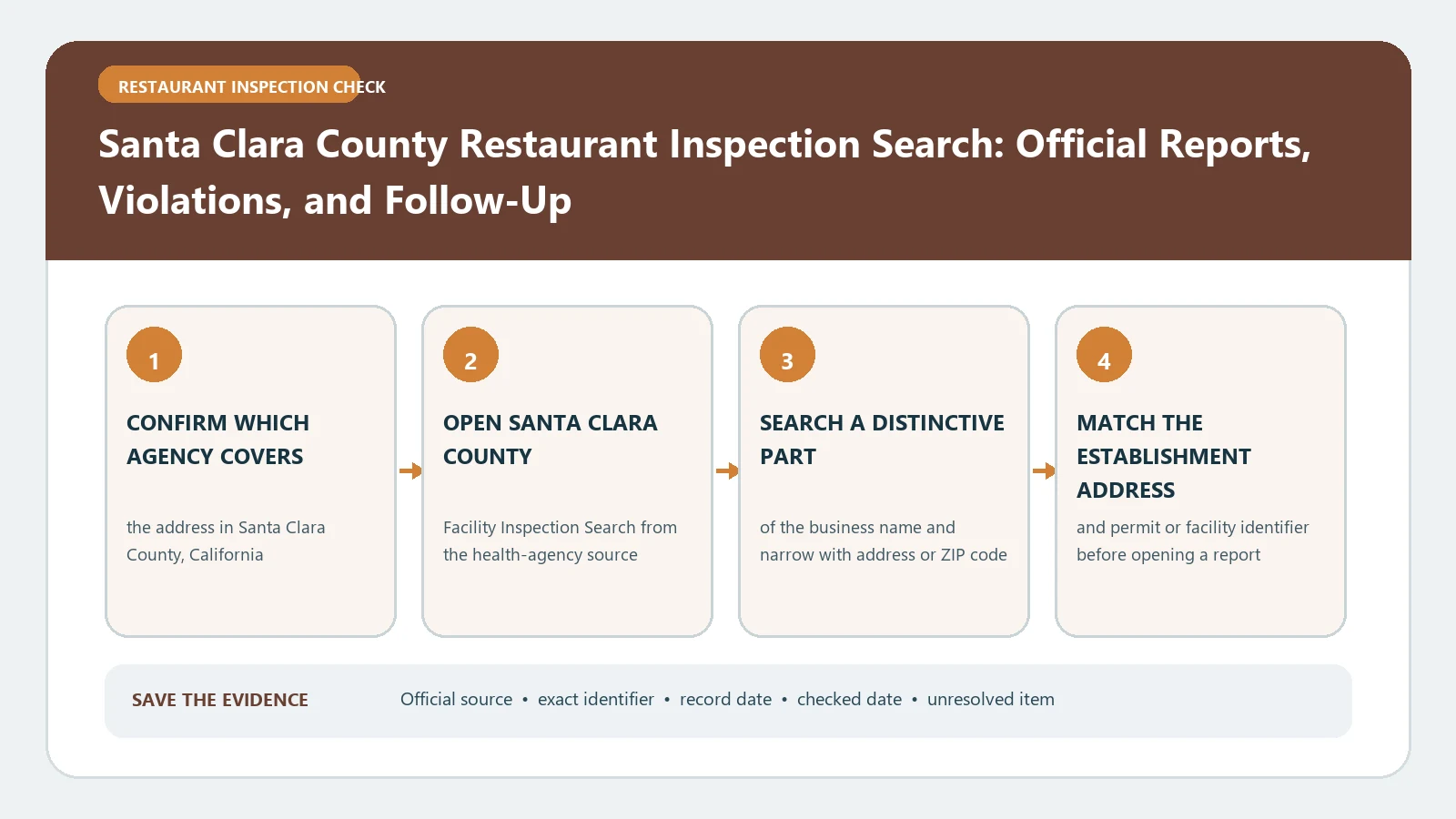
Use Santa Clara County’s SCCDineOut web application to find the exact food facility, then read the placard color, compliance score, inspection activity, violations, and observation date as separate fields. The placard and score measure different parts of the county system, and a past report does not guarantee the kitchen’s condition today.
The County Department of Environmental Health describes SCCDineOut as its official inspection-results application. The live SCCDineOut facility search accepts a facility name and nearby location and displays the county’s current-data notice, placard definitions, scores, activities, violations, and closure records. The county’s placarding and scoring program explains the color system and online numerical scores. These sources were checked August 26, 2026.
Open the web app, not the retired native app
Santa Clara County discontinued the native mobile app and directs users to the browser-based SCCDineOut application. Start from the county explainer page or the official web app. Avoid an old app-store listing or a copied score site, because it may not carry the current county data notice or closure link.
Read the “current as of” date shown by the live application before searching. That date tells you how fresh the displayed dataset claims to be; it is not the inspection date for a particular restaurant. Save both dates separately.
Find the facility and pin the premises
Search a distinctive part of the food-facility name and use the nearby-location field to narrow the result. Verify the complete address and contact details before opening an inspection. A chain location, bakery counter, corporate cafeteria, school kitchen, or restaurant inside a larger property may have a record that differs from the public storefront name.
Keep an identity note with the facility name as displayed, street address, facility detail URL, latest activity date, and lookup date. If two candidates remain, do not choose the higher score. Return to the address and any permit or facility information available on the detail page.
The address-search guide provides a cross-jurisdiction method for resolving suite numbers and aliases, but SCCDineOut remains the evidence for Santa Clara County.
Placard color and compliance score answer different questions
The county explicitly separates placard color from compliance score. The color is driven by major violations and their correction status under the county program. The numerical score represents broader conformity with the California Retail Food Code and is calculated from violation categories. Do not translate one field into the other.
Read the record in this order:
- inspection activity and observation date;
- placard color issued for that activity;
- compliance score, when the activity carries one;
- major, moderate, and minor violation details;
- inspector observations and any later activity.
This order keeps a color change attached to the event that produced it. It also prevents an unavailable score from being treated as zero.
Green, yellow, red, and unavailable are bounded labels
The live app defines green as pass under the program’s major-violation rule, yellow as conditional pass after multiple major violations were corrected during the inspection, and red as closure for an imminent threat that was not corrected during the inspection. It also uses an unavailable state when a placard or score was not issued for that activity or predates the program.
Record the color exactly and retain the activity date. A green placard is not a promise that no minor or moderate violations were documented. A yellow placard should lead you to the later activity rather than to an assumption that the correction remained permanent. A red record should be paired with explicit later reopening or placard evidence before describing the facility as reopened.
Scores belong to routine inspections
SCCDineOut states that scores are associated with routine inspections. Other activities can therefore appear without a comparable score. Do not average an unavailable reinspection score with a routine score, and do not rank a closure activity against a routine visit as though they were identical measurements.
For the routine report, retain the score, violation categories, and observation date. Then look at later activities to see whether the county recorded a reinspection, placard change, or closure-related event. The health inspection report guide can hold those fields without flattening them into one rating.
Follow a conditional pass or closure into later activity
The live app says a yellow placard may be followed by a reinspection within three business days to confirm that major violations remain corrected. Treat that as a county-defined possibility, not a guaranteed appointment. Search the same facility for the next dated activity and record what the county actually published.
Build a short activity chain: original date, placard, major violations, correction wording, later visit date, and later placard. For a red closure, add the closure record and explicit reopening evidence if present. Keep a blank later-event field unresolved when the public application has not yet supplied the answer.
Use the restaurant reinspection guide to organize the chain, while preserving Santa Clara County’s wording and timing.
Account for the app’s data date and closure marker
SCCDineOut warns that the displayed information may not represent the most recent inspection and shows a dataset-current date. It also marks facilities with recent closure activity and provides a separate closure-record view. Those are reasons to recheck the facility detail, not reasons to infer an event that is not shown.
If a known restaurant is missing, try a shorter facility name, nearby address, prior name, and the exact premises. Confirm that the facility type falls within the placarding program. If the app and a posted placard appear inconsistent, save the app date, activity date, facility URL, and what was observed at the premises, then ask County Environmental Health to reconcile the difference.
Leave with a Santa Clara evidence card
Your final card should contain the official facility name, address, facility URL, data-current date, activity date, activity type, placard color, compliance score when applicable, violation summary, later action, and checked date. That is enough for another reader to reproduce the same county search.
The card does not certify present safety, prove every correction remained in place, or replace the county’s permit and closure decisions. Reopen SCCDineOut before a current reservation, complaint, transaction, or public statement. If the premises fall outside Santa Clara County, restart with the city inspection lookup hub rather than carrying this color system into another jurisdiction.