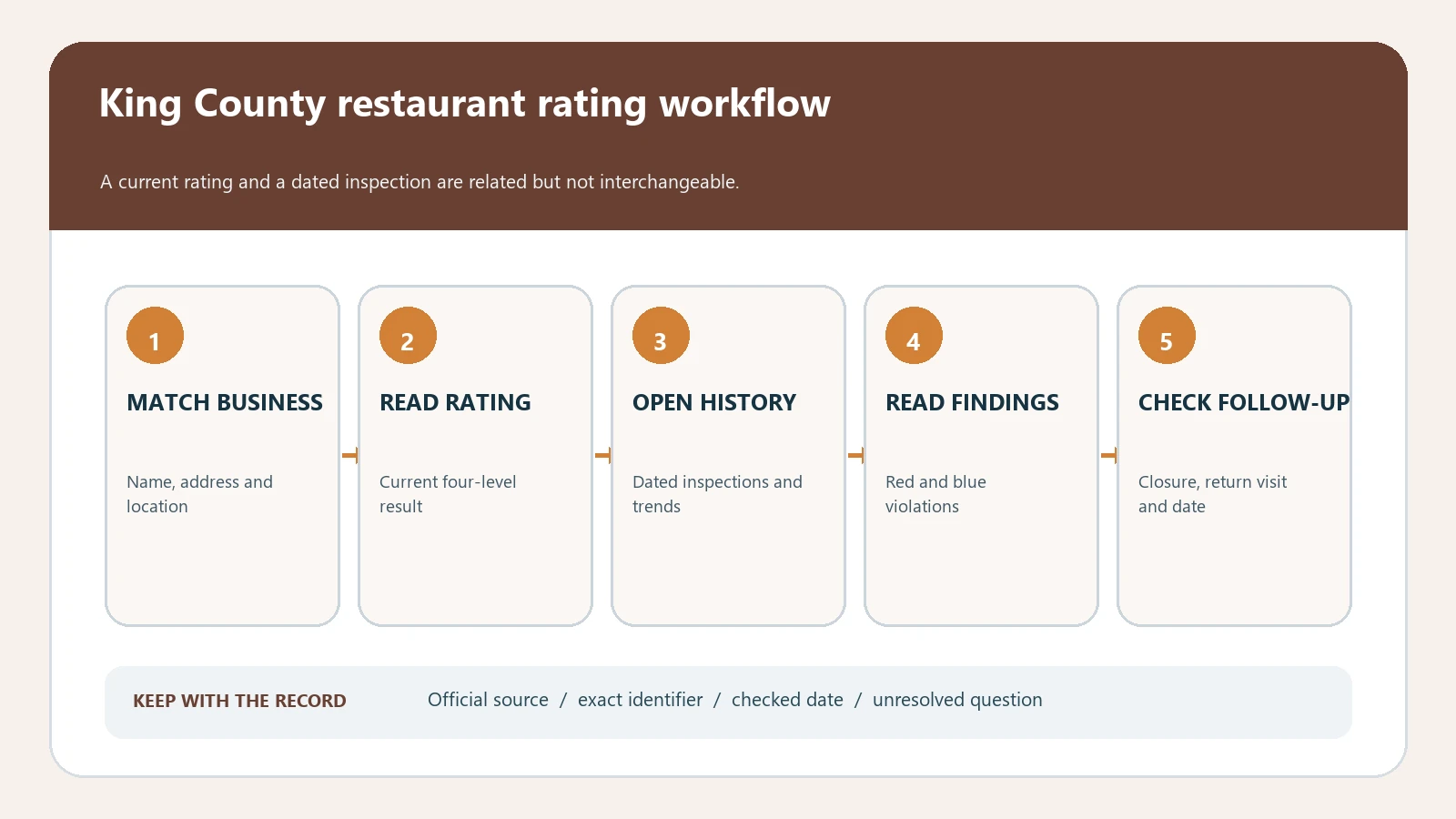
To find a Seattle restaurant inspection, use the Public Health – Seattle & King County Food Inspections and Safety Rating lookup, search the business name or street address, select the exact location on the map, and open History. Read the current rating together with the dated inspection history, facility identity, risk category, return inspections, and any closure or reopening record. King County’s rating reflects a pattern of food-safety performance, not simply the newest visit, and no rating guarantees the conditions at the restaurant today.
Seattle restaurants are inspected by Public Health – Seattle & King County, so the county lookup is the correct official route even when the address is inside Seattle. Search results can include similarly named businesses, multiple branches, mobile units, markets, caterers, or a business that moved. Match the facility before interpreting any symbol or history; a correct rating attached to the wrong outlet is still the wrong answer.
Match the Seattle location before reading its rating
Start with the complete street address. If you search by name, compare every returned address and choose the branch you intend to check. Look for suite, directional, street suffix, and neighborhood differences. A restaurant name can change while the permitted facility record continues, and one address can host more than one permitted operation. Record the business name and address exactly as the county displays them and note the date of your search.
The official page says a user can type the business name or address in the lookup, or navigate the map, then select the business and use the History link. Map proximity alone is not identity. If several markers sit in one building or shopping center, open each candidate until the displayed business and street address agree. For a food truck, caterer, bakery, meat or fish vendor, or other expanded rating category, make sure the permit type describes the operation being researched.
| Identity field | What to compare | Common mismatch |
|---|---|---|
| Business name | Official spelling and any current or former name | A chain name is matched to another branch |
| Street address | Number, direction, street, suffix, suite, and city | A nearby marker or another unit in the same center is selected |
| Operation type | Restaurant, mobile vendor, bakery, caterer, market, or other permitted food business | A separate operation at the address is treated as the restaurant |
| Inspection dates | Chronological visits attached to the selected facility | A cached search snippet is mistaken for the current record |
| Checked date | Date and official result route | A screenshot is shared without enough information to reproduce the search |
Open the inspection history, not just the smiley sign
- Open the official King County rating lookup and search the full restaurant name or street address.
- Select the exact facility after comparing the displayed name and address. Do not rely only on the map marker.
- Record the current food-safety rating and the facility details shown with it.
- Select History and list the recent inspection dates in order, including routine and return visits when identified.
- Read the findings and follow-up as dated events. Keep an initial inspection separate from a later correction or reinspection.
- If the record mentions a closure or the current operating status matters, check the county closure pages for a dated closure and any posted reopening information.
- Save the official link or search path and the date checked; reopen it before making a current claim.
A visible sign is useful at the door, but the online history gives context. A restaurant may have improved after a weak inspection, or a current rating may reflect several visits rather than the single report a searcher first opens. Keep each date, visit type, finding, and follow-up together. Do not combine violations from different dates into one fictional inspection.
How King County’s four ratings work
King County’s food safety rating system page lists four public categories: Excellent, Good, Okay, and Needs to Improve. Excellent reflects consistently high standards for safe food handling; Good means performance above minimum requirements; Okay means minimum requirements were met; and Needs to Improve is associated with a recent closure or repeated return inspections needed to correct unsafe food handling. Use the county’s current wording and scale rather than translating these labels into an A–F grade.
The rating combines trend and scale. For higher-risk establishments, the county explains that the trend can use the average unsafe-food-handling score from the last four routine inspections; lower-risk categories use up to two routine inspections. Different risk categories handle food differently, so their rating thresholds and inspection histories should not be compared as if every facility has the same process. A coffee stand and a complex full-service kitchen can be rated under different risk categories while both remain in the same public system.
| Rating shown | Plain-language reading | What to inspect next |
|---|---|---|
| Excellent | The county describes a consistent record of high food-safety practice | Recent routine dates, underlying findings, and whether the selected outlet is correct |
| Good | The record exceeded minimum food-safety requirements under the county scale | Trend across the relevant routine inspections and any corrected findings |
| Okay | The establishment met minimum requirements under the rating system | Report detail, repeat issues, return visits, and whether the trend changes |
| Needs to Improve | A recent closure or multiple return inspections affected the rating | Closure and reopening record, correction timeline, and newest official history |
| Not rated or no sign | The operation may be outside the rating group or the record may need a different search | Permit type, coverage, temporary-event or farmers-market status, and county guidance |
King County states that temporary-event and farmers-market food vendors are not included in the food safety rating system, even though permitting requirements can still apply. Do not convert “not rated” into “not inspected,” “unsafe,” or “unpermitted.” First identify the vendor type and use the county’s appropriate permit or records route. Conversely, a rating sign indicates participation in the county system but is not a promise that no future problem can occur.
Read the dated history as a sequence
Inspection history is most useful when read chronologically. Begin with the newest routine inspection, then look backward far enough to understand the trend used by the rating. Note return inspections and correction activity after the original visit. An item corrected during an inspection, corrected later, repeated, or still unresolved has a different timeline; summarize only what the official record supports.
Avoid ranking restaurants by copying one count or score into a spreadsheet. The county’s system accounts for risk category and performance over time, and raw numbers can be misleading outside that framework. A better comparison stays within the official rating, confirms matching outlets, uses similar dates, and preserves the actual history. Even then, an inspection is a regulatory snapshot, not a complete measure of food quality, service, popularity, or future safety.
| History element | Record it this way | Avoid this conclusion |
|---|---|---|
| Routine inspection | Date, inspection type, official findings, and status | One visit permanently defines the restaurant |
| Return inspection | Date, reason, linked earlier visit, and recorded outcome | Every earlier issue was corrected unless the record says so |
| Repeated finding | Exact dated entries and county terminology | Similar wording always refers to the same cause |
| Rating change | Old rating, new rating, relevant dates, and history used | The newest visit alone necessarily caused the public category |
| Closure and reopening | Closure date and reason, then separately the authorized reopening date or current status | An old closure proves the business remains closed today |
Check closures and reopenings separately
When a rating or report suggests a closure, open the official King County food business closures page. The county lists closure reasons and, depending on the event, may show the shutdown date, whether the business reopened, the reopening date, and notes. The page also says closure information remains online for at least seven days after approval to reopen, so the current absence of an old event is not proof that no closure ever occurred.
The County’s closure-decision explanation describes immediate-closure conditions and distinguishes critical food-handling concerns from other violations. Use that page to understand the program, not to diagnose a restaurant yourself. A closure record is a dated agency action. Report the reason and status as posted, then check for an authorized reopening. Do not announce that a business is currently closed from an old article, review, or screenshot.
If the restaurant does not appear
Try a shorter business name, the street address without the suite, a former name, and the map around the known location. Check whether the operation is a mobile vendor, caterer, bakery, market counter, temporary event, farmers-market vendor, or a facility permitted under another displayed name. Search nearby results carefully, but never substitute a similar business because it looks likely.
A missing result can reflect spelling, a recent opening or change, portal coverage, permit type, or a search-interface issue. It does not establish that the facility was never inspected or lacks a permit. If the record is important, contact Public Health with the exact name, address, business type, and date range, and ask for the appropriate public-record route. Keep the agency response with the search log.
What this inspection search cannot prove
A King County record can identify the permitted facility, public rating, dated inspection history, and posted follow-up. It cannot guarantee current food safety, predict future handling, prove that every condition was observed, resolve a medical question, or replace a foodborne-illness report. It also does not rate taste, service, value, or general customer satisfaction.
For the broader routing process, use the restaurant inspection check by city guide. The restaurant inspection report guide shows how to preserve dates and findings, while the reinspection and follow-up guide helps separate an initial visit from later corrections. If status is the question, continue with the closure and permit-suspension guide.
Questions Seattle diners and researchers ask
Does Excellent mean a restaurant had no violations?
Not necessarily. The category reflects the county’s rating method and performance trend. Open the dated history to see what inspectors recorded and whether later visits or corrections appear.
Why does King County use several inspections for a rating?
The county designed the rating to reflect food-safety practices over time as well as the scale of performance. The number of routine inspections used depends on the establishment’s risk category.
Is a Seattle restaurant inspected by the City of Seattle?
The public restaurant inspection and rating route is operated by Public Health – Seattle & King County. Use the county’s official lookup for a Seattle address.
Does an old closure mean the restaurant is closed now?
No. Check the official closure entry for a reopening date and verify the newest status. Describe closure and reopening as separate dated events.
King County ratings, inspection histories, closure posts, and portal coverage can change. Verify the live official record before relying on a result. Last reviewed August 6, 2026.