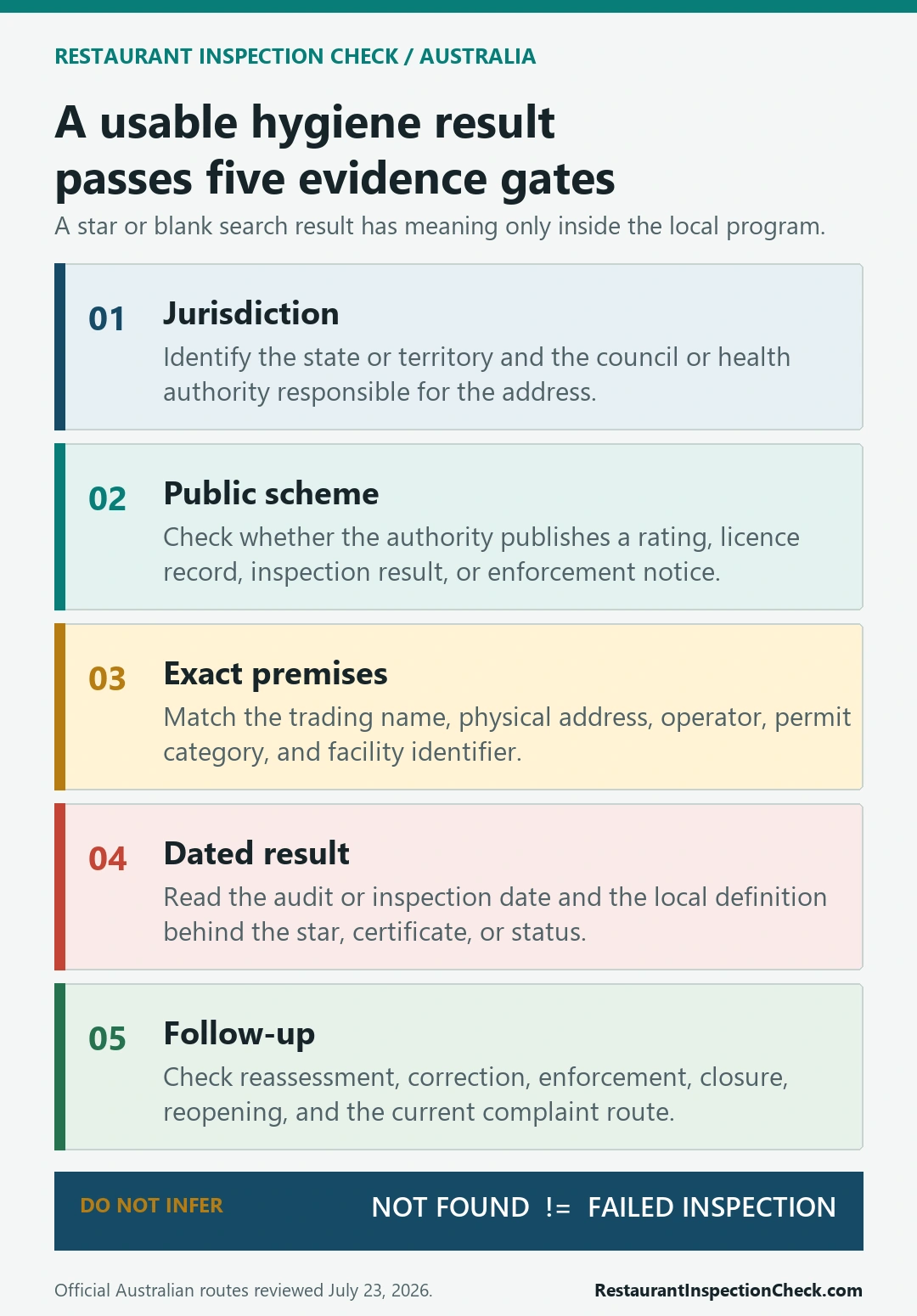
Australia does not have one national public restaurant food-hygiene rating checker. Start with the state or territory where the premises operates, identify the local council or health authority responsible for retail food enforcement, and then check whether that authority publishes a rating scheme, inspection record, licence register, or enforcement notice. A missing listing or certificate is not automatically a failed inspection.
The useful question is not simply, “What is this restaurant’s Australian hygiene score?” It is: “Which authority covers this exact premises, what does that authority publish, and how current is the result?” The answer can differ between councils even within the same state. This guide shows how to make that distinction before you rely on a star, certificate, or search result.
Official source routes and program descriptions were checked on July 23, 2026. Council participation, public-search coverage, display consent, licence status, and inspection outcomes can change. Reopen the live authority record before making a decision.
Start with the state or territory and local authority
Food Standards Australia New Zealand develops and manages the Australia New Zealand Food Standards Code, but it is not the restaurant inspector. The FSANZ explanation of its role says enforcement is handled by state and territory authorities. For many retail restaurants, cafes, and takeaways, the practical inspection or complaint contact is a local council.
Use the FSANZ food regulatory agencies directory to identify the official route. It directs New South Wales users to local councils for hygiene and standards at most retail outlets, Queensland users to local councils for food-business licensing and complaints, and provides the relevant state, territory, council, or health-department contacts for the other jurisdictions.
- Record the full street address, suburb, and postcode of the premises.
- Confirm the state or territory and the council or health authority covering that address.
- Look for an official rating search, food-business register, inspection page, or enforcement register.
- Search by address as well as the trading name, then match the licensed operation.
- Read the program’s coverage and publication rules before interpreting a blank result.
If an official page is difficult to locate, use our international restaurant inspection sources guide to identify the public authority, then return to that authority’s current website. A review platform, delivery app, map listing, or restaurant website cannot substitute for the regulator’s record.
Separate regulation, inspection, rating, and public display
Four different things are often compressed into the phrase “food hygiene rating Australia.” They should be checked separately. A business can be regulated and inspected even where the authority does not publish a consumer-facing score. A council can assign an internal or program rating while public display remains optional. An enforcement notice is also different from a routine inspection score.
| Evidence layer | Question it answers | What it does not prove |
|---|---|---|
| Regulatory responsibility | Which council, health department, or state authority covers the premises? | That a public rating database exists |
| Licence or registration | Which operator and activity are recorded at the address? | The current hygiene condition on its own |
| Inspection or audit | What was assessed on a dated visit? | That the result is published as a star or certificate |
| Public rating or display | What the local program permits consumers to see | Direct comparison with another council’s scale |
| Enforcement and follow-up | Whether the authority recorded action, correction, closure, or reopening | A live guarantee about conditions after the recorded date |
This separation prevents two common errors: treating “not published” as “not inspected,” and comparing stars or certificates issued under different local rules as if they were a national grade. The official-source versus review-site guide provides a quick source test when search results mix council pages with commercial listings.
Match the exact premises and licensed business
A restaurant’s storefront name may differ from the licence holder or the name used in a council dataset. One brand may have several branches, a hotel may contain more than one licensed food operation, and a new owner can trade at an address that still appears under an earlier record. Search the address first when the name is ambiguous.
Match the street number, suburb, postcode, business name, licence or permit category, and any facility identifier shown. Then record the date of the search. Our restaurant inspection search by address guide explains how to work through spelling variations, former names, shopping-centre units, and multiple results without choosing the nearest-looking branch.
- Exact match: the trading name and physical address point to the intended premises.
- Probable match: the address is correct but the legal or former name differs; verify with the authority or licence detail.
- Wrong match: the same brand appears at another suburb, shopping centre, or council boundary.
- No match: stop and check coverage, spelling, licence eligibility, and publication rules before drawing a conclusion.
Example: Brisbane’s Eat Safe rating and public record
Brisbane City Council runs a local program called Eat Safe Brisbane. Council says every licensed food business in Brisbane receives a star rating following an audit. Five stars means full compliance with the assessment criteria, four indicates a high standard, three indicates a good standard, and two or no stars reflect poorer compliance under the local program.
Public availability is a separate question. The Council food safety ratings page explains that public display is not mandatory, only licensable food businesses receive a rating, and a business can be absent or not show a rating for several reasons. The official Eat Safe search lets consumers search by all or part of a business name or address, suburb, category, and selected star levels.
Council’s Food Safety Permits open dataset is another official route. It lists current permit records with fields such as business name, business address, permit category, and Eat Safe rating where published. The dataset is licensed under CC BY 4.0 and records its own update date, so save that date with any conclusion.
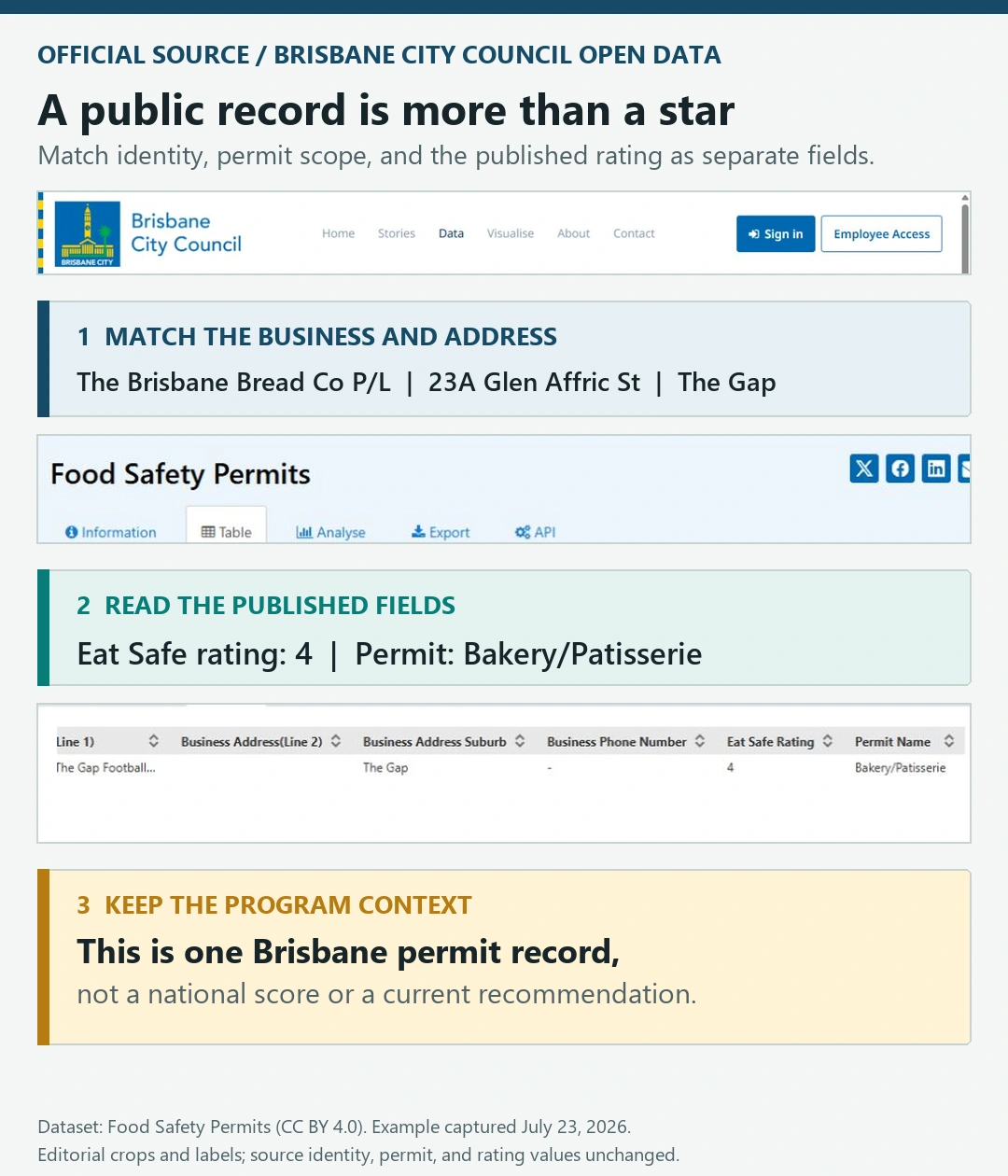
Do not translate a Brisbane star directly into a score used elsewhere. Treat it as evidence within the Eat Safe Brisbane framework, for the matched premises and the date available. Use the program explanation alongside the result rather than reading the number in isolation.
Example: NSW Scores on Doors is voluntary
New South Wales provides a different example. The NSW Food Authority consumer brochure explains that Scores on Doors operates through participating local councils and is voluntary. Participating restaurants, cafes, and takeaway businesses can receive a certificate after a routine inspection when they meet the program threshold.
That means the absence of a Scores on Doors certificate is not, by itself, proof of a poor inspection result. The council may not participate, the business may not participate, the operation may sit outside the program’s scope, or the current certificate may not be displayed. First confirm that the relevant council and business type are covered, then ask the council what public record is available.
The broader food hygiene rating check guide is useful after you identify the correct local scheme. Do not combine the Brisbane and NSW examples into one national scale: they demonstrate why the program rules belong beside the visible rating.
Read the date, scope, and follow-up together
A rating is a compressed description of a dated assessment. Check what the visit covered, whether the page states an audit or inspection date, whether a later reassessment exists, and whether an enforcement, closure, correction, or reopening record changes the picture. A high historical rating is not a guarantee of today’s conditions, and an older adverse result should not be presented as current after documented correction.
| Read together | Why it matters |
|---|---|
| Authority and program | Defines the geographic coverage, legal role, and rating method |
| Premises identity | Prevents a result from another branch, operator, or address being used |
| Inspection or audit date | Shows when the recorded observation was made |
| Rating, findings, or status | Explains the result under that program’s own definitions |
| Later follow-up | Shows correction, reassessment, enforcement, closure, or reopening where published |
| Search and dataset update date | Lets another reader reproduce the same evidence window |
Save the result URL, a dated screenshot if appropriate, the exact search terms, and the premises details. Use the food hygiene rating checklist to record what you verified. A screenshot is supporting evidence, not a substitute for the live authority page.
What a missing listing or rating can mean
“Not found” is an unresolved search result, not a hygiene verdict. The Brisbane Council page, for example, lists possibilities such as a one-off temporary licence, a business outside the Brisbane City Council area, an operation that is not licensable under that scheme, or an unlicensed operator. It also explains that public star display is not mandatory.
- Remove extra words and search part of the trading name.
- Search the full street address and suburb.
- Check the council boundary and whether another authority licenses the operation.
- Read the program eligibility, participation, and publication rules.
- Contact the responsible authority with the exact premises details if the record remains unclear.
The food hygiene rating checker guide covers additional search recovery steps. Do not publish a claim that a restaurant failed merely because a voluntary certificate or publicly disclosed star is absent.
Report a current food-safety concern
A historical rating search is not the right channel for a current illness, contamination, allergen, hygiene, or unsafe-handling concern. The FSANZ food complaint guidance directs consumers to the state or territory authority or local council that investigates and enforces the Food Standards Code.
Record the business name and address, date and time, food involved, what was observed, purchase evidence, and any relevant medical advice. Use the official complaint channel promptly. For urgent medical symptoms, seek appropriate medical help rather than waiting for a database update or council response.
Australia food hygiene rating questions
Is there a national food hygiene rating website for Australia?
No single national public checker covers every Australian restaurant under one rating method. Identify the state or territory and responsible council or health authority, then use the public source that authority provides.
Does every inspected restaurant have a public star rating?
No. Inspection, rating, publication, and display are separate. The local program may not publish a score, participation may be voluntary, or public display may depend on eligibility or business consent.
Does no search result mean the restaurant failed?
No. It can reflect the wrong authority, a spelling or trading-name mismatch, a council boundary, a business outside the scheme, a temporary or non-licensable operation, voluntary participation, or publication limits. Resolve coverage before interpreting the absence.
Can Brisbane and NSW ratings be compared directly?
No. Eat Safe Brisbane and NSW Scores on Doors operate under different local arrangements. Read each program’s definitions, eligibility, publication rules, and date instead of treating the visible stars or certificate as a national scale.
What should I save from an official search?
Save the responsible authority, program name, exact premises and operator match, licence or permit identifier if shown, result and visit date, later follow-up, search URL, search terms, and the date you checked the source.
Sources and review date
- FSANZ: food regulatory agencies
- FSANZ: what we do
- FSANZ: food complaints
- Brisbane City Council: food safety ratings
- Brisbane City Council: Food Safety Permits open data
- NSW Food Authority: Scores on Doors consumer guide
Reviewed July 23, 2026. Restaurant Inspection Check is an independent research guide. It does not inspect food businesses, issue ratings, or represent FSANZ, Brisbane City Council, the NSW Food Authority, or another regulator.