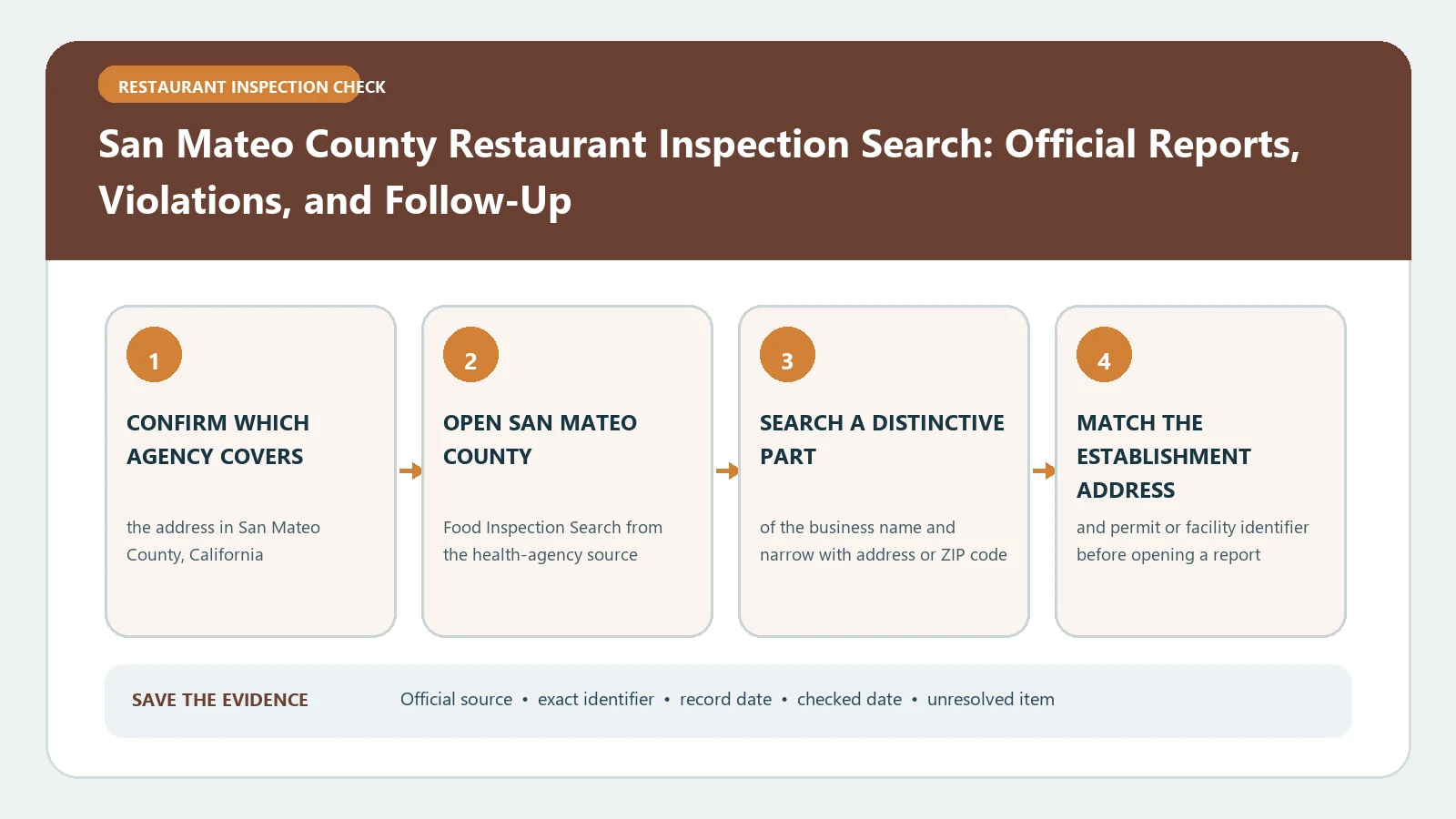
Use San Mateo County’s inspection report search for a restaurant’s inspection history, and use the County’s separate closure and administrative-hearing page to check facilities currently listed for serious or repeated violations. Match the address before reading a green, yellow, or red placard. The closure page is not a historical archive, so absence from that list does not erase an earlier closure.
Checked August 26, 2026 against the current routes published by San Mateo County Health, Environmental Health Services, San Mateo County Environmental Health Services, San Mateo County Health, Environmental Health Services, San Mateo County Health, Environmental Health Services.
History and current closure status live on different pages
| Question | County source | Important limit |
|---|---|---|
| What inspections are recorded for this premises? | Inspection report search | Match the facility and open dated reports |
| Is the facility on the current closure/hearing list? | Closures and Administrative Hearings | The County says businesses are removed after correction and historical information is not maintained there |
| What does the posted color communicate? | Examples linked from Food Safety | The placard summarizes a disposition; read the report for the observed violations |
Match the facility before trusting the placard
- Search the restaurant name and compare the returned street addresses.
- Open the facility record and copy its identifier, address, and newest inspection date.
- Check whether the same premises appears on the closure page.
- Keep the placard color with the report that produced it, not with an undated screenshot.
- Open any later inspection or reinstatement before describing the facility’s current listed status.
Green, yellow, and red are dispositions, not permanent labels
San Mateo County’s placarding materials use green for Pass, yellow for Conditional Pass, and red for Closed. The current 2026 placard material explains that a closed facility must remain closed until written permit reinstatement is issued. A later official event can therefore change the facility’s status; preserve both dates.
| Placard | Record meaning to retain | Next evidence |
|---|---|---|
| Green / Pass | Pass disposition for that inspection | Read any documented violations and later visits |
| Yellow / Conditional Pass | Conditional disposition requiring the related report | Find the County’s follow-up and resulting placard |
| Red / Closed | Operating permit suspended for the recorded condition | Written reinstatement or later reopening evidence |
The closure list deliberately drops corrected entries
The County closure page says businesses remain listed until the violation is corrected and are removed on the next update. It also says historical information is not maintained on that page and that self-closures independent of an inspection are not listed. Treat the page as a current enforcement view, not a complete historical database.
- Listed now: record the business, address, closure date, reason, and page-check date.
- No longer listed: inspect the facility history and request older reports before concluding there was no closure.
- Closed independently of a County inspection: the closure list may not contain the event.
- Name changed at the same address: search both identities and separate the operators by date.
Request the report when the portal cannot supply it
San Mateo County’s Food Safety page says that if the report is not found, you can request copies by emailing [email protected] or calling 650-372-6200. Include the exact address, business and former names, approximate date, and whether you need the inspection, closure, or reinstatement record.
| Request detail | Why it helps |
|---|---|
| Facility address and suite | Separates similarly named businesses |
| Current and former names | Finds records across an ownership or brand change |
| Inspection or closure date range | Identifies the missing event |
| Document type | Distinguishes report, hearing, closure, and reinstatement material |
| Portal search attempted | Shows why the online route was insufficient |
Write the result as a sequence, not a color verdict
The defensible sequence is: inspected on a stated date, received the stated disposition, had the stated violations, and later received the stated follow-up or reinstatement. A placard alone does not prove conditions today.
For a broader explanation of violation and correction fields, use Food Inspection Reports and Violations. If the address falls under another Bay Area agency, return to Restaurant Inspection Check by City.
Separate inspection, closure, and reinstatement dates
A red placard may be connected to several dated records: the inspection that identified the condition, the suspension or closure action, and the written reinstatement that permits reopening. Put each event on its own row even when they occur close together. The current closure page can confirm a present listing, but the facility history or requested documents are needed to reconstruct a past sequence after the listing is removed.
| Event | Primary evidence | Statement it can support |
|---|---|---|
| Inspection | Dated facility inspection report | What the inspector documented at that visit |
| Closure | Red placard, suspension, or County closure record | The official action and its date |
| Correction | Follow-up report describing the corrected condition | What the later inspector verified |
| Reinstatement | Written permit reinstatement or reopening record | When the County allowed operations to resume |
| Current-list removal | Later version of the nonhistorical page | Only that the business is no longer displayed there |
Explain an empty closure search without erasing history
Use precise wording: the facility was not shown on the County’s current closure page on the date checked. Then say whether you also reviewed the inspection-history portal or requested older closure and reinstatement records. This avoids the unsupported leap from not currently listed to never closed. For a due-diligence file, retain the page-check date because tomorrow’s list can differ after a correction update.
When the same address has a new operator, label the ownership boundary beside the dated events. Preserve the premises history, but do not attribute a former operator’s closure or correction work to the current business without an official record connecting them.