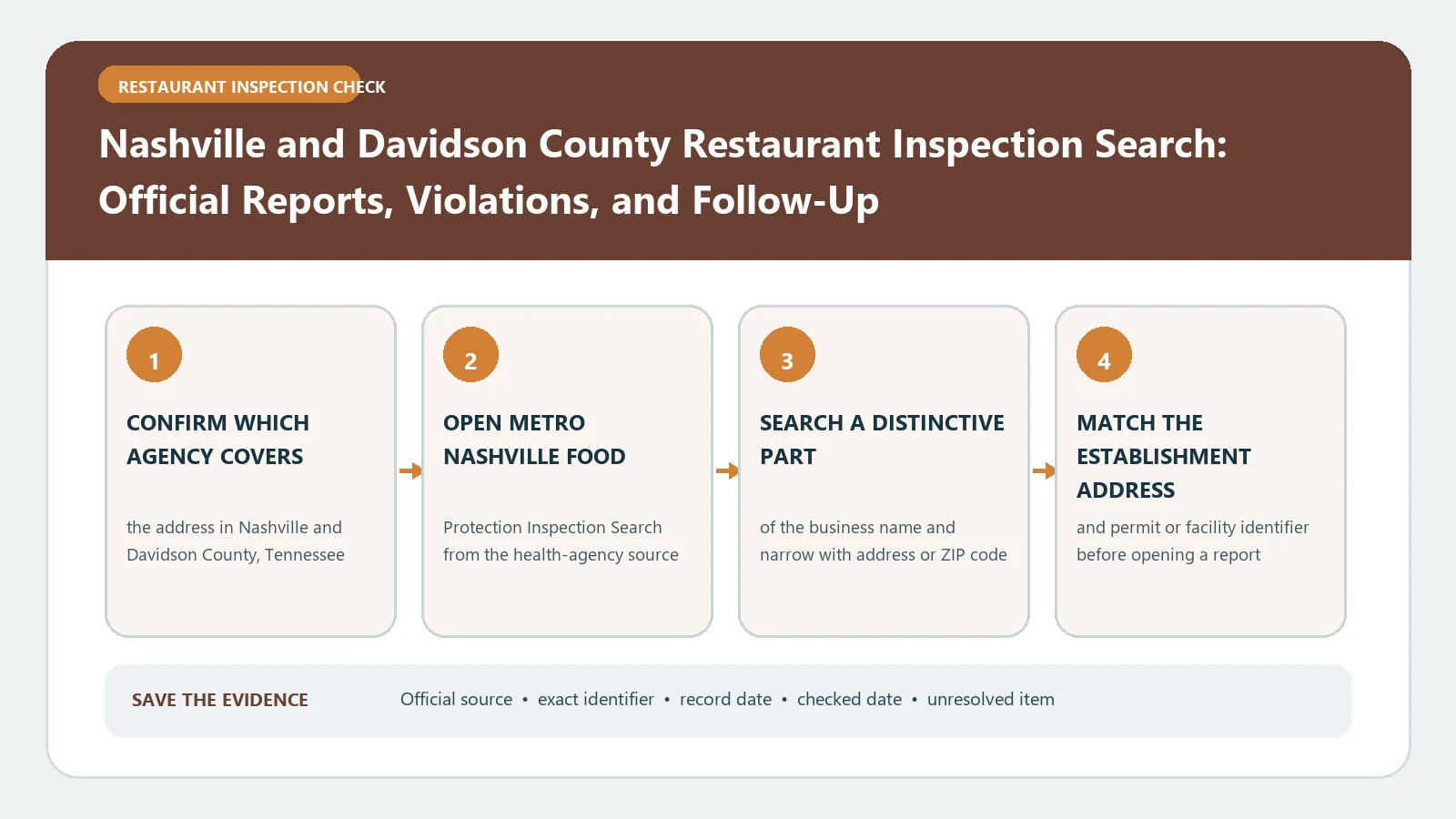
For a Nashville restaurant, start with Metro Public Health’s Food Protection Services and verify that the address is in Davidson County. Then open the inspection-report route linked by the agency and build a dated visit history. A Tennessee food business may be regulated by a different program if it is a retail store rather than a restaurant, so the business type comes before the score.
Metro’s Food Protection Services page identifies the local program and explains its scoring and correction rules. The Tennessee Department of Health Environmental Health page supplies the statewide inspection-report route and explains program and complaint boundaries. These official sources were reviewed August 26, 2026.
Decide whether Metro Health owns the record
Metro Public Health inspects Davidson County food service establishments such as restaurants, snack bars, and school cafeterias. Tennessee also separates restaurant oversight from some retail-food-store oversight. A grocery store, convenience market, or food operation inside a retail business may lead to a different agency record.
Write down the physical address and the kind of operation before searching. Do not route the record solely from the mailing city, brand, or word restaurant in a search result. If the address is outside Davidson County, find the health department that serves that location. If the business is a retail store, confirm whether the Tennessee Department of Agriculture rather than the restaurant program controls the inspection.
Match the permitted establishment, not just the sign
Begin with a distinctive part of the name and verify the complete address. Retain any permit, establishment, or facility identifier in the result. Food halls, hotels, universities, hospitals, and shared kitchens may contain several separately inspected operations. A former operator at the same address is not automatically part of the current restaurant’s history.
A reproducible Nashville identity record includes:
- the official establishment name;
- street address and ZIP code;
- facility or permit number, when available;
- inspection date and visit type;
- score and report link;
- the date the official source was checked.
If two results remain plausible, do not average their scores or merge their violations. Keep both candidates unresolved until another official field distinguishes them.
Interpret the Metro deduction system
Metro describes a 0–100 scale. Non-priority violations deduct one or two points, while priority violations deduct four or five points. The point total is only the start of the reading. Open the report and separate the item observed, its priority, whether it was corrected immediately, and any deadline or later action.
Priority items must be corrected immediately or within ten days according to the Metro program page. Administrative action can follow when critical problems are not corrected within the required period or when critical violations repeat on three consecutive routine inspections. Those are local rules; do not import a grade band or closure threshold from another city.
For unfamiliar report language, the food inspection violations guide explains how to keep observations, correction notes, and later visits separate while the Metro source controls the actual meaning.
Keep the score apart from permit and enforcement status
A numerical inspection score and an administrative action are related but distinct fields. The score summarizes deductions on a visit. A warning, scheduled return, suspension, or other administrative step records what the agency did next. Do not relabel a lower score as closed unless the matched official record states a closure or suspension.
The same care applies to an apparently strong score. Read the priority findings and correction notes because one total can hide the sequence that matters to the user. When Metro records immediate correction, preserve that wording and the inspection date. When a deadline appears, leave the outcome open until a later official event answers it.
For a due-diligence note, quote the local field names and place the score, priority item, deadline, and administrative status in separate columns. This makes it possible to update one later event without altering what the earlier report documented.
Build the correction clock from published events
Create one row for every official visit. Start with the routine inspection, then add a reinspection, complaint visit, or enforcement event only if the source publishes it for the same facility. Preserve the original score and findings even when a later visit records correction.
Use four columns that do not collapse into one another: observed on, correction stated, deadline stated, and later agency action. If the report says a priority item was corrected during the inspection, record that fact. If it provides a ten-day correction window, record the due window but wait for the later report before claiming the agency verified compliance.
The restaurant reinspection check provides a general chronology method. It does not replace Metro’s report or create a follow-up result that the agency has not published.
Repair a missing or conflicting search
When no result appears, try the address without suite punctuation, a shortened business name, a legal operator name, and a prior name. Confirm that the address is actually in Davidson County and that the facility type belongs to Metro’s food-service program. A new operator may have a new permit even when the storefront did not move.
If the Metro page and statewide route appear to disagree, save screenshots or exact result fields with the lookup time, then contact the responsible program with the establishment identity and inspection date. Do not resolve a conflict by choosing the higher score or the newer-looking website. One page may be the program explanation while another is the current report interface.
State only what the Nashville record supports
The final note should name Metro Public Health, the matched establishment, the latest visible visit date, score, priority findings, and any later published correction or administrative action. Mark missing follow-up as not found in the checked source, not as proof that none occurred.
An inspection report documents conditions observed at a particular time. This does not mean the restaurant is safe today, and the report does not settle an active complaint. Reopen the official report before relying on it for a current decision, and use the health inspection report guide to preserve the source, fields, and caveat in a shareable record.