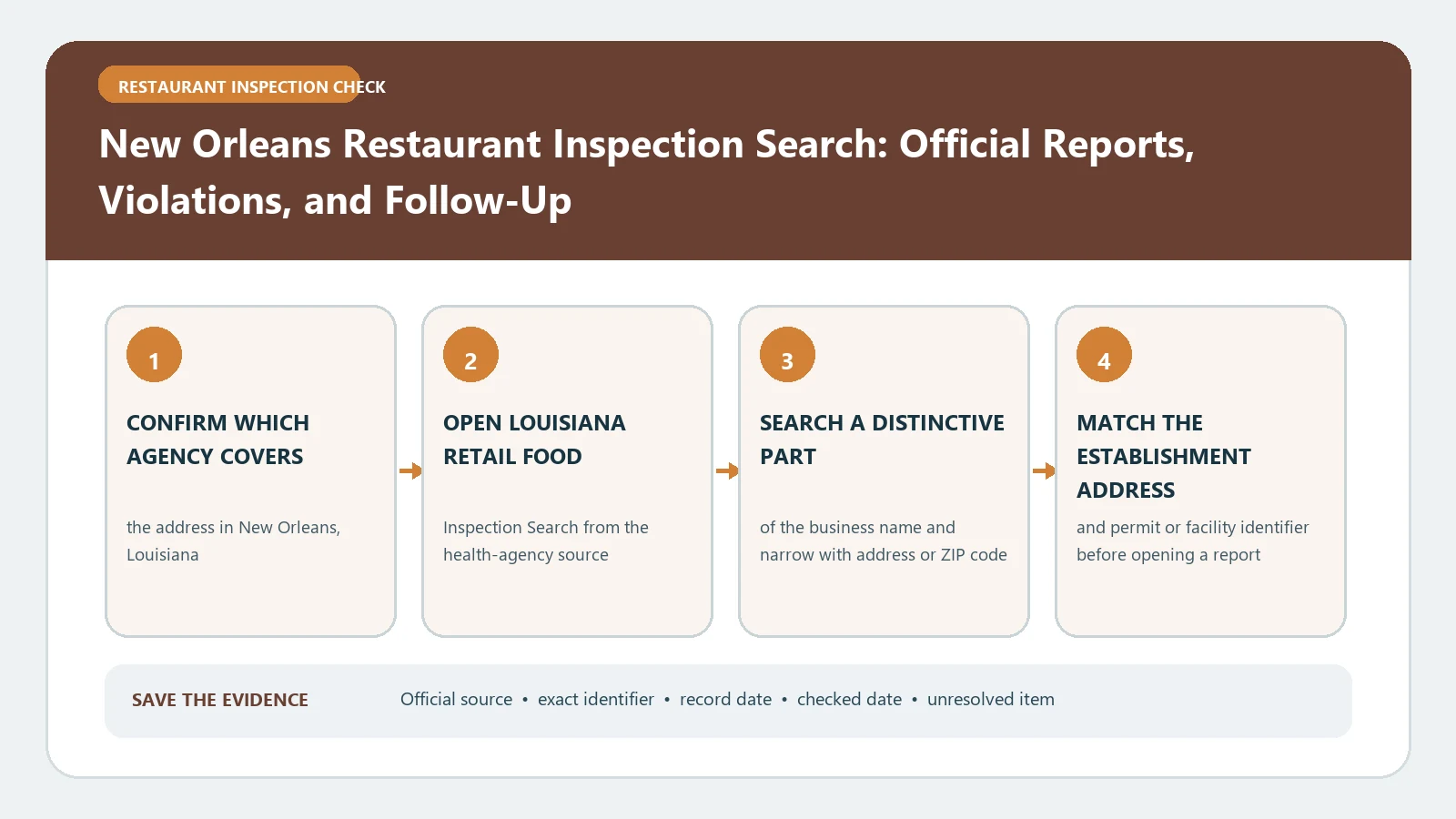
New Orleans restaurant inspections are searched through the Louisiana Department of Health retail-food system. Match the facility by legal or displayed name and street address, allow for the state’s publication delay, then trace every visit type in date order. A blank search during that delay and a single historical violation both need more context.
The state’s Retail Food Inspections page explains the dashboard, visit types, risk-based frequency, violation categories, and reporting delay. The Louisiana Retail Food Program identifies the permitting and inspection program and routes unresolved inspection or complaint questions to public health sanitarians. Both sources were checked August 26, 2026.
Enter through Louisiana’s retail-food program
Use the state health page rather than a third-party grade list. Louisiana’s dashboard covers retail-food operations statewide, so New Orleans is a location filter inside the state system rather than a separate city scoring universe. Confirm that the result is a restaurant or relevant retail-food facility and not another operation with a similar name.
Before searching, collect the street number, street name, ZIP code, and any legal business name visible on a permit or receipt. In a hotel, casino, market, food hall, or institution, several food operations can share one property. The official facility identity must connect the report to the restaurant you mean.
Make room for the seven-day posting window
Louisiana says the inspection site is updated daily but uses a seven-day delay before publishing inspections so reports can be checked for accuracy. When an inspection is known to have occurred recently, record the visit date and your search date. Wait through the stated delay before treating the online absence as a records problem.
The delay also changes how to describe the latest result. Say latest published inspection found in the dashboard, not latest inspection performed, unless the agency confirms both are the same. A current storefront notice may be newer than the public database for several days.
Use risk frequency as context, not as a predicted date
Louisiana explains that establishments are assigned a risk category and may be inspected from one to four times per year depending on the operation. That range helps explain why two facilities can have different numbers of routine visits. It does not create a public appointment calendar for one restaurant.
Do not calculate a missing inspection by dividing a year into equal periods. Instead, list the routine dates the dashboard actually publishes and note the facility’s visible visit types. A complaint visit or pre-opening inspection should not be counted as a scheduled routine visit unless the agency labels it that way.
If the apparent gap is longer than expected, confirm that the facility did not change name, permit, address, or status. Then ask the local sanitarian whether an older record sits outside the dashboard or under another identifier. Record the agency response as a separate source note rather than silently filling the date.
Keep the four visit types distinct
The state identifies routine, reinspection, pre-opening, and complaint inspections. Those labels tell you why the inspector was there. They should not be merged into one average score or treated as interchangeable evidence.
Build a Louisiana history card for each visit:
- official facility name and address;
- inspection date and visit type;
- critical and non-critical findings shown;
- correction or compliance language in the report;
- later visit that refers to the earlier finding;
- source URL and lookup date.
A pre-opening visit answers a different question from a routine inspection. A complaint inspection indicates the visit context, not that every allegation was proven. A reinspection should be connected to the earlier report it follows. The restaurant report guide can hold these fields without changing the state’s labels.
Read critical findings beside later action
Louisiana divides violations into critical and non-critical categories. The agency explains that critical violations are more likely to contribute directly to contamination or illness if left uncorrected. Non-critical items are not directly related in the same way but may become more serious when neglected.
Do not stop at the category. Read what was observed, whether the report records correction during the visit, and whether a later reinspection or other action appears. Keep the original finding even after a later report documents improvement. The history should answer what the agency observed on each date, not rewrite the past using the newest event.
For a complaint-related visit, use the complaint and inspection record guide to separate the submitted concern from the public inspection finding. The official Louisiana record controls whether the inspection was classified as complaint and what the inspector documented.
Resolve names, operators, and dashboard gaps
If a New Orleans search returns nothing, shorten the facility name, search by street number, remove punctuation, and try a legal operator or former trade name. Check whether the location changed ownership. A new permit can divide the history even when the restaurant name or address looks familiar.
When the dashboard and a local file differ, preserve both exact records and contact the public health sanitarian for the facility’s area. Louisiana warns that electronic entries can differ from reports maintained by local Office of Public Health locations. Do not silently choose one result or combine fields from two facilities.
Records older than the dashboard’s available range may require an agency request. State what the online system did and did not show, including the dates searched. An unsuccessful query establishes only that the chosen terms did not produce a visible match at that time.
Close with a source-dated finding
Your conclusion should identify the Louisiana Department of Health as the source, name the matched New Orleans facility, and state the latest published visit type and date. Add the critical or non-critical findings and any later published action without turning them into a private safety rating.
Louisiana describes each inspection as a snapshot. The report does not guarantee current conditions, popularity, or future compliance. Before visiting, filing a complaint, or publishing a claim, reopen the official dashboard after the seven-day window and check whether a reinspection or newer event has appeared. The reinspection follow-up guide helps keep that final check tied to the earlier report.