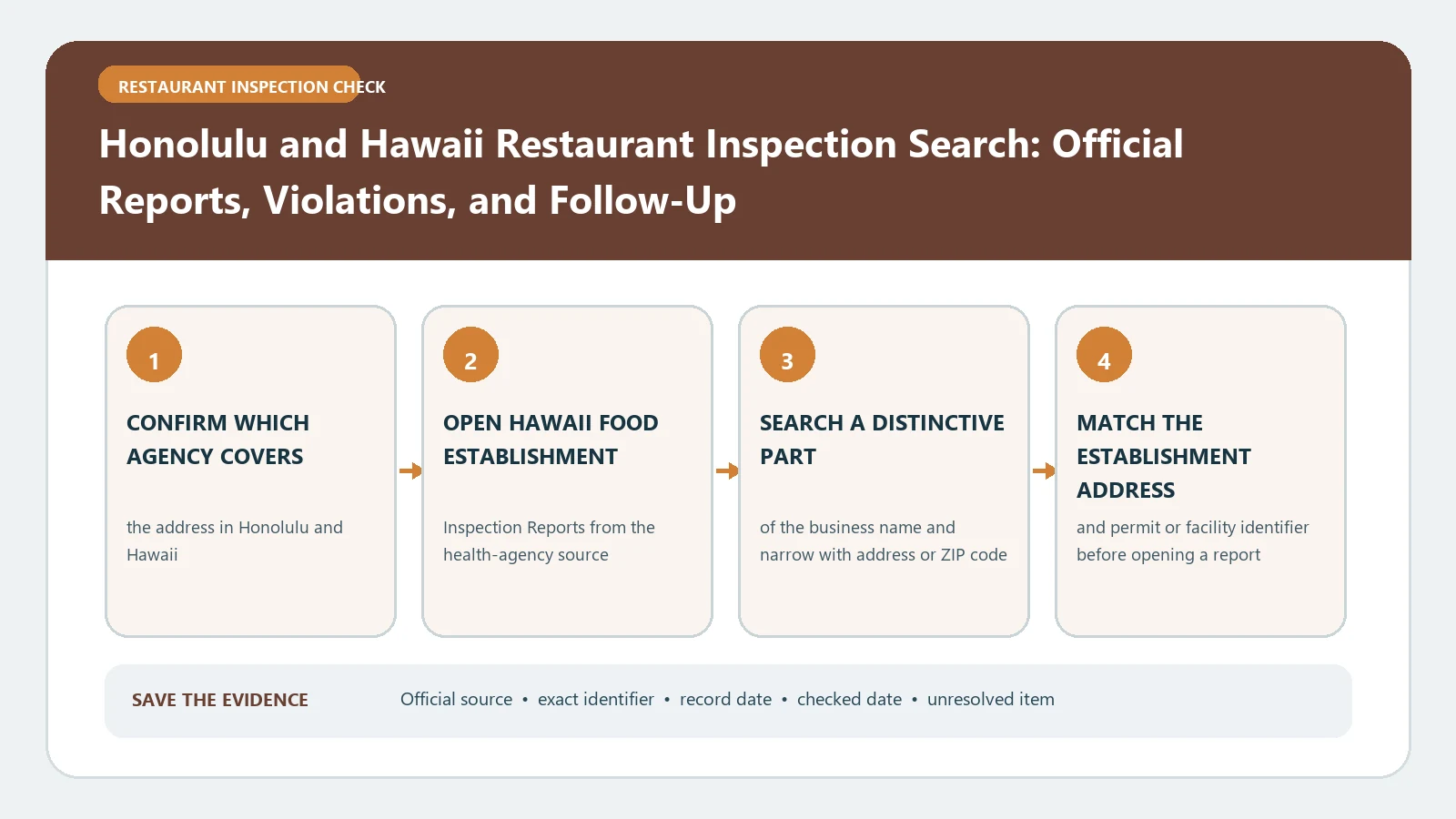
For a Honolulu or Hawaii food establishment, use the state’s current inspection-history portal, confirm the island and street address, and connect the latest placard to the inspection and follow-up that produced it. Hawaii’s green, yellow, and red placards describe the outcome of a regulatory process at a particular time. They are not permanent ratings and should never be separated from the dated report.
The Hawaii Department of Health Food Safety Branch says that past inspections are now available at the State of Hawaii inspection portal. The branch’s current page documents the vendor transition and points users to this replacement route. A June 2026 Honolulu conditional-reopening notice also shows how a red closure, a follow-up inspection, and a yellow conditional status can occur in sequence. Sources were checked August 26, 2026.
Use the replacement inspection portal
Older Hawaii articles and bookmarks may still lead to hi.healthinspections.us. Do not assume that an old portal is complete simply because it loads. The Food Safety Branch announced a vendor change and, as of the checked date, directs the public to inspections.myhealthdepartment.com/soh for past inspections.
Start from the state branch page when possible, then follow its inspection link. This confirms that you are using the current public route rather than an unrelated review site or an abandoned vendor page. Save the final portal URL and the lookup date because Hawaii can change vendors, search paths, or report availability again.
If your question concerns a different local system, use the inspection directory by city and jurisdiction rather than applying Hawaii’s placard meanings elsewhere.
Match the island, address, and establishment
A restaurant name alone can produce the wrong result across Oahu, Hawaii Island, Maui, Molokai, Lanai, or Kauai. Enter the most distinctive part of the facility name, then compare the physical address and island. For a hotel, food court, market, or resort, look for the specific permitted food operation, not just the property name.
Build a match card before opening a report:
- name exactly as displayed in the state portal;
- street address, unit, city, and island;
- permit or facility identifier when shown;
- facility type if the result distinguishes restaurant, market, mobile unit, or another operation;
- current placard or inspection status and the date attached to it.
If two results share an address, do not merge them. A hotel kitchen, pool bar, banquet operation, and independent tenant may each have a separate inspection history. If ownership changed, the older report may belong to the prior operator even though the sign outside looks similar.
Read the visit history before the placard color
Open the latest inspection, then move backward far enough to understand what changed. Record the inspection type, date, cited observations, correction language, and any linked report. If the portal provides a printable report, preserve that report’s facility identity with the date rather than saving an unlabeled screenshot.
Next, look for a follow-up tied to the same establishment. A yellow placard may lead to a later green placard after the Department verifies corrections. A red closure may lead first to a conditional reopening and later to another visit. Reading only the most recent color can hide the event that caused the follow-up; reading only the original closure can hide an authorized reopening.
The restaurant report field guide gives a general way to organize dates, findings, and dispositions, but Hawaii’s report labels remain controlling for a Hawaii record.
Treat green, yellow, and red as different regulatory states
The Food Safety Branch’s placard program uses green for a passed status, yellow for a conditional pass, and red for a closed status. The exact basis must come from the official report and the current rule, not from color alone. The 2026 Honolulu notice illustrates the distinction: the Department closed a facility after an imminent health hazard, later found that hazard resolved, and allowed conditional reopening while other critical violations remained pending.
That sequence shows why a yellow placard should not be described as either fully cleared or automatically closed. It permits operation subject to the Department’s stated conditions and follow-up. A red placard means the establishment must remain closed until the Department authorizes a change. A green placard records the outcome of the applicable inspection process; it does not guarantee that conditions will remain unchanged after the inspector leaves.
Follow the placard to the next official action
When a report shows a yellow or red result, create a short event line for every later action:
- record the inspection or complaint date that triggered the placard;
- copy the cited condition and any required corrective action;
- locate the next follow-up inspection for the same facility;
- note the placard or operating status after that visit;
- repeat until the public record reaches a clear current state or becomes unresolved.
Use the closure and permit-suspension check to keep closure, conditional reopening, and final follow-up separate. Never infer reopening from social media, a delivery listing, or normal business hours when the state record still shows a closure question.
Request a report when the online history is incomplete
The current Food Safety Branch page lists report-request contacts by island. If an expected report is absent, the search produces only a current status, or the vendor transition left a gap, contact the branch serving that island. Give the establishment name, exact address, island, approximate inspection date, and any facility identifier. Ask for the specific report period rather than requesting every record without a reason.
For Oahu, the branch page provides its report-copy route; it also lists phone contacts for Hawaii Island, Maui, Molokai, Lanai, and Kauai. Recheck the official contact page before calling because offices and procedures can change. A blank web result is a reason to verify coverage, not evidence of a passing inspection.
Keep a Honolulu and Hawaii evidence note
Save the matched identity, island, inspection dates, placard sequence, cited observations, follow-up status, current portal URL, and checked date. State whether the latest visible result was green, yellow, red, or unclear, and identify the visit that supports that statement.
The narrow conclusion is that the Hawaii Department of Health’s public sources displayed a particular inspection and placard history for the matched facility on the retrieval date. It does not certify today’s kitchen conditions, prove that no unposted inspection exists, or replace a direct Department answer about an urgent closure or illness concern.