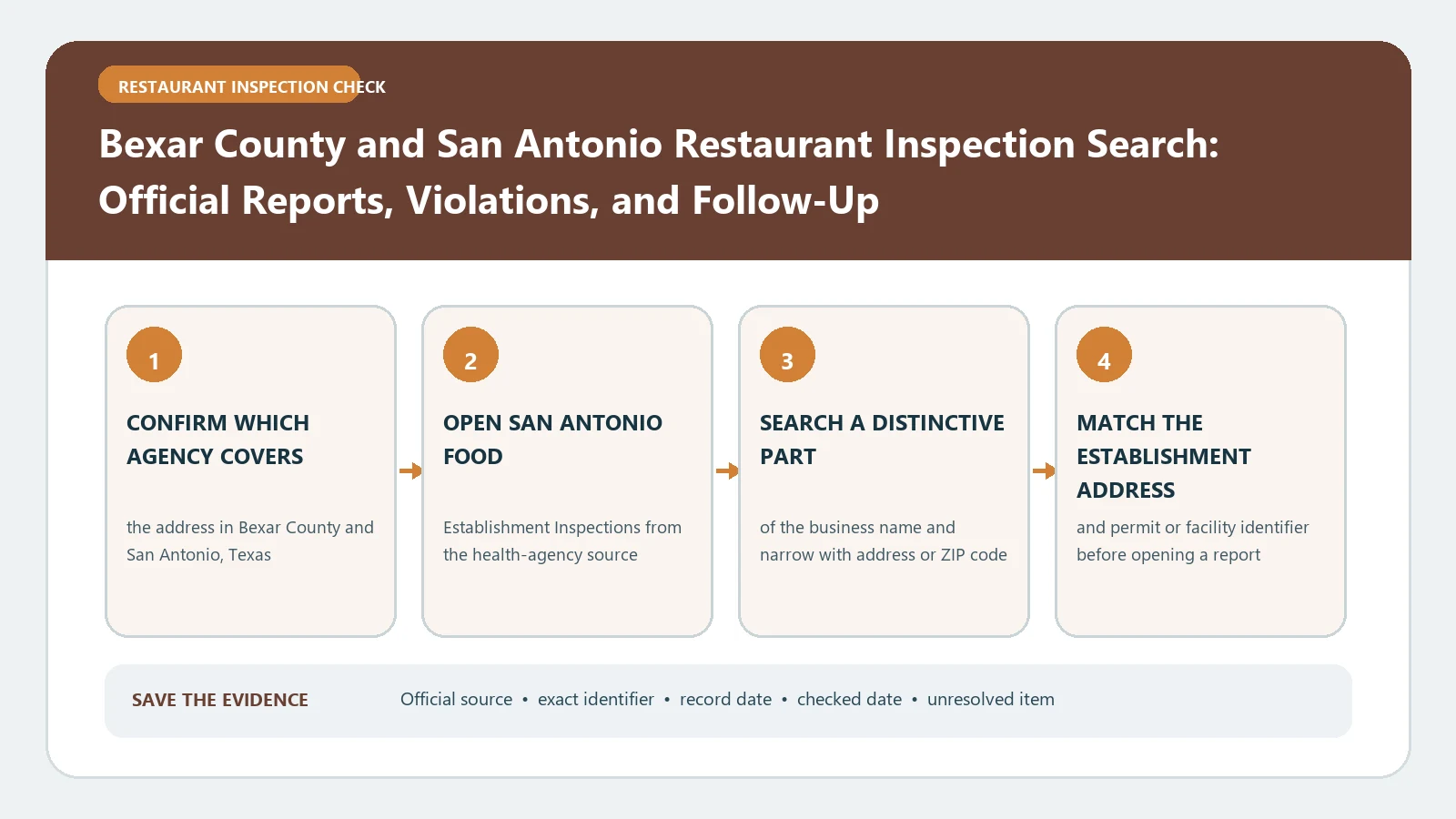
For a San Antonio or Bexar County restaurant, begin at the City of San Antonio Metropolitan Health District’s inspection page. Confirm that Metro Health covers the exact address, then choose the live inspection search for one facility or the dated weekly report files for a known inspection period. Match the premises before interpreting any result, because a mailing address alone does not establish the regulating jurisdiction.
Metro Health’s Food Establishment Inspections Reports page provides the official search entry, weekly restaurant report files, and a service-request route. The Food and Environmental Health Services page identifies the division that licenses and inspects food establishments and investigates food-establishment complaints. San Antonio’s development-services starting guide explains the Metro Health route for food businesses in the city limits and unincorporated Bexar County. These sources were checked August 26, 2026.
Confirm Metro Health owns the address
Start with the physical premises, not the brand. San Antonio city limits and unincorporated Bexar County can lead to Metro Health, while an address in another incorporated municipality may require a separate local check. Record the city shown by the parcel or address authority and confirm the responsible health program before using a similarly named result.
The facility type matters too. A restaurant, mobile vendor, school cafeteria, hotel kitchen, or assisted-living food operation can appear under different operational names. Metro Health states that its sanitarians inspect a broad set of food establishments and investigate violations and outbreaks. That scope is useful for routing, but the matched inspection record must still identify the premises you mean.
Choose the live search or a weekly report file
Use the “Search Inspections” route on the Metro Health reports page when you need one establishment’s record. Search with a distinctive name and verify the address. Retain any permit, establishment, or facility number shown in the result. The search is the better starting point when you do not know the inspection date.
Use a weekly XLSX report when you know the approximate visit period, need to preserve a dated batch, or want to confirm that an event appears in the city’s published weekly output. Download the file from the official year and week rather than a copied spreadsheet. Record the file name, covered dates, access date, and the row that matched the premises.
The two routes serve different jobs. A weekly row can confirm an event in a publication period, while the live search can provide the current facility-facing route. Do not assume that one spreadsheet row represents the entire inspection history.
Lock the facility before reading the inspection
Create a San Antonio identity card with the official establishment name, complete address, ZIP code, permit or facility identifier, inspection date, and report source. For a business in a hotel, market, food hall, hospital, or shared property, verify the specific permitted food operation rather than the property’s main name.
If the live search and spreadsheet use slightly different names, require the address and identifier to agree before joining them. A DBA change may be harmless, but a new operator can receive a different permit. Preserve both names and explain the match. When no identifier is available, label the join “address and name match” rather than presenting it as a confirmed permit continuity.
Read the event without inventing a citywide scale
Open the detailed report or use the exact fields the official source supplies. Record the inspection date, visit type, result, violation text, correction notation, and any later action in separate fields. Do not import a letter-grade scale, point threshold, or closure rule from another Texas city. Metro Health’s page is the controlling route for this record.
The division’s program page establishes that food establishments are licensed and inspected under local and state requirements. It does not make every search result a certificate of current compliance. A dated inspection documents what the agency recorded for that event. Read any correction or enforcement language literally and look for a later Metro Health event before saying the issue was verified as resolved.
The San Antonio result-fields guide can help keep city, county, permit, and report fields apart. Use it as an organizer; cite the Metro Health record for the actual finding.
Trace follow-up as a separate event
When the first report identifies a correction, return, or enforcement step, add it to a small chronology. Keep the original inspection date and finding in the first row. Add a later inspection, service response, or administrative action only when the official record connects it to the same facility.
The chronology should contain:
- original inspection date and visit type;
- finding or result exactly as published;
- immediate correction or stated next step;
- later Metro Health event and its date;
- unresolved question, if the public record does not close the loop.
Use the restaurant reinspection follow-up check for the sequencing method. San Antonio’s official record still determines whether the later event was a reinspection, complaint visit, permit action, or something else.
Recover a missing report without guessing
If the live tool produces no match, shorten the business name, search the street number and street name, and try a prior DBA. Confirm the city or unincorporated-county status of the address. Then check the weekly report file for the known visit period. Save each attempted input and the date because a blank search proves only that the chosen query returned no result at that time.
When the portal is unavailable or the two official routes disagree, use the service-request path on the Metro Health page. The city asks people reporting food-establishment questions or complaints to provide the name, location, incident date, and details. For a record question, add the facility identifier and the report week. Do not submit private health details through a general public-record note.
Finish with a dated Metro Health record
A useful conclusion names the authority, matched facility, source route, inspection date, visible result, and any later published action. It also states whether the address was treated as San Antonio, unincorporated Bexar County, or unresolved. Save the official URL and the date checked so another reader can repeat the search.
The result does not guarantee the restaurant’s present condition, settle an active complaint, or establish that no newer or nonpublic record exists. Before acting, reopen the Metro Health page and confirm that the live search, weekly archive, and facility identity still agree. Readers who need to restart with the regulator can use the city inspection lookup hub.