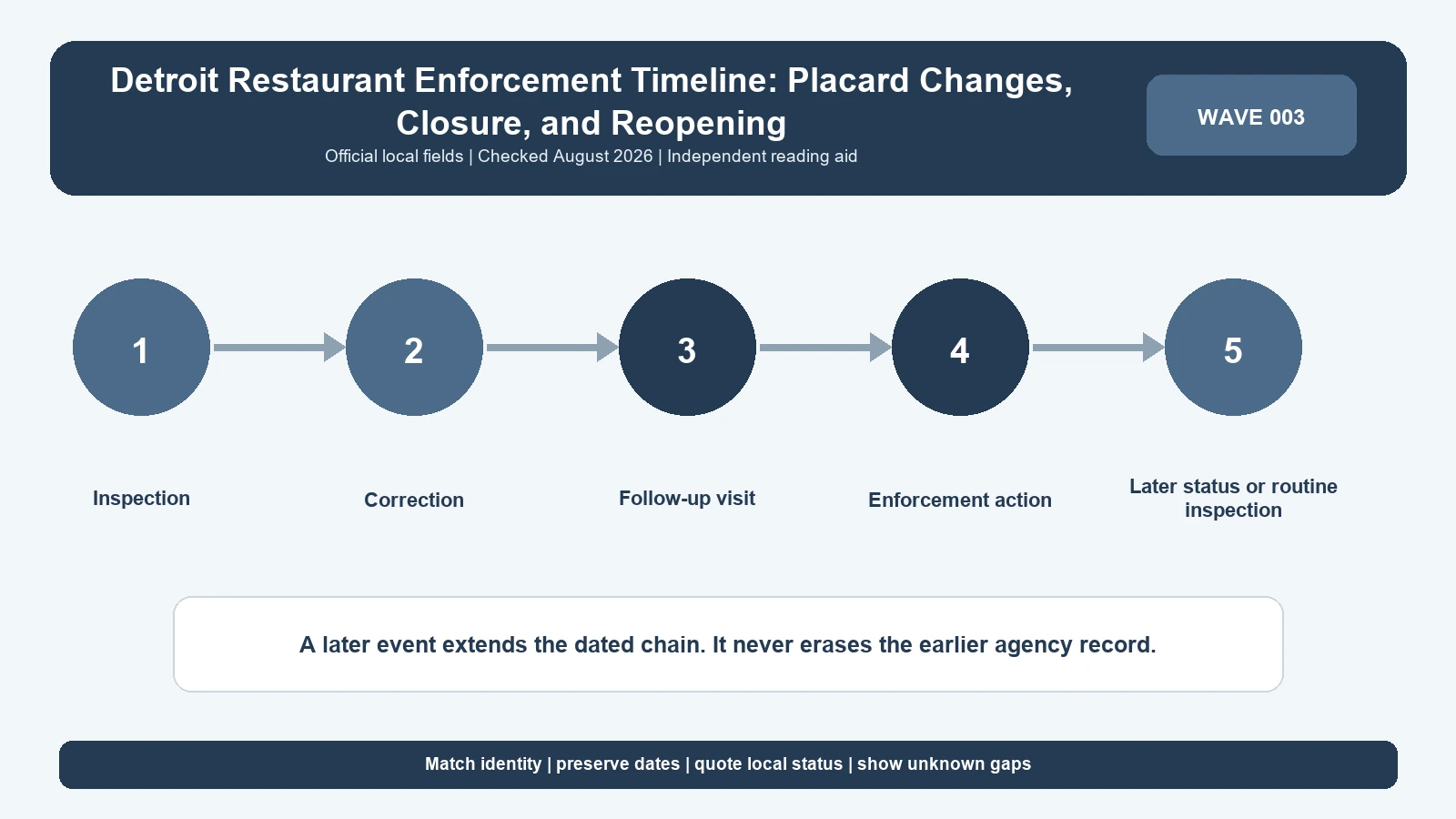
A Detroit enforcement chronology follows dated color changes: an inspection may support green In Compliance or white informational status, while a severe hazard, invalid license, or final progressive-enforcement stage can produce a red closure placard. Reopening requires a later Detroit determination; business activity alone is not enough.
Last checked: August 7, 2026.
Retrieve inspection events at Detroit Food Safety Program, apply color definitions from Detroit Dining with Confidence placard program, and retain Detroit Dining with Confidence fact sheet beside the timeline. Add a program-start marker for October 1, 2024. Earlier inspections can provide history, but they cannot receive a Dining with Confidence color retroactively.
Create a program boundary at October 1, 2024
Put all pre-ordinance reports in a historical section using their original fields. Start the placard lane on the effective date. This prevents a reader from seeing a blank color in 2023 as evidence of white or noncompliance and makes it clear when Detroit began communicating through green, white, and red.
| Period | Permitted timeline field | Source treatment | Do not do |
|---|---|---|---|
| Before October 1, 2024 | Inspection result and finding only | Use contemporaneous report wording | Assign a placard color |
| October 1, 2024 onward | Official color and supporting status | Apply Detroit criteria | Backdate the color |
| Cross-boundary facility | One identity history with visible program divider | Preserve licenses and addresses | Treat program launch as ownership change |
| Unknown placard date | Color undetermined | Search official record and dated images | Use the newest web photo |
Anchor every transition to one licensed establishment
Record the establishment name, complete address, food-service license identifier and validity, inspection date, and placard observation date. A change in operator or license at the same address can break continuity. Split candidate histories when the city evidence does not support the join.
| Anchor | Why it matters | Change signal | Timeline response |
|---|---|---|---|
| Food-service license | Green requires a valid license and red can reflect invalidity | Identifier or validity changes | Open new status row |
| Address and unit | Separates co-located facilities | Unit differs | Do not merge |
| Inspection event | Explains placard decision | New visit date | Append rather than overwrite |
| Enforcement stage | Can affect green or red | Stage advances or resolves | Cite each city action |
| Placard date | Shows when color was public | Photo predates report | Keep both dates |
Trace green and white as separate starting states
Green requires the full In Compliance checklist: serious P/Pf violations corrected, fewer than five total P/Pf violations, no progressive enforcement, no follow-up due to overall low sanitation, and a valid license. White is informational and can mean not yet inspected, not currently green, or temporary. Do not treat white as a failed green inspection without identifying the actual context.
A transition from white to green can occur after an inspection demonstrates all green criteria. Record that inspection and decision. A transition from green to white can reflect loss of a criterion without red enforcement; publish the official reason if available and mark it unknown otherwise.
Require Detroit evidence for a red event
Detroit’s red lane covers enforcement or closure associated with a severe health hazard, invalid food-service license, or final progressive enforcement. The underlying record should supply the basis and effective date. A count of five Priority violations, a required follow-up, or the phrase not green does not by itself prove red.
| Red pathway | Evidence to capture | Next event | Unsupported claim |
|---|---|---|---|
| Severe health hazard | City finding, action, and date | Correction and reinspection | Every violation caused closure |
| Invalid license | Official license status and effective date | Renewal or reinstatement | The restaurant corporation dissolved |
| Final progressive enforcement | Stage and Detroit action | Compliance decision or hearing outcome | Permanent closure |
| Red placard | Official record or dated matched image | Later color or reopening | Still red now |
The closure and permit-suspension guide helps identify which document can support an operational claim. A placard is strong public evidence, but the order and license record explain what Detroit did and why.
Keep correction and reinspection as independent events
An operator can address the cited condition, but Detroit determines whether a follow-up inspection passes and whether the facility may reopen. Record corrective work by its source type. A restaurant announcement or invoice can show activity; it cannot substitute for the Health Department’s reinspection and operating decision.
| Event | Source class | Safe wording | Required next proof |
|---|---|---|---|
| Corrective work | Operator or contractor document | Specified work was reported completed | Detroit verification |
| Reinspection | Health Department visit | Detroit returned on the stated date | Outcome and status |
| Passed reinspection | Official city result | Facility passed the published follow-up | Reopening or new placard if separately required |
| Reopened | Detroit clearance or operating status | City allowed operation to resume | Later routine history |
| New placard | Official color or dated image | Public status changed on or by that date | Permanent safety |
Use the restaurant reinspection guide to crosswalk cited items. Preserve the original red event after correction. A green reopening row is an addition to the record, not an edit to the closure date.
Build a Detroit color-transition ledger
The most useful asset is a state-change table with supporting child rows. Each transition must contain a previous state, trigger, city action, effective date, next state, and source. Unknowns should be explicit because white and red can each arise through more than one route.
| Ledger field | Value | Audit function |
|---|---|---|
| Facility identity | Name, address, license | Keeps one operation in scope |
| Prior color | Green, white, red, or pre-program not applicable | Defines starting state |
| Trigger | Inspection finding, license issue, enforcement stage | Explains the transition |
| Agency action | Inspection result, closure, clearance | Separates observation from authority |
| Effective date | Actual city date | Orders events |
| Next color | Official displayed state | Shows public status change |
| Provenance | Official URL, report ID, access or image date | Allows reproduction |
Version the ledger by appending new rows. Never replace red with green in the historical row or convert a pre-ordinance blank into white. If the city record and a photo conflict, compare their dates and ask Detroit which public status controlled at the relevant time.
Handle a missing transition
- Search the exact facility and address.
- Verify the food-service license status.
- Check whether the event predates the placard ordinance.
- Save the inspection and enforcement records separately.
- Date every placard photo.
- Ask the Health Department if the gap changes a closure or reopening conclusion.
If red is visible but no reopening record is found, end the timeline with ‘no later Detroit reopening decision located at the checked time.’ Do not declare permanent closure. If a reservation page is active, list it only as non-agency commercial evidence and keep it out of the official-status column.
State the endpoint narrowly
A latest green record can show that the establishment met Detroit’s criteria at that dated event. It cannot guarantee current conditions. A historical red can show that enforcement or closure occurred then; it does not establish today’s placard. The chronology’s value comes from preserving both statements.
Use the Detroit inspection search guide when the first report is uncertain. Once identified, the reliable chain is program boundary, license and facility match, inspection findings, official color, corrective work, Detroit reinspection, and a separately dated reopening or color change.
Detroit timeline questions
Can white turn directly into green?
Yes when Detroit’s official inspection and license evidence supports all green criteria. Record the event rather than assuming the transition.
Does correction remove the red event?
No. Append correction, reinspection, reopening, and the new color while preserving the historical closure.
Can delivery-app activity prove reopening?
No. Use Detroit’s clearance, inspection, license, or official placard record for an operational claim.
Validate every Detroit color transition
A color-transition ledger needs a prior state, triggering inspection or license event, Detroit action, effective date, and next official state. Insert not applicable before the October 1, 2024 program launch. Never fill an old blank with white. When red appears, preserve whether the basis was a severe hazard, invalid license, or final progressive-enforcement stage, and require Detroit evidence for reopening.
- Keep pre-program inspections in their original vocabulary.
- Carry the same licensed facility through each transition.
- Separate operator correction from Detroit verification.
- Record the actual reinspection outcome and date.
- Append reopening and a new placard without deleting red.
- Reject commercial activity as a substitute for city clearance.
The last audit compares the current summary with the immutable event rows. A newer green can show that Detroit recorded In Compliance at that point; it cannot erase a previous closure. White may remain informational rather than adverse. If no event follows red, the correct ending is that no later Detroit reopening decision was located at the checked time—not that the establishment is permanently closed. This wording leaves room for a later authoritative update. Also retain the placard image date, inspection date, license-status date, and page-retrieval date as separate values. Their order can explain an apparent conflict without accusing the restaurant or agency of displaying false information. When the official page later changes, append the newer state and note whether it reflects a fresh inspection, license restoration, enforcement resolution, or only a newly captured image. Keep the source snapshot with that update so future readers can distinguish a real state transition from a revised web presentation.
Scope: Detroit placard transitions, inspection events, enforcement, and reopening records. This independent chronology is not a real-time city status.