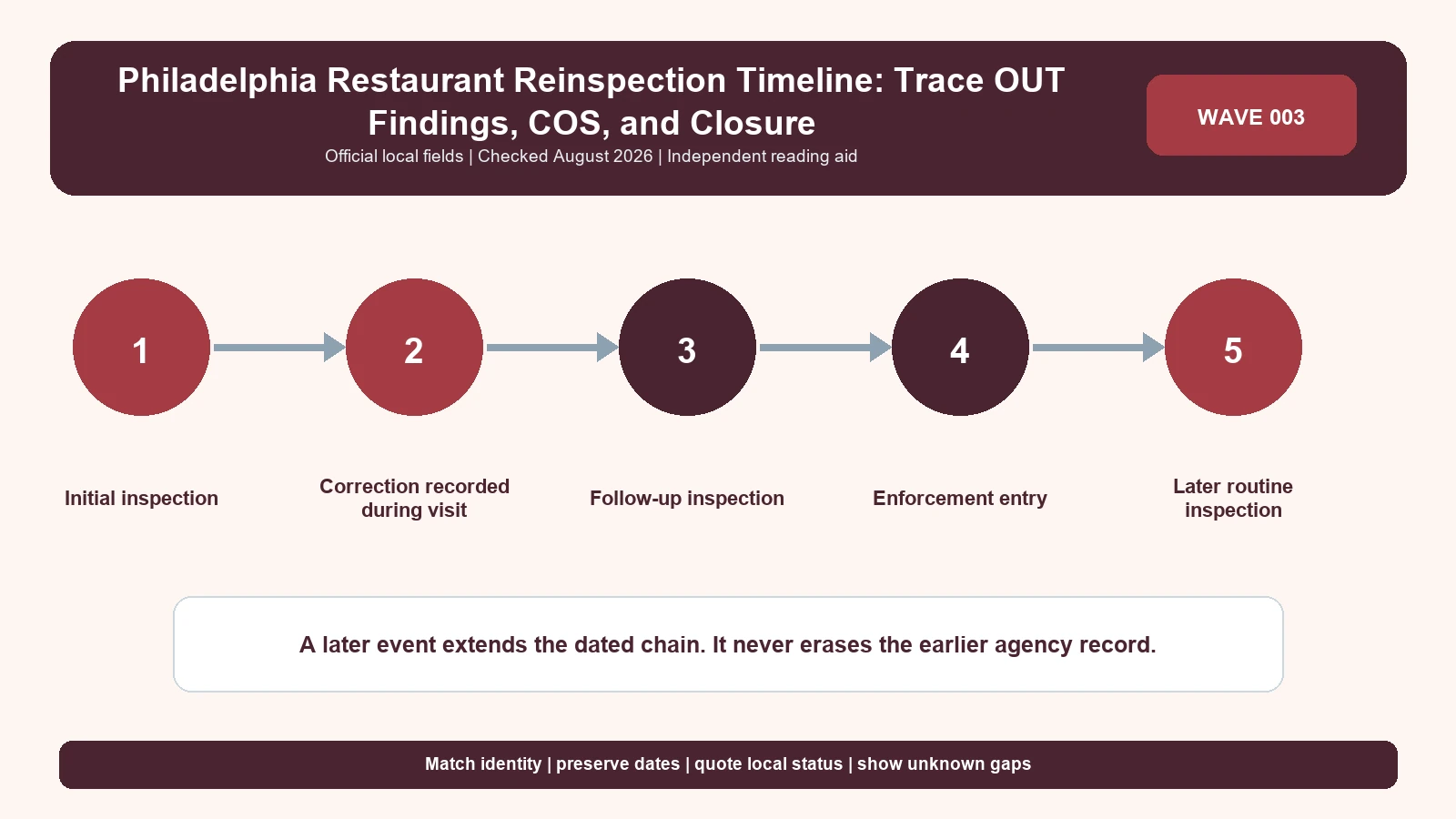
A Philadelphia reinspection timeline starts with the original OUT item, not with the newest report. Link the same food facility across dates, preserve COS and repeat marks, then add the correction period, reinspection, closure, or reopening exactly as the Office of Food Protection records it. A smooth-looking sequence is not useful if it hides an unverified gap.
Last checked: August 7, 2026.
Collect events from the Philadelphia Food Safety Inspection Report Search; use the Philadelphia guide to the Food Facility Inspection Report to decode IN, OUT, COS, R, and the city’s correction or closure lanes. The Philadelphia Public Health food-business resources identifies the city program responsible for food-business inspection. Each citation should stay attached to the event it supports rather than being dumped into an undated source list.
Freeze the first report before looking for a follow-up
Save the food-facility name, address, inspection date, report type, and each OUT observation from the first selected report. This prevents the later document from changing your description of the earlier visit. If the city later marks a correction, the timeline should gain a correction event; the original observation remains part of the history.
| First-report field | Timeline use | Join rule | Failure to avoid |
|---|---|---|---|
| Food Facility and address | Defines the operation at the start of the chain | Require a coherent address and license context | Combining two branches |
| Inspection date | Anchors the observation | Use the date printed on the report | Sorting by web-page date |
| OUT item and comment | States what required correction | Carry the same item into later review | Writing only ‘failed inspection’ |
| COS and R marks | Separate onsite correction from repeat history | Apply marks to their linked items | Treating all findings as one status |
Choose the response lane from the report, not from a generic deadline
Philadelphia’s guide describes two very different paths. Depending on the violation, a business may receive thirty days to correct. An imminent public-health hazard or severe vermin infestation can require immediate cessation of operations until correction. The selected report controls which path belongs in the timeline. Do not add a 30-day deadline to every OUT mark or infer closure from the word violation.
| Event lane | Evidence required | Next event to seek | Unsupported shortcut |
|---|---|---|---|
| COS | The report marks the item corrected on site | Any remaining OUT items | All problems were resolved |
| Time allowed to correct | A stated correction period for the named item | Reinspection or compliance record | The business missed the deadline |
| Reinspection | A later report for the same facility | Item-by-item comparison | The later visit checked everything |
| Immediate closure | City language requiring operations to cease | Dated clearance or reopening | The restaurant remains closed today |
A repeat mark connects reports only at the item level
R is the strongest local clue that a finding has appeared before, but it still belongs to a specific item. Put the earlier item number, wording, and date beside the repeated item. Minor wording changes can occur; the city mark and the underlying requirement are more reliable than keyword similarity. If the older report is outside the three-year window, describe it as unavailable rather than reconstructing it from R alone.
- Copy the current report’s R mark.
- Search the same facility for the preceding report.
- Match the cited requirement and observation.
- Record whether the earlier item was COS, open, or unclear.
- Add the later correction only when a city document supports it.
- Leave the link unresolved if the earlier report cannot be retrieved.
Keep onsite correction, later correction, and reinspection separate
COS occurs during the inspected visit. A correction completed afterward is a different event, even if it addresses the same requirement. A reinspection is another city visit and may have a limited scope. Use three distinct columns for those states. This avoids the misleading sentence ‘the restaurant passed reinspection’ when the later report only documents selected corrections.
The reinspection follow-up guide provides a generic event model. For Philadelphia, replace its generic labels with the actual OUT, COS, R, correction, and closure wording from the city reports. The Philadelphia inspection search guide remains the owner for finding the establishment.
Treat closure and reopening as a pair of independent city actions
If the city requires a facility to cease operations, quote the order or report language and its date. Reopening requires a later clearance, inspection, or status from the responsible agency. A restaurant website, delivery listing, or social post may suggest activity but does not replace city evidence. If no reopening document is visible, the timeline ends with an explicit unknown.
| Chronology row | Minimum fields | Defensible statement |
|---|---|---|
| Initial inspection | Facility, date, OUT item, comment | The city recorded the finding on that visit |
| Correction event | Item, correction method, recorded date | The selected item was reported corrected |
| Reinspection | New report date, type, findings | The city conducted a later visit |
| Closure | Order or report wording and effective date | Operations were required to cease on that date |
| Reopening | Clearance source and date | The city allowed operations to resume on that date |
Expose publication and retention gaps
The Philadelphia search advertises a three-year report window. A sequence can therefore begin before the oldest visible report or lose a historical event as time passes. Record when the search was performed and which inputs were used. If a report number is mentioned but no document opens, keep the reference and mark the body unavailable. That gap is more honest than a guessed transition.
- Search the exact address and ZIP code after a name-only search fails.
- Check former names when the address remains stable.
- Keep separate chains when the license or operation changes.
- Save the report URL before the rolling window moves.
- Ask the Office of Food Protection about a missing report that changes the conclusion.
Publish the event ledger as the linkable asset
The useful asset is a source-linked ledger with one row per event and one child row per finding. Include report date, report type, item number, IN or OUT, COS, R, required action, deadline if stated, follow-up date, operational status, and source URL. Add an uncertainty column. Readers can then cite a specific transition instead of repeating an unsupported summary about the restaurant.
Version the ledger when new records arrive. Do not silently edit a historical OUT item to IN or replace a closure row with reopened. Append the newer event, note the retrieval date, and revise only the editorial conclusion. That practice makes the table auditable and prevents a cached copy from being mistaken for current status.
The last visible event is not a safety certificate
A later favorable report documents another visit; it does not guarantee every condition after the inspector left. A historical closure documents a past action; it does not establish the restaurant’s status today. The timeline answers what the city recorded next for the same facility. It cannot predict illness, certify quality, or prove that no unpublished agency action exists.
Use the closure and permit suspension guide when the chain includes an operational action. Keep the final wording date-specific: ‘Philadelphia recorded X on date Y, followed by Z on date W.’ Avoid ‘safe now,’ ‘permanently closed,’ or ‘all violations cleared’ unless the current city record supports that exact claim.
Questions about the Philadelphia chain
Does COS mean a reinspection is unnecessary?
COS resolves the marked item during that visit. Other OUT items or city instructions can still require later action.
Can R prove continuous noncompliance?
No. R identifies repeat history for the marked requirement. Read the reports between the two dates before describing continuity.
What if the city search shows no reopening report?
State that no later public report was found at the checked time and contact the Office of Food Protection. Do not infer current closure or reopening.
Test the Philadelphia chronology against alternative explanations
Before releasing the timeline, challenge every connection. A gap may reflect the city’s rolling three-year window, a former facility name, a different license, or a report that is not exposed online. An R mark supports repeat history for an item but does not identify every intervening condition. A later COS mark supports onsite correction on that visit but does not prove what happened between the two dates. Record these alternatives in the uncertainty column.
- Compare the full address on the first and later reports.
- Keep initial OUT and later correction as separate events.
- Apply any correction period only when the selected report supports it.
- Do not turn an expected follow-up into a fabricated inspection date.
- Require Philadelphia evidence for both closure and reopening.
- Mark an unavailable older report rather than reconstructing it from R.
The published endpoint should describe the last city event located and the date of the search. If Philadelphia’s page shows a later routine inspection but no explicit link to the earlier item, call it a newer snapshot rather than resolution. If the chain ends at a closure, state that no later city reopening record was found at the checked time. These narrow formulations keep the ledger useful after a new report is added.
Scope: dated Philadelphia Office of Food Protection inspection and enforcement records. This independent chronology does not create an agency status or guarantee current conditions.