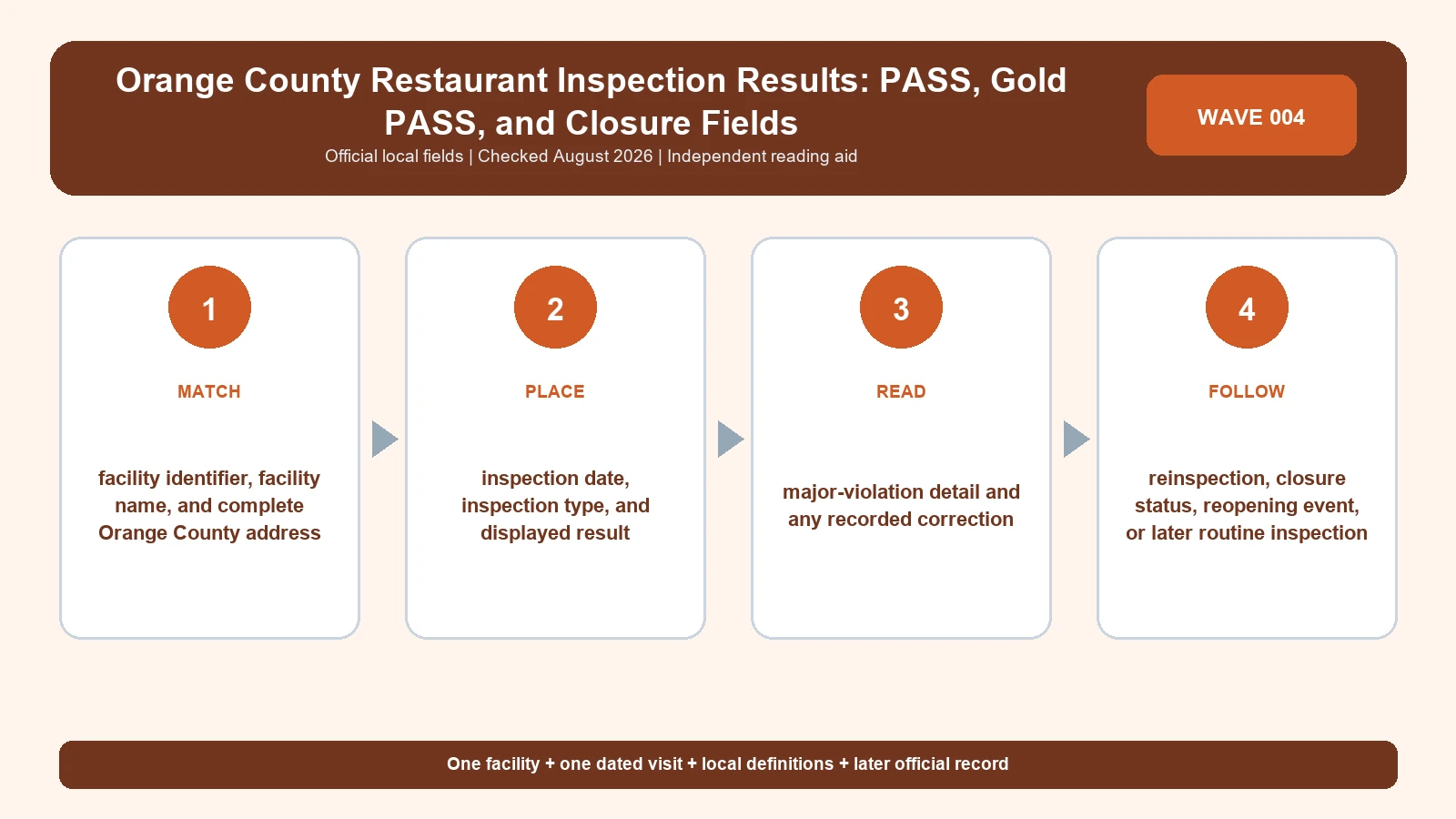
An Orange County, California restaurant record can show an inspection result, a traditional PASS seal, eligibility for a Gold PASS Seal, or a dated closure and reopening entry—but those are different fields. Match the facility and visit before interpreting any seal, and never import Los Angeles County’s letter-grade system.
Last checked: August 7, 2026.
Use Orange County Food Safety and inspection records for Orange County inspection-record and closure routes. Read Orange County Award of Excellence criteria for the county’s Award of Excellence criteria, and consult Orange County Immediate Health Hazards when the record includes permit suspension or temporary closure. These are Orange County Health Care Agency sources; a neighboring county’s placard rules do not apply.
Confirm that the record belongs to Orange County and the exact facility
California search results can surface agencies with similar environmental-health names. Verify that the issuing page belongs to Orange County, then copy the facility name, complete address, inspection date, and any permit or record identifier. A chain with locations in several counties can display a different sign at each branch.
| Match field | Value to capture | Reason | Failure to avoid |
|---|---|---|---|
| Issuing agency | Orange County environmental health source | Selects the governing local system | Applying Los Angeles letter grades |
| Facility name | Name on the official record | Finds the candidate operation | Joining every brand branch |
| Address | Full street, unit, and city | Confirms the inspected location | Assuming the county from a brand name |
| Inspection date | Date of the agency visit | Anchors the result or seal context | Using a photo-upload date |
| Permit or record key | Identifier displayed by the county | Supports history joins | Treating it as a consumer rating |
If an address appears on both an inspection record and a closure list, compare the name and dates before connecting them. A former restaurant may have occupied the same storefront. Keep the old operator’s events separate unless permit context or agency evidence supports continuity.
Separate the traditional Orange Seal from the Gold PASS Seal
Orange County’s traditional PASS seal communicates inspection status. The Gold PASS Seal is an Award of Excellence earned under additional criteria. It should not be described as the ordinary pass level or converted into an A grade. A facility can lose Gold eligibility and display the traditional Orange Seal without that change alone proving closure.
| Displayed concept | Orange County meaning | Evidence to open | Do not call it |
|---|---|---|---|
| Traditional Orange PASS Seal | County pass placard | Most recent inspection record | A Los Angeles A grade |
| Gold PASS Seal | Award of Excellence when all published criteria are met | Two unannounced routines and current criteria | Permanent certification |
| Gold withdrawn | Facility no longer meets award criteria | New inspection and seal history | Automatic closure |
| Closure entry | Separate operational action published by the county | Reason, date, reopening fields | A low score or seal color |
A photograph of a seal is evidence of what was displayed when photographed, not a complete inspection history. Record the capture date and use the county report for claims about findings. A newer official record should not be dismissed because an older street-view image shows a different seal.
Audit every Gold PASS criterion
Orange County publishes a multi-part test. The facility must handle open food and show substantial compliance after two unannounced routine inspections. It must have no major Critical Risk Factor violations, no food-manager or food-handler card violation, and no more than five total minor and Good Retail Practice violations. Treat the award as a checklist, not a vague premium score.
| Gold criterion | Evidence needed | Asset field | Unsafe shortcut |
|---|---|---|---|
| Open-food operation | Facility and inspection context | Eligibility scope | Every food business qualifies |
| Two unannounced routines | Two dated routine reports | Inspection 1 and Inspection 2 | One favorable report is enough |
| No major Critical Risk Factor violation | Item-level classification | Major-CRF count | No violations at all |
| No manager or card violation | Relevant compliance fields | Credential-violation flag | A valid card guarantees all safety |
| At most five minor/Good Retail Practice violations | Complete item count under county definitions | Count and source rows | Five points or five complaints |
The test is conjunctive: all criteria must be satisfied. Do not award Gold yourself because one report looks favorable. Cite the county’s displayed seal or official recognition and use the checklist only to explain it. If one supporting report is outside the available online history, mark the independent audit incomplete.
Read inspection findings without inventing a grade
The useful details are the cited condition, local classification, correction status, and later agency record. Orange County’s terminology controls. A violation count does not become a percentage, and Gold is not a 100-point result. Preserve the exact words from the inspection report before adding a plain-language explanation.
Use the food inspection violation guide for a generic field separation, then return to Orange County’s categories. The source column should contain the official classification; any editorial comparison belongs in a separate column with a clear caveat.
Use the closure list as a different dataset
Orange County’s public food-safety page routes users to restaurant closures. Closure rows can include a reason, whether the establishment reopened, and a reopening date. Those fields answer an operational question, not an inspection-score question. Do not paste a closure status into the seal column or treat a PASS seal as proof that no historical closure occurred.
| Closure field | What it supports | Verification step | What it cannot prove |
|---|---|---|---|
| Closure date | County recorded an operational action on that date | Match facility and address | It remains closed now |
| Reason | County’s stated basis | Quote rather than broaden | Every violation on the inspection |
| Reopened yes/no | Published state in the selected entry | Check access date and later record | A lifetime operating status |
| Reopen date | Date operations were allowed to resume when published | Connect to follow-up or clearance | No later issue occurred |
When the evidence includes suspension, closure, or reopening, switch to the closure and permit-suspension guide. An inspection result and an operational action may be related, but each needs its own date and source.
Build an Orange County seal-and-event card
The best citation asset has two panels. The inspection panel stores the facility, visit, findings, and seal evidence. The operational panel stores closure, reason, follow-up, and reopening. This prevents a single colored badge from carrying claims it was never designed to answer.
| Panel | Columns | Reader question |
|---|---|---|
| Facility | Name, address, county, permit or record key | Is this the correct operation? |
| Inspection | Date, type, finding classifications, corrections | What did the county record? |
| Seal | Traditional PASS or county-published Gold, observed date | What recognition was displayed then? |
| Gold audit | Each criterion and supporting report | Can the explanation be reproduced? |
| Closure | Action date, reason, reopen field, reopen date | What operational event occurred? |
| Provenance | Official URLs, retrieval date, image date | Is the evidence current enough for the claim? |
Publish ‘not displayed’ when the county record lacks a value. Do not convert an absent Gold seal into failure, an absent closure row into never closed, or a blank reopen date into still closed. Each is an evidence gap that may require agency confirmation.
What Orange County results cannot promise
The official records can describe a dated inspection, award status, closure, or reopening. They cannot guarantee current kitchen conditions, predict foodborne illness, certify food quality, or make branches in other counties equivalent. Gold PASS is earned recognition under stated criteria, not a permanent warranty.
Use the Orange County inspection lookup guide to retrieve the record. Keep the final answer local and dated: exact facility, Orange County source, inspection event, seal meaning, and a separate operational history where one exists.
Orange County record questions
Is Gold PASS the same as an A grade?
No. It is Orange County’s Award of Excellence under a published checklist, not a Los Angeles County letter grade.
Does losing Gold mean the restaurant closed?
No. The county says Gold can be replaced with the traditional Orange Seal when criteria are no longer met. Closure needs separate evidence.
Can a PASS seal prove there was never a closure?
No. Search the county’s dated closure and reopening records independently.
Confirm the Orange County system before publishing a seal
The first audit question is jurisdiction. Orange County’s traditional PASS seal and Gold PASS Award of Excellence must not be confused with Los Angeles County letter grades. Match the county agency, facility, address, and visit. When explaining Gold, verify every published criterion rather than relying on color, a promotional photo, or one favorable routine report.
- Record Orange County as the issuing agency.
- Separate the traditional Orange PASS Seal from Gold PASS.
- Locate two unannounced routine inspections for a Gold audit.
- Count major Critical Risk Factor, credential, and minor/GRP criteria correctly.
- Keep closure-list fields in an operational panel.
- Date all seal photographs and official retrievals.
A second reader should be able to reproduce the seal explanation from the two reports and county criteria. If one report falls outside the visible record, call the independent Gold audit incomplete even when the seal is displayed. If Gold disappears, do not infer closure: the county says the traditional Orange Seal replaces it when award criteria are no longer met. Closure requires its own dated record.
Scope: Orange County, California inspection, seal, award, and closure records. This independent guide does not issue awards or guarantee current safety.