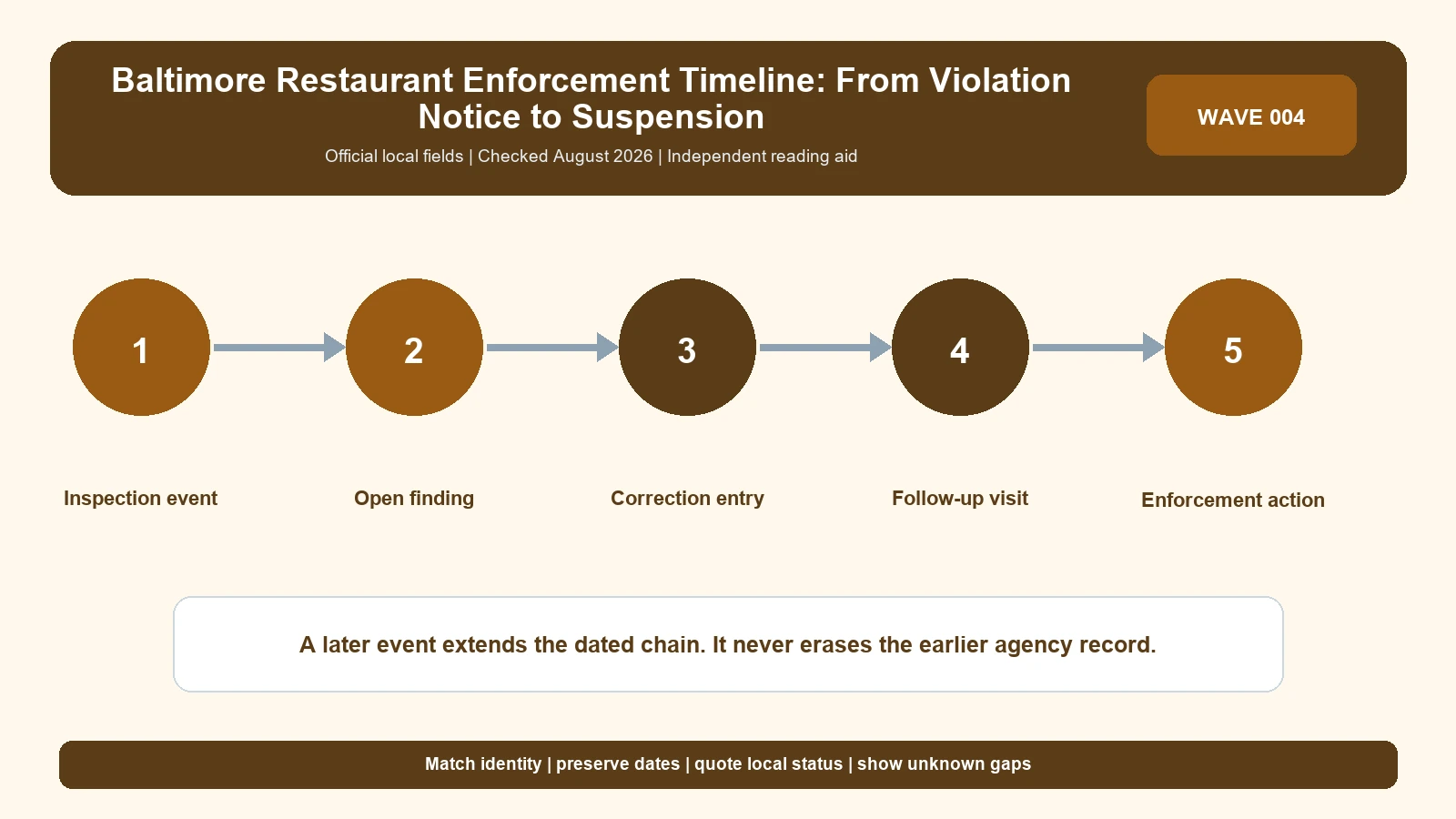
A Baltimore enforcement timeline begins with a facility-specific violation notice: the condition, required corrective action, time allowed, and hearing route. If the condition is not corrected, the city can suspend the license and discontinue operations; when public health requires, Baltimore can suspend immediately without prior notice. Neither path should be inferred from a violation count.
Last checked: August 7, 2026.
Locate reports through the Baltimore City Food Facilities Program and Baltimore Open Data food-inspection search. Use the Baltimore City Law Library Title 6: Food Service Facilities, especially sections 6-601 through 6-603, to label the notice, noncorrection, and immediate-suspension paths. The code supplies authority; the dated facility records prove which events actually happened.
Fix the licensed food facility at the start
Copy the facility name, full address, facility type, inspection date, and any license, report, or record identifier. Baltimore regulates thousands of food facilities, so a name can match a market, carry-out, institution, or restaurant. Confirm the operation at every date and split the chronology if a new license or operator appears.
| Anchor | Use in chronology | Break signal | Response |
|---|---|---|---|
| Facility name and type | Defines the regulated operation | Type or name changes | Verify license continuity |
| Address and unit | Separates branches and co-located facilities | Unit or street number differs | Do not merge |
| License or record key | Connects official documents | Identifier changes | Create a new candidate chain |
| Inspection date | Orders observations | Only publication date is available | Label dates separately |
| Notice date | Starts facility-specific response period | Notice is missing | Do not invent a deadline |
Preserve all four parts of the violation notice
Section 6-601 describes a notice that identifies the violating condition, corrective action, time allowed, and hearing availability. Put each part in its own column. This prevents the condition from being mistaken for the remedy and keeps a due period from being presented as an actual reinspection date.
| Notice field | Timeline role | Evidence statement | Not established |
|---|---|---|---|
| Condition | Initial observation | Baltimore cited this condition on the stated date | It remained continuously present |
| Corrective action | Required response | City directed the named remedy | The remedy was completed |
| Time allowed | Response window | Notice required action within that period | The deadline was missed |
| Hearing route | Procedural option | Notice or code made a hearing available | The operator requested or won a hearing |
The code may describe what a valid notice contains, but it does not supply the facts of a particular restaurant’s notice. If the document is unavailable, preserve the report identifier and mark all unverified fields unknown. Do not choose a common deadline from another case.
Follow the ordinary noncorrection path only when records support it
Under section 6-602, failure to correct can lead to license suspension and discontinuation of operations. Build the chain with evidence for both the original requirement and the later failure or suspension action. A report that simply does not display a correction is not enough to prove failure after the allowed period.
| Ordinary path event | Required record | Safe wording | Unsafe wording |
|---|---|---|---|
| Inspection | Dated report and finding | City recorded the violation | Case opened for suspension |
| Violation notice | Facility-specific action and time | City directed correction | Deadline automatically expired |
| Follow-up | Later inspection or compliance record | City checked the stated conditions | Every earlier item was reviewed |
| Failure to correct | City determination or repeated item with context | City recorded noncorrection | Silence proves failure |
| Suspension/discontinued operation | Explicit Baltimore action and effective date | License was suspended and operations discontinued | Closure is permanent |
Use the restaurant reinspection follow-up guide for the item crosswalk. Keep the Baltimore notice and code fields intact; a generic follow-up model cannot supply the local legal action.
Keep immediate suspension in a separate branch
Section 6-603 allows immediate suspension without prior notice when public health requires it. This branch does not wait for the ordinary correction sequence. Require an explicit city action or document that identifies the facility, effective date, and public-health basis. Do not decide that a serious-sounding violation must have used section 6-603.
| Immediate branch | Evidence | Next question | Boundary |
|---|---|---|---|
| Public-health basis | Baltimore’s stated reason | What condition had to change? | Editor cannot broaden the basis |
| Immediate suspension | Order or official action with date | Was operation discontinued? | Violation report alone is insufficient |
| Corrective work | Source-labeled repair or remediation evidence | Did the city verify it? | Operator statement is not clearance |
| Agency return | Dated inspection or review | What outcome was recorded? | A visit equals reopening |
| Restored operation | Official reinstatement or clearance | What was the effective date? | Commercial activity proves authority |
When a suspension or closure occurs, use the closure and permit-suspension guide. Cite the Baltimore order for the action and a later Baltimore source for restoration. Reservation pages, social posts, and customer photographs cannot replace the agency decision.
Treat complaint, inspection, and enforcement as separate records
Baltimore accepts food-facility complaints through 311 and CitiTrack. A complaint can precede an inspection, but the complaint date and allegation should stay in a different row from the inspector’s observation. Link the two only when the city record supplies a case or visit connection.
Likewise, an inspection finding can precede enforcement without proving that the finding caused the action. Preserve the city’s stated basis. A chronology is strongest when it shows the source for each relationship instead of relying on proximity in time.
Account for the January 1, 2016 electronic-record boundary
Baltimore’s program route says electronic inspection reports are available from January 1, 2016. A timeline can therefore begin in the middle of a facility’s history. Mark the oldest visible electronic event rather than calling it the first inspection. Ask Food Control about older material when it changes an enforcement claim.
Open-data apps and schemas can change. Store the dataset title, publisher, direct report identifier, URL, and retrieval date. If a later catalog version drops a field, retain your earlier source record and mark the new gap; do not reconstruct official language from an editorial summary.
Publish a Baltimore notice-to-restoration ledger
The linkable asset should use immutable event rows and item-level child rows. A suspension remains in history after restoration; the later clearance is appended. This prevents the latest status from erasing why the city acted.
| Ledger row | Minimum fields | Audit purpose |
|---|---|---|
| Complaint lead | 311/CitiTrack identifier, allegation, date, source | Separates allegation from finding |
| Inspection | Facility, date, type, observation, report | Establishes city evidence |
| Notice | Condition, corrective action, time, hearing route | Defines required response |
| Follow-up | Actual date, scope, item outcome | Shows what Baltimore checked next |
| Enforcement | Section or authority, action, reason, effective date | Documents operational change |
| Restoration | Clearance, license status, effective date | Supports reopening |
| Provenance | Official links and access date | Makes the sequence reproducible |
Give each relationship a confidence value: explicit case link, facility-and-item match, facility-only match, or unresolved. A timeline should never hide a weak join. If a later inspection shares the address but the license changed, start a new facility episode.
Investigate missing outcomes without guessing
- Search by exact facility name and full address.
- Open the electronic report rather than relying on the catalog preview.
- Look for the facility-specific notice and its date.
- Separate the ordinary and immediate-suspension paths.
- Check 311 records only as complaint leads.
- Contact Food Control when a missing clearance changes current-status wording.
End an incomplete chain with a transparent research result: no later Baltimore correction, suspension, or restoration record was located in the checked official sources. That sentence does not assert that the city took no action; it describes the public evidence available to the researcher.
Use dated endpoints
A later inspection can show that Baltimore revisited the facility. A restoration record can show that authority to operate returned on a specific date. Neither guarantees current conditions or excludes later action. Preserve the retrieval cutoff and update by appending new events.
Use the Baltimore inspection search guide when the original report is uncertain. The reliable enforcement chain is facility identity, condition, notice, allowed time, actual follow-up, explicit city action, and separately documented restoration.
Baltimore enforcement questions
Does every violation enter the suspension path?
No. Require the facility-specific notice, later compliance evidence, and explicit city action.
Can Baltimore suspend without prior notice?
The Health Code allows immediate suspension when public health requires it, but a facility-specific action must show that the city used that authority.
Does a later open restaurant listing prove reinstatement?
No. Use a Baltimore clearance, license, inspection, or reopening record for the operational claim.
Challenge the Baltimore enforcement branch before release
Decide whether the evidence supports the ordinary noncorrection path under section 6-602 or the immediate public-health suspension path under section 6-603. Do not blend them. The ordinary chain needs a notice, allowed time, later noncorrection or enforcement evidence, and explicit suspension. The immediate chain needs a Baltimore action showing that public health required suspension without prior notice.
- Lock the facility, license context, address, and event dates.
- Store all four notice components from section 6-601.
- Use actual follow-up records rather than calculated dates.
- Keep 311 allegations outside the inspection finding column.
- Require Baltimore documentation for discontinuation and restoration.
- Preserve the 2016 electronic-history limit and retrieval date.
The release reviewer should trace both authority and facts. A Health Code section alone proves what Baltimore may do, not what happened to a particular restaurant. A facility report alone may prove a condition, not suspension. The published chain becomes defensible only when each row cites the appropriate source class. If restoration is missing, state that no later city clearance was located through the checked date and stop there.
Scope: Baltimore City violation notices, follow-up, suspension, and restoration records. This independent chronology does not determine a live license or safety status.