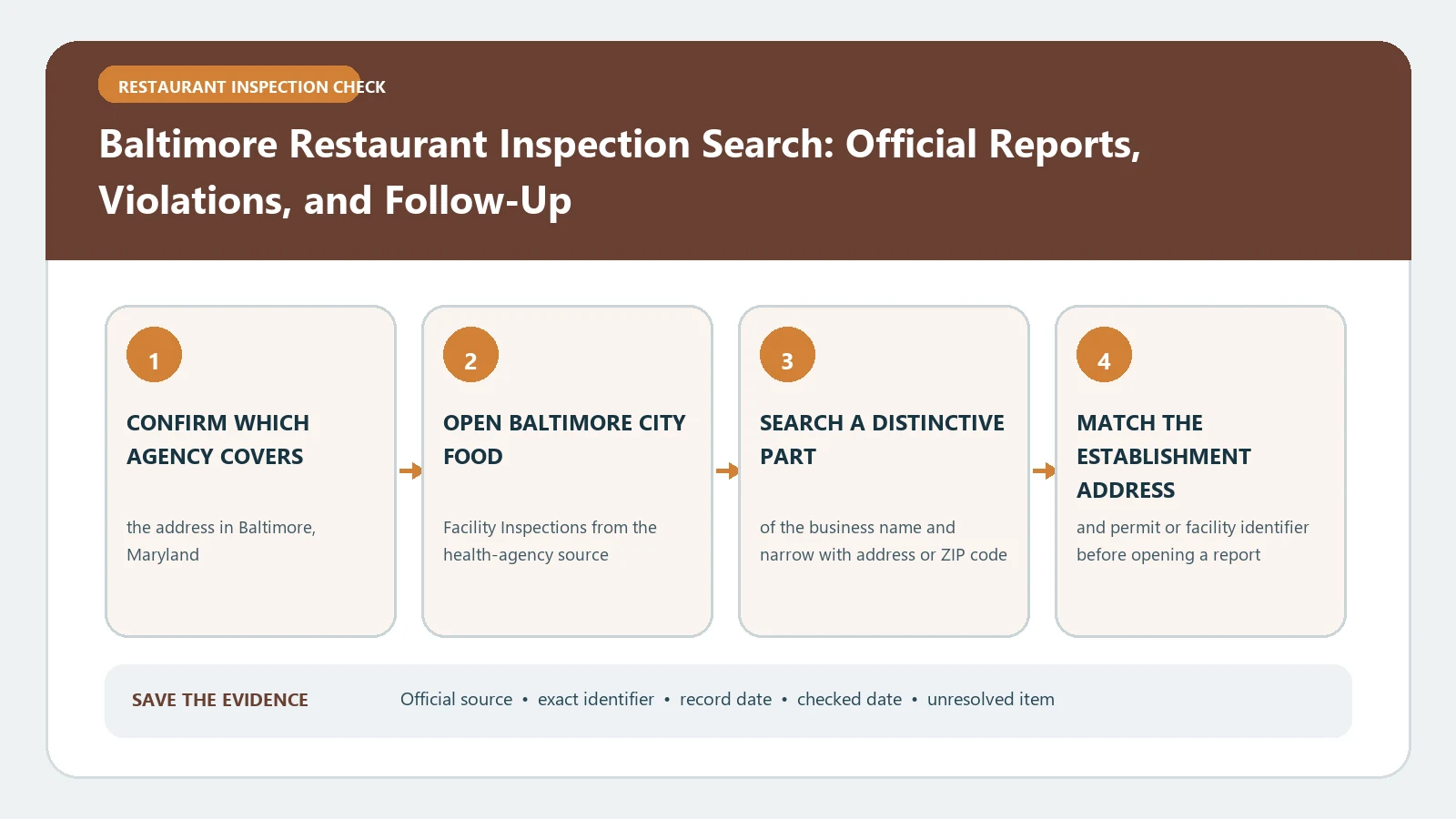
For a Baltimore restaurant, search the Baltimore City Health Department portal by the facility name and street, confirm the premises, and then read the dated report rather than treating a search result as a current safety verdict. The portal covers electronic inspection reports from January 1, 2016 forward. Older records follow a separate public-information route, so the date you need determines the first step.
The Baltimore inspection portal accepts a partial facility name, street name, ZIP code, or City Council district. Baltimore’s food-service-facility code explains the Health Commissioner’s inspection and enforcement authority, including priority assessment, violation notices, and license suspension. Both official sources were checked August 26, 2026. Save the retrieval date because later inspections and enforcement events can change the record.
Let the inspection date choose the Baltimore route
Begin with the period you are investigating. Use the public portal for a report dated in 2016 or later. If the relevant event is older, do not interpret an empty portal result as a clean history. The portal directs users to request earlier material under the Maryland Public Information Act, and copy charges may apply.
This time boundary matters for a lease review, a historical complaint, or a restaurant that operated under an earlier name. Record the date range you searched and whether you also requested the pre-2016 file. That small note prevents a later reader from mistaking a portal limit for an absence of inspections.
Match the premises before opening a report
Search the full public-facing name first, then shorten it if necessary. Baltimore permits partial text, so a street-name search often works better when punctuation, initials, or a corporate suffix has changed. Compare the street number, street name, ZIP code, and any facility identifier shown in the result.
Several food operations can occupy one building. A market counter, hotel kitchen, tavern, and restaurant may have separate records even when they share an address. Keep each facility name and identifier separate. If a new operator took over the same storefront, preserve the old and new names rather than merging their histories.
The Baltimore result-field guide is useful for organizing identifiers, but the official portal remains the source of the record. A guide cannot confirm that two similarly named businesses are the same licensed facility.
Build one visit from the report fields
Open the report and capture the facility identity before the findings. A useful visit record contains:
- facility name, street address, ZIP code, and available ID;
- inspection date and the displayed inspection service or type;
- inspection result and each violation description tied to that visit;
- the report link or document reference;
- the date and time of your search.
Do not detach a violation from its inspection date. The same establishment can have a routine inspection, follow-up, complaint response, or another service within a short period. Sorting all findings into one undated list can make a corrected condition appear current.
Read priority and enforcement as different questions
Baltimore law requires the Health Commissioner to assess food-service facilities as high, moderate, or low priority using the applicable state categories. That priority classification describes the facility’s risk category for inspection planning. It is not a consumer letter grade and it is not the result of one visit.
A violation notice is a different event. Under the city code, the notice identifies the condition, required corrective action, and time allowed. Failure to comply can lead to suspension, while an immediate public-health concern can support suspension without a prior notice. Preserve the precise language and date shown in the case. Do not convert every cited item into a closure claim.
For a sequence involving notices or suspension, use the Baltimore enforcement-timeline guide to keep the events in order without replacing the city documents.
Follow the same facility forward
After finding a concerning inspection, search the exact facility again and sort the visible reports by date. Look for a later visit that addresses the same condition or carries a follow-up service type. Compare the actual finding, not just the existence of a newer report.
A later inspection can document changed conditions, but it does not erase the earlier observation. A missing follow-up does not mean that no correction occurred; the report may not be electronic, may be delayed, or may require a records request. Mark the outcome as later report found, later report not located, or agency confirmation needed.
Recover a missing result without guessing
When a name search fails, try the street name alone, omit directional abbreviations, and test the ZIP code. Search a former trade name if ownership recently changed. If the address sits outside Baltimore City, stop and identify the county authority rather than continuing in the city portal.
For a pre-2016 visit, use the portal’s public-information instruction. For a current operation whose portal identity remains unclear, contact the Health Department and provide the exact address and any facility ID. A blank search page does not mean that the premises passed, holds a current license, or has never been inspected.
Preserve the failed query as evidence. Note the spelling, address form, filters, date range, and retrieval time, then list the alternate searches attempted. This small log distinguishes an actual portal gap from a lookup that used the wrong trade name or jurisdiction and gives the agency enough information to reproduce the problem.
Also save the portal result URL or report identifier when one appears. That reference allows a later reviewer to distinguish a changed public display from a different search.
Write a bounded Baltimore finding
A defensible note says which named facility and address appeared, which dated reports were reviewed, what result or violations the city displayed, and whether later activity was located as of the retrieval date. It should not declare the restaurant safe today or certify that every correction remains in place.
Keep the source links, facility identifiers, inspection dates, enforcement documents, and lookup date together. If the real concern is a current illness, active unsanitary condition, or suspected unlicensed operation, use the official complaint or Health Department contact route instead of relying on an older inspection history. The general violation-reading guide can help with terminology after the Baltimore record has been correctly matched.