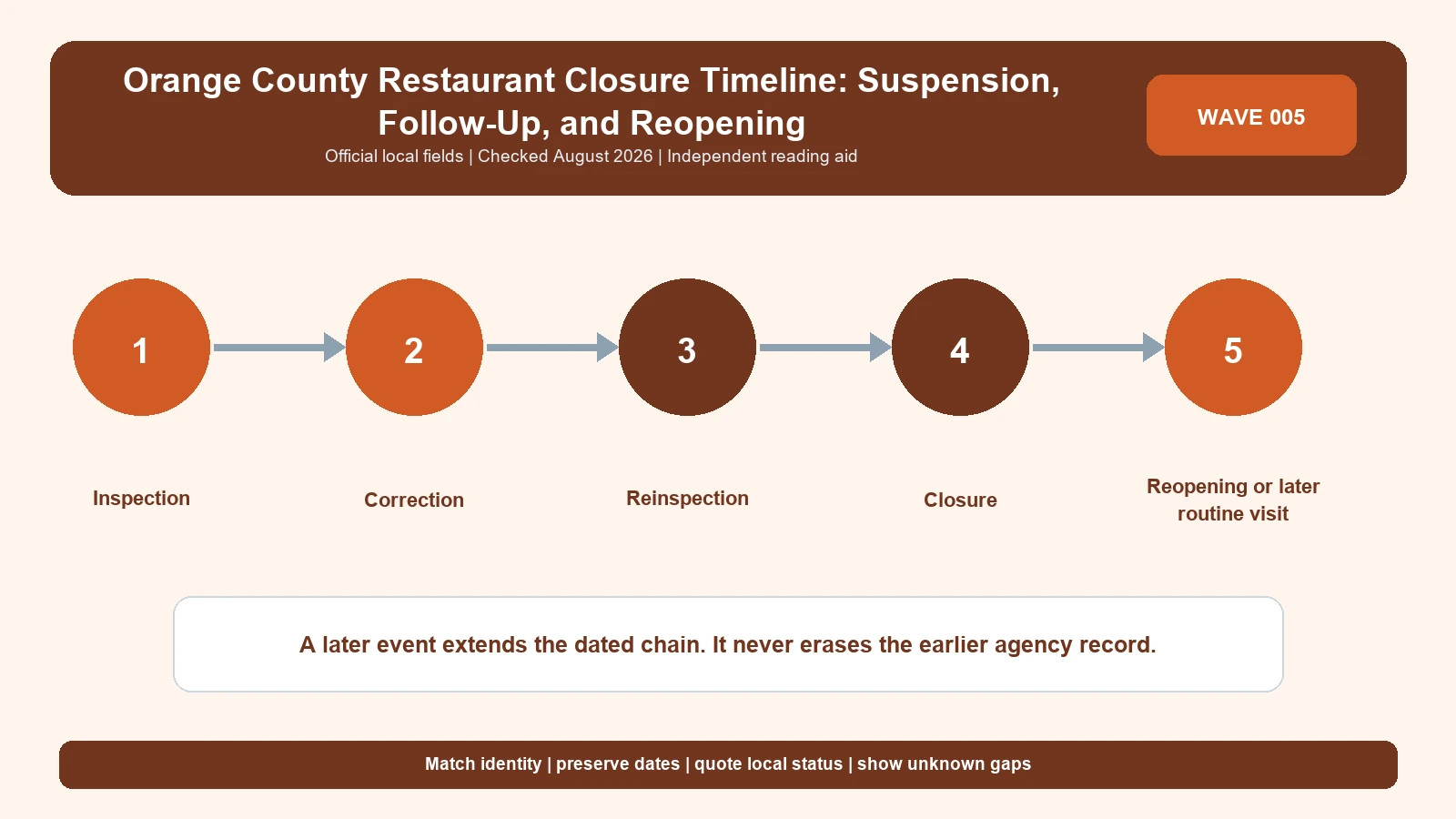
An Orange County restaurant closure timeline requires an explicit county permit suspension or closure, correction of the imminent health hazard, an Environmental Health follow-up, and a separate reopening or permit-reinstatement decision. An inspection finding or missing Gold PASS Seal cannot substitute for any of those events.
Last checked: August 7, 2026.
Start at Orange County Food Safety and inspection records for inspection and closure records. Use Orange County Immediate Health Hazards for the county’s imminent-hazard and reopening procedure, and consult Orange County Award of Excellence criteria only when a seal transition is relevant. This evidence must remain distinct because an award, inspection result, and authority to operate answer different questions.
Establish the Orange County facility before building the chain
Copy the establishment name, complete address, city, and any permit or inspection identifier from the first county record. Verify the county itself; California jurisdictions use different placards and enforcement systems. A record from Los Angeles, Riverside, or San Diego cannot fill an Orange County gap.
| Identity evidence | Timeline use | Mismatch risk | Required response |
|---|---|---|---|
| County agency | Selects governing system | Neighboring county page | Discard from Orange County chain |
| Facility name | Names the operation | Brand has multiple branches | Require address match |
| Full address | Fixes location | New operator occupies storefront | Check permit context |
| Permit or record identifier | Connects agency events | Identifier changes | Open a new candidate history |
| Event date | Orders inspection and action | Photo or publication date used | Preserve each date type |
Require an imminent-hazard or suspension record for closure
Orange County explains that an imminent health hazard can lead Environmental Health to temporarily suspend the permit and order the facility closed. Use the county’s exact action term, reason, and effective date. A major violation, a poor-looking report, or absence of a Gold seal is not itself proof of closure.
| Possible event | Minimum source evidence | Defensible statement | Prohibited inference |
|---|---|---|---|
| Inspection finding | Official report and observation | County documented the condition | Facility closed |
| Imminent health hazard | County classification or action reason | County identified the stated hazard | Every cited item was imminent |
| Permit suspension | Explicit suspension and date | Permit was temporarily suspended | Suspension was permanent |
| Closure order | Facility, reason, effective date | County ordered closure on that date | It remains closed today |
Write the exact hazard description. Broad phrases such as sanitation issue or failed inspection lose the causal link between the county finding and its action. If the public closure list supplies only a short reason, quote it and resist expanding it with assumptions from another report.
Document the operator's correction without treating it as reopening
The county directs an operator to correct the conditions that caused closure and then contact Environmental Health for follow-up. A repair invoice, pest-control receipt, or business announcement may document an attempted correction, but it does not restore the permit. Put operator evidence in a supporting column and reserve agency status for the county’s record.
| Correction evidence | What it can support | What still must come from the county |
|---|---|---|
| Repair or service document | Work was reportedly performed | Hazard no longer exists |
| Discard or sanitation log | Specified corrective action was recorded by operator | Agency acceptance |
| Restaurant announcement | Business says it addressed the issue | Permit reinstatement or legal reopening |
| Environmental Health follow-up | County returned to evaluate conditions | Outcome and authority to resume |
Use the follow-up as a new dated event
After correction, the operator contacts Environmental Health for a follow-up inspection. Record the actual return date and what the county evaluated. Do not calculate the visit date from the closure date or assume that a visible inspection means the operator passed. The follow-up outcome must be supported by the official record.
The restaurant reinspection guide can label original finding, correction, and verification. Orange County’s permit-suspension procedure remains controlling. Keep every uncertainty visible, including a closure record with no accessible follow-up document.
Reopening requires county clearance
Orange County says a new or reinstated permit is issued only when the conditions causing closure no longer exist. The county closure list may publish reopened yes/no and a reopen date. Use those fields as separate evidence; do not infer reopening from social-media activity, delivery availability, lights on, or a traditional PASS seal.
| Reopening field | Evidence role | Safe wording | Limit |
|---|---|---|---|
| Reopened yes | County reports restored operation | County lists the facility as reopened | No later issue occurred |
| Reopened no | Selected county entry lacks reopening at checked time | Not listed reopened in that record | Permanent closure |
| Reopen date | Dated restoration event | Operations were allowed to resume on that date | Current status forever |
| Permit reinstatement | Agency restores authority | Permit was reinstated after correction | Inspection findings are erased |
Use the closure and permit-suspension guide for final operational wording. The strongest sentence names the agency and dates: Orange County ordered closure on one date and recorded reopening on another. Anything broader needs newer evidence.
Keep Gold PASS and traditional PASS on a parallel lane
A closure or disqualifying finding can affect displayed recognition, but the Gold PASS program is not the legal reopening system. Orange County says a facility that no longer meets Gold criteria receives the traditional Orange Seal. Show a seal change only when official or dated visual evidence exists and never use it to fill a missing permit event.
| Seal event | What it shows | What it does not show |
|---|---|---|
| Gold PASS displayed | Award recognition at a dated point | No imminent hazard can occur later |
| Traditional Orange Seal displayed | County pass placard rather than Gold award | The facility was recently closed |
| Gold withdrawn | Award criteria no longer met | Permit suspended |
| Seal photo unavailable | No visual evidence collected | Restaurant failed or closed |
Publish an Orange County closure ledger
A useful public asset uses immutable event rows. The closure remains in history after reopening; the reopening is appended. This allows a reader to cite the action without mistaking it for present status.
| Ledger row | Required fields | Source test |
|---|---|---|
| Initial inspection | Date, type, findings, facility identity | Official inspection record |
| Hazard determination | County wording and reason | Agency source identifies imminent hazard |
| Permit action | Suspension or closure term and date | Official operational record |
| Corrective work | Action, actor, date, source class | Clearly separate operator and agency evidence |
| Follow-up | Actual inspection date, scope, outcome | Environmental Health record |
| Reopening | Reopened field, date, reinstated permit if shown | County clearance |
| Seal | Gold or traditional, observed date | Award lane only |
Add a retrieval date and preserve blanks. A blank reopen date means the selected public record does not display one; it does not prove the business remains closed. A missing closure reason does not authorize the editor to copy a rumor. Ask Environmental Health when the gap affects the conclusion.
Verify changes without overwriting history
- Search the official closure list and inspection record.
- Match name, address, county, and permit context.
- Save the closure reason and effective date.
- Record correction evidence by source type.
- Locate the county follow-up and reopening field.
- Append later routine inspections and seal changes as new rows.
A restaurant may reopen and later close for another reason. Treat each episode as its own chain under the same facility history. Do not collapse multiple closures into one event or allow a recent reopening to erase an earlier dated action.
Limits of the Orange County timeline
The ledger can show what Orange County recorded about closure, correction, follow-up, and reopening through the checked date. It cannot certify present safety, predict illness, prove every corrective step is public, or establish the status of another branch. A later PASS seal is not a lifetime warranty.
Use the Orange County restaurant lookup guide when the original facility is uncertain. Once matched, insist on the full evidence chain: county action, stated reason, correction, agency return visit, and dated restoration of authority.
Orange County closure questions
Does a major violation prove closure?
No. Closure or permit suspension requires an explicit Orange County action.
Can a restaurant reopen immediately after correcting the hazard?
Correction is followed by county contact and follow-up; use the official reopening or permit-reinstatement record.
Does a traditional Orange Seal mean the business lost its permit?
No. It is the regular PASS seal and can replace Gold when award criteria are not met.
Run an Orange County reopening proof test
For each closure episode, require a county action, stated reason, effective date, correction evidence, Environmental Health follow-up, and reopening or permit-reinstatement record. Operator repairs and announcements can be useful supporting material, but they belong in a non-agency column. Only the county can establish that the conditions causing closure no longer exist and restore authority to operate.
- Match the closure list to the exact facility and address.
- Quote the county’s imminent-hazard or suspension wording.
- Label who produced every correction document.
- Use the actual Environmental Health return date.
- Preserve reopened yes/no and reopen date as separate fields.
- Keep Gold or traditional PASS changes on a parallel award lane.
Test the endpoint against commercial noise. Delivery availability, lights on, reservations, or a restaurant post may suggest activity but cannot prove county clearance. If the closure list shows reopened yes and a date, cite those fields. If it shows no or a blank date, describe only the selected record and access time; do not turn a temporary data gap into a declaration of permanent closure.
Scope: Orange County, California closure, correction, follow-up, reopening, and seal records. This independent chronology is not a live permit determination.