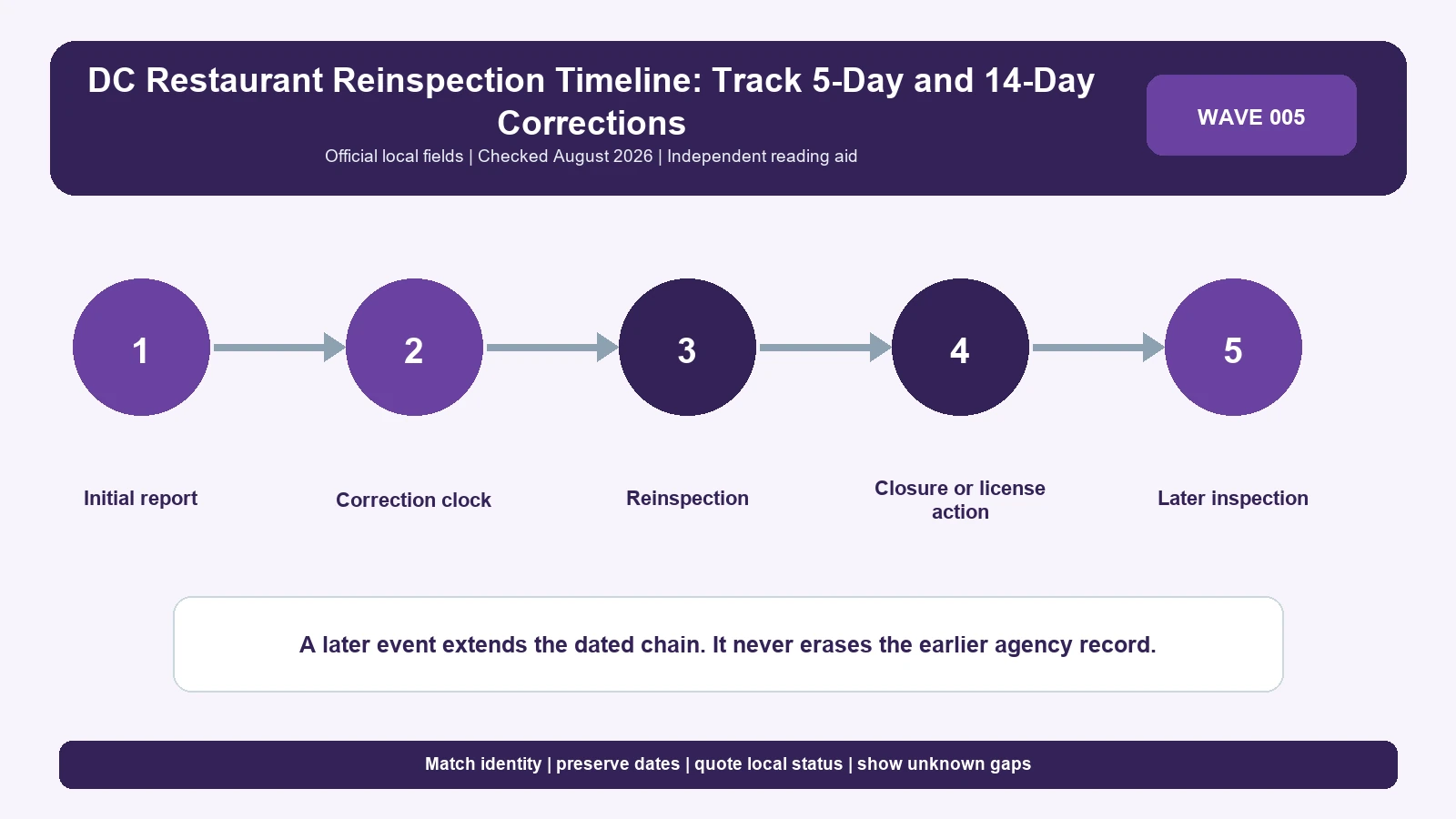
Review the inspection report’s assigned correction deadline before building a DC restaurant reinspection timeline. Under 25-A DCMR §§ 4410–4412, Priority and Priority Foundation violations generally must be corrected during the inspection. DC Health may allow or specify more time based on the potential hazard and corrective-action complexity, but that period may not exceed five calendar days after the inspection. Core violations generally must be corrected by a DC Health-specified date no later than fourteen calendar days, although DC Health may approve a longer written compliance schedule when no health hazard will result. These are correction deadlines, not guaranteed reinspection dates; the later dated report proves what happened.
Last checked: September 1, 2026.
Retrieve the establishment reports through DC Health Food Establishments, apply field definitions from the DC Health guide to food establishment inspections, and use DC Health Division of Food for the responsible program route. The current category overview is useful, but use the official 25-A DCMR final rulemaking—especially §§ 4410–4412 on PDF pages 197–198—for the correction rules and exceptions. Keep each policy citation beside the report date to which it was applied.
Anchor the chain to the BBL and license period
Record the establishment name, full address, Basic Business License number, and license period from the original report. Recheck them at every event. A new license at the same address may represent a new operator, and a familiar trade name can persist after a legal change. Split the chain when the identity evidence does not support continuity.
| Identity field | Timeline use | Mismatch signal | Response |
|---|---|---|---|
| BBL number | Primary public license link | Number changes | Open a new candidate history |
| License period | Places the event within authority to operate | Event falls outside displayed period | Verify with DC Health |
| Name and address | Confirms location and operation | Branch or suite conflict | Do not merge |
| Establishment type | Explains operational context | Type changes materially | Record dated change |
| Risk category | Preserves program context | Category changes | Do not call it performance movement |
Sort violations into COS, five-day, and fourteen-day lanes
First preserve every cited item and category. A COS mark ends the correction question for that item during the visit and, according to DC Health, does not count toward possible reinspection. Under § 4410, Priority and Priority Foundation violations generally must be corrected during the inspection; only a period allowed or specified by DC Health may run as long as five calendar days. Under § 4412, Core violations generally have a DC Health-set deadline no later than fourteen calendar days, but an approved written compliance schedule may extend beyond fourteen days if no health hazard exists or will result.
| Lane | Trigger | Timeline entry | Not supported |
|---|---|---|---|
| COS | Report marks item corrected onsite | Correction recorded on inspection date | Every violation was corrected |
| Five calendar days | Uncorrected Priority or Priority Foundation item | Required correction period for that item | Closure for five days |
| Fourteen calendar days | Uncorrected Core item | Required correction period for that item | The item is insignificant |
| Immediate action | DC documents imminent hazard or suspension | Quote action and effective date | Any fail automatically closes |
Do not calculate a reinspection date by adding five or fourteen days and publish it as an event. Five days is the outside limit for a Priority or Priority Foundation correction period that DC Health allows or specifies. Fourteen days is the ordinary outside limit for Core, subject to an approved § 4412.2 written compliance schedule. These are correction deadlines, not promised reinspection dates; the city record supplies the actual return date and outcome. If the follow-up is not public, mark it not located and contact the Division of Food when the gap affects an operational claim.
Use current and historical terminology carefully
Current reports use Priority, Priority Foundation, and Core. Older DC material can describe critical and noncritical violations and legacy correction windows. Keep the vocabulary and rule source attached to the report’s era. An undated mash-up can give a reader the wrong deadline.
For every rule citation in the ledger, store the source title, access date, and the report date to which you applied it. If you cannot establish the governing terminology, transcribe the report and label the deadline uncertain instead of guessing.
Compare the return visit at item level
The follow-up may focus on selected uncorrected findings. Match the code citation, category, observation, and BBL. A later pass label is useful, but it does not by itself prove that every Core or COS item from the original report was reviewed again.
| Later-record pattern | Defensible statement | Remaining question |
|---|---|---|
| Same item marked corrected | DC recorded correction for the named item | Conditions after that date |
| Same item cited again | The later visit again records the condition | Any subsequent action |
| Item absent from follow-up | Selected follow-up does not show it | Whether it was outside scope or omitted |
| New violation appears | A later observation was documented | Whether it existed earlier |
| Only top-line result visible | DC published that event result | Item-level outcome |
The reinspection follow-up guide offers a generic crosswalk, but the DC version must retain COS and the two local correction windows. Place an ‘unknown’ value where the later report does not answer the item question.
Create a distinct lane for imminent hazards
DC Health describes conditions such as no hot water, sewage, utility loss, fire, vermin, contaminated food, foodborne-illness outbreak, inadequate refrigeration, or flood as possible imminent hazards. The agency can immediately close an establishment or suspend its license when the facts support that action. That pathway should never be inferred from an ordinary violation category.
| Operational event | Required proof | Next record | Unsafe shortcut |
|---|---|---|---|
| Immediate closure | DC action, reason, establishment, effective date | Reinspection or clearance | A fail result equals closure |
| License suspension | Explicit suspension record | Reinstatement or later license status | BBL disappears, therefore suspended |
| Hazard correction | Agency-documented corrective condition | Verification visit | Restaurant statement alone |
| Reopening | DC authorization and date | Later routine inspection if available | Delivery app is active |
Use the closure and permit-suspension guide for an operational chain. Cite the DC action itself, not merely the inspection report that preceded it. Reopening is a separate agency event and must not be inferred from a corrected item.
Build a DC deadline-and-outcome ledger
The linkable asset should preserve the report header, one child row per violation, and a separate event row for every reinspection or administrative action. Avoid a single status column that overwrites the past. A time-series ledger shows exactly when the evidence changed.
| Ledger layer | Columns | Why it matters |
|---|---|---|
| Establishment | Name, address, BBL, license period, type, risk category | Fixes identity |
| Original visit | Date, inspection type, pass-fail | Starts the record |
| Violation | Code, category, observation, COS | Assigns the correction lane |
| Due window | Five days, fourteen days, immediate action, or not applicable | Documents current rule logic |
| Follow-up | Actual date, scope, item outcome | Replaces prediction with evidence |
| Administrative action | Exact term, reason, effective date | Separates closure from findings |
| Provenance | Official URL and retrieval time | Makes updates auditable |
Version the ledger by appending rows. Do not change an original fail to pass after reinspection; record both dated outcomes. Do not erase a COS violation; retain its observation and the onsite correction. This preserves history while allowing the current editorial summary to change.
Investigate missing DC events without filling the gap
- Search by BBL, name, and full address.
- Check the report’s license period.
- Separate COS items before expecting a reinspection.
- Allow for the public posting process.
- Record every official search route and access date.
- Ask the Division of Food when the missing event changes a closure or reopening statement.
A blank public sequence does not prove that DC took no action. It may reflect identity mismatch, publication lag, retention, or an unavailable document. Write the research result narrowly: ‘No later report was located in the checked official route on August 7, 2026.’
End with a dated DC event, not a safety promise
The last record can show that DC Health documented correction, conducted a reinspection, imposed an action, or restored authority on a specified date. It cannot guarantee current conditions or establish that no later event exists. A public-health timeline should make its cutoff visible.
Use the DC restaurant inspection lookup guide when the establishment record remains uncertain. Once matched, the reliable sequence is the original report, COS filtering, the correction deadline actually assigned under §§ 4410–4412, the verification or follow-up event if it is published, and any separately verified operational action. Do not convert a violation category alone into a scheduled return date.
DC timeline questions
Does COS count toward possible reinspection?
DC Health says a violation corrected onsite does not count toward possible reinspection. Other uncorrected items can still require follow-up.
Are five and fourteen days closure periods?
No. They are correction deadlines, not closure periods or guaranteed reinspection dates. Priority and Priority Foundation violations normally must be corrected during inspection, with any period allowed by DC Health capped at five calendar days. Core violations are normally due by a DC Health-set date no later than fourteen calendar days, subject to an approved longer written compliance schedule under § 4412.2.
Can a later pass erase an earlier fail?
No. Keep both dated reports and describe the later event as an addition to the history.
Verify every DC deadline and action transition
Classify each original violation as COS, Priority or Priority Foundation, Core, or an explicitly documented imminent hazard, then record the deadline actually shown or supported by the rule. Immediate correction is the Priority and Priority Foundation default; a period allowed by DC Health may run up to five calendar days. Core generally runs no later than fourteen calendar days unless DC Health approves a longer written compliance schedule. Keep policy evidence separate from the actual later event. Adding days to the inspection date does not create a reinspection record, and a pass-fail result alone does not create a closure order.
- Carry BBL, address, and license period through every event.
- Remove COS items from possible-reinspection counting only as DC directs.
- Store the maximum correction window as policy, not event date.
- Use the actual follow-up report to determine item outcome.
- Require separate DC evidence for suspension and reopening.
- Preserve historical category terminology when the chain crosses rule eras.
Review the final row for overstatement. If the last document is a reinspection, name its scope and item outcomes. If the last document is an immediate closure, do not announce reopening without a later DC clearance. If no later report appears, write that no matching event was located through the checked date. The public timeline is an evidence cutoff, never a current-safety certificate. Preserve the precise search inputs as well, because a later researcher must distinguish a genuinely new event from a record that an earlier name-only query failed to return.
Scope: DC Health inspection, correction, and dated enforcement records. This independent chronology does not establish a restaurant’s current operating status or current safety conditions.