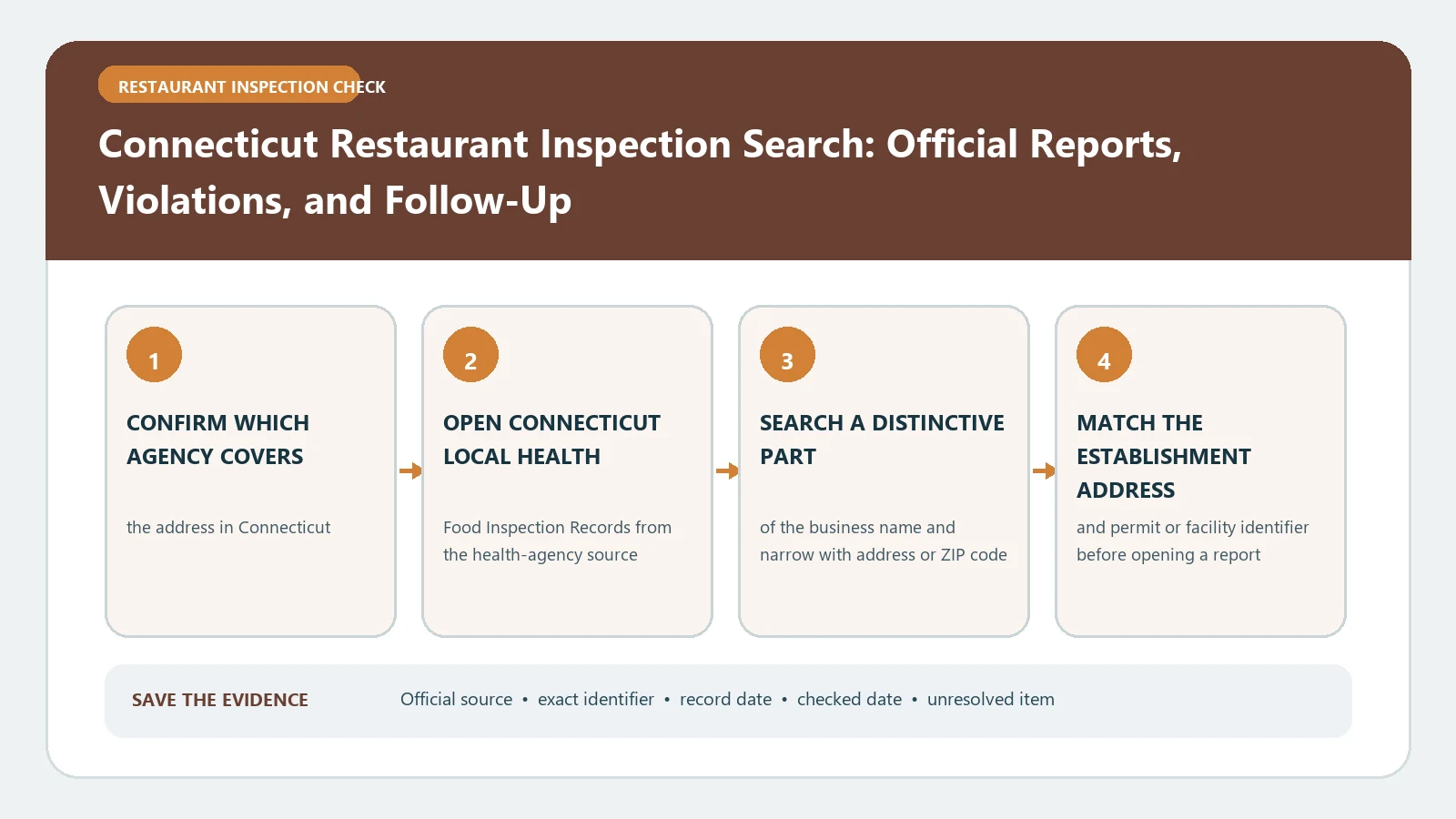
Search Connecticut Local Health Food Inspection Records by establishment name and address, then open the dated inspection report rather than relying on a standalone score or grade. A past inspection describes conditions observed at that visit and does not guarantee the restaurant's current condition.
A useful connecticut restaurant inspection search result needs more than a screenshot of the first result. Use Portal CT and DATA CT, verify the matched subject, and preserve enough context for another person to reproduce the lookup.
Authority and scope come before the search box. For Connecticut Restaurant Inspection Search: Official Reports, Violations, and Follow-Up, confirm the publisher of Connecticut Local Health Food Inspection Records, the territory or population it covers, and the date of the material. Only then use the result list to reach the detailed record. This order matters because a plausible name match can hide the wrong authority, record type, route, property, product, or effective period.
| Official source | Use it for | Save with the result |
|---|---|---|
| Portal CT | Start the lookup and identify the current public record | Input used, matched subject, record identifier, status, and displayed date |
| DATA CT | Read definitions, instructions, dates, and scope limitations | Authority name, page title, definition relied on, and review date |
The sources perform different jobs. One locates the subject, another explains inspection date and type, and a linked file may establish closure or permit action when published. For Connecticut Restaurant Inspection Search: Official Reports, Violations, and Follow-Up, note beside each fact which page supplied it. That small source map prevents an old summary or private directory from inheriting authority it does not have.
Match the subject before interpreting a result
Start with the hardest-to-confuse field available for Connecticut. Pair establishment or DBA name with city or ZIP code, then use street address as a cross-check. Record every version entered into Connecticut Local Health Food Inspection Records; otherwise a no-result screen cannot be distinguished from a formatting failure.
| Input to collect | How to record it | Mistake to avoid |
|---|---|---|
| establishment or DBA name | Copy it from the original record; do not normalize it from memory. | Do not publish personal or sensitive identifiers in a shared note. |
| street address | Record the value before the lookup so search changes remain visible. | Do not publish personal or sensitive identifiers in a shared note. |
| city or ZIP code | Use the format requested by the official search form. | Missing punctuation or a unit can change the result set. |
| permit or facility identifier | Keep a second corroborating identifier when names or addresses can repeat. | A close match can still belong to a different record. |
Separate the public evidence card from confidential supporting records. The card can name establishment or DBA name and the matched public record while a protected file holds any sensitive proof. Note the search method because results from an address, name, number, map, or date filter are not interchangeable.
A step-by-step verification workflow
- Confirm which agency covers the address in Connecticut.
- Open Connecticut Local Health Food Inspection Records from the health-agency source.
- Search a distinctive part of the business name and narrow with address or ZIP code.
- Match the establishment address and permit or facility identifier before opening a report.
- Read the latest routine report together with complaint, reinspection, and closure records.
- Use the agency contact or records process if a report is missing, ambiguous, or too old for the decision.
Do not stop at the first plausible row. Move from search input to identity match, then from status to definition, and finally to the dated next action. For Connecticut Restaurant Inspection Search: Official Reports, Violations, and Follow-Up, a second search using street address is a useful control. Save database silence as a limited observation rather than a clearance.
Translate the result one field at a time
The safest interpretation begins with literal transcription. Copy the value for score, grade, or compliance status, open any explanatory link, and state only what that source supports. Avoid upgrading an informational map, preliminary screen, historical inspection, registry entry, or application stage into a final decision.
| Result field | Verification action | Interpretation limit |
|---|---|---|
| inspection date and type | Keep current and historical entries in separate rows. | A prior inspection is a dated observation, not a guarantee of present sanitation or safety. |
| score, grade, or compliance status | Open the detailed record or linked document before interpreting it. | A prior inspection is a dated observation, not a guarantee of present sanitation or safety. |
| violation text and severity | Transcribe the displayed wording and date exactly. | Complaint, closure, and reinspection records may appear in separate fields or systems. |
| corrective action | Open the detailed record or linked document before interpreting it. | A prior inspection is a dated observation, not a guarantee of present sanitation or safety. |
| reinspection or follow-up date | Open the detailed record or linked document before interpreting it. | Complaint, closure, and reinspection records may appear in separate fields or systems. |
| closure or permit action when published | Keep current and historical entries in separate rows. | Complaint, closure, and reinspection records may appear in separate fields or systems. |
Keep record time and lookup time separate. Connecticut Local Health Food Inspection Records may display an issue, effective, expiration, inspection, modification, or publication date; the day you opened it is an additional field. For Connecticut Restaurant Inspection Search: Official Reports, Violations, and Follow-Up, retain each label and flag a missing date rather than inferring chronology from page order.
The table below converts connecticut restaurant inspection search from a loose search into a structured check. It is tailored to Connecticut: identity first, scope second, status third, and next action last. Preserve the source wording so future updates can be compared line by line.
Save a result another reader can reproduce
Turn the lookup into a citation asset by recording both evidence and uncertainty. For connecticut restaurant inspection search, the strongest reusable note shows the exact official URL, matched identifier, observed value, governing date, access date, and the next unresolved agency question.
| Evidence field | What to enter | Why it matters |
|---|---|---|
| Target | Connecticut Restaurant Inspection Search: Official Reports, Violations, and Follow-Up | Names the exact record or decision being checked |
| Official source | Portal CT | Preserves the issuing authority rather than a copied summary |
| Search input | Exact name, address, number, parcel, model, route, or other identifier used | Makes the result reproducible |
| Matched record | Displayed identifier, jurisdiction, and record type | Shows why the result belongs to the intended subject |
| Observed result | Status or field copied without expanding its meaning | Separates evidence from interpretation |
| Dates | Record date, effective date, and checked date in separate fields | Exposes stale or superseded information |
| Unresolved item | Specific missing field, conflict, or agency question | Prevents silence from becoming a false conclusion |
A screenshot or downloaded public file can preserve context, but it cannot replace the live URL. Capture the jurisdiction, legend, record identifier, and date when permitted. Label whether the evidence came from a result list, detailed record, map layer, report, notice, or agency response so the citation can be audited later.
When the official systems disagree
A stale record often looks complete. Check for renewal, modification, follow-up, expansion, rescission, or replacement activity after the displayed date. Keep the earlier record for history, label the newer source clearly, and obtain confirmation if the conflict changes the decision tied to Connecticut.
- Inspection systems and grade scales differ by jurisdiction and cannot be compared as if they were one national scale.
- A prior inspection is a dated observation, not a guarantee of present sanitation or safety.
- A missing online report may reflect spelling, ownership, jurisdiction, publication lag, or records-retention limits.
- State the exact unresolved question and include the record identifier in a private agency inquiry.
- Recheck after an agency update, correction, inspection, filing, map revision, or policy effective date.
- Keep the earlier result when change history matters; label it superseded rather than silently replacing it.
The next task may need a different owner page. Review restaurant inspection check by city, restaurant health inspection report guide and food inspection reports violations, then choose only the guide that answers the adjacent question. These pages organize the workflow; Connecticut Local Health Food Inspection Records and its issuing authority remain the evidence source for Connecticut Restaurant Inspection Search: Official Reports, Violations, and Follow-Up.
Does an official search result prove the final outcome?
The system output is one documented observation. Preserve it exactly, then complete any separate check named by the authority. Do not turn a database label into a guarantee the issuing page never offers.
Check the format of establishment or DBA name, try street address, confirm jurisdiction, and look for an archive or document system. Save the failed query and checked date. For a consequential matter, contact the authority rather than interpreting silence as clearance.
How often should the result be checked again?
There is no universal interval. Recheck when the governing date approaches, when new information is submitted, and before relying on Connecticut Restaurant Inspection Search: Official Reports, Violations, and Follow-Up for money, safety, travel, property, or eligibility decisions.
Use this page to structure the work, but cite Portal CT and DATA CT for the fact. Include the record or document title, public identifier, relevant date, live URL, and access date so another reader can return to the evidence.
Last reviewed August 6, 2026.