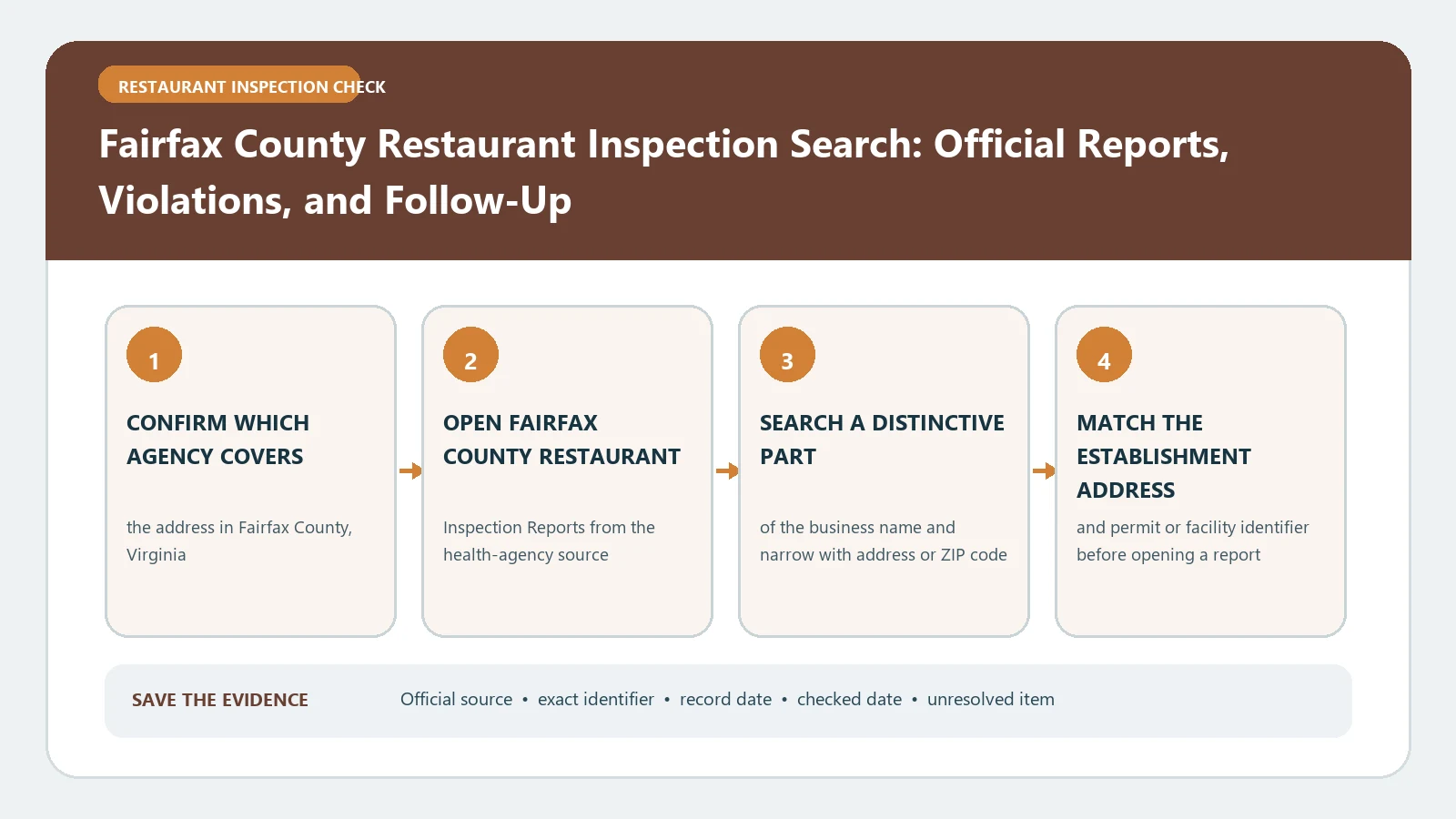
Use Fairfax County’s Food Establishment Inspection Reports page to open the official database, match the restaurant and address, and read a series of dated reports rather than judging the facility from one visit. Fairfax says reports are generally available about two weeks after inspection, so a recent visit may not yet appear online.
The county’s Food Establishment Inspection Reports page covers food establishments in Fairfax County, the City of Fairfax, and the City of Falls Church and links the public report database. The broader Fairfax Food Safety page provides the program, permit, complaint, and Environmental Health contact routes. Both official sources were checked August 26, 2026.
Confirm that Fairfax is the inspecting authority
Begin with the full street address. The county page includes Fairfax County and two named cities, but an address elsewhere in Northern Virginia may belong to another health district. Confirm the jurisdiction before interpreting a familiar restaurant name.
Within the database, compare the establishment name, address, and any permit or facility identifier. A grocery store, school, hotel, or food court can contain multiple inspected operations. Keep separate records separate, even when they share a building or brand.
If the business moved or changed ownership, do not combine the old and new history without an official identifier connecting them.
Account for the publication delay
Fairfax states that inspection reports are available approximately two weeks after inspection. When the latest visible report is older than expected, record the online lookup date and wait through the stated publication window before calling the history incomplete.
For a time-sensitive concern, contact Environmental Health rather than assuming that no newer visit occurred. A database is a publication surface, not a live view of every inspection in progress.
The delay also affects comparisons. A restaurant may display a current document at the premises before the corresponding online report appears. Preserve both dates and let the county resolve any mismatch.
Read one report as a dated observation
Open the matched report and capture the facility identity, inspection date, inspection type, observations or violations, correction language, and any required follow-up. Keep every finding attached to that inspection.
Fairfax explicitly says the report describes conditions found at the time of inspection and that a single inspection should not be used to evaluate an establishment. The correct unit is therefore a visit, not a permanent restaurant grade.
Use the restaurant report-reading guide to arrange the document into identity, visit, finding, correction, and next-action fields. The county report remains the source.
Compare the series without erasing earlier findings
After opening the first report, return to the facility history and sort the other visits by date. Look for a later inspection that addresses the same issue or a follow-up visit. Record what that later report actually says.
A later report can document changed conditions, but it does not make the earlier observation disappear. Conversely, an old violation cannot establish that the condition is present today. A useful timeline keeps both visits and describes the evidence at each date.
Include the report’s inspection type when the database supplies it. A routine visit, complaint response, follow-up, and preopening review answer different questions even when they occur at the same premises. If two reports share a date, retain both document references until the county confirms whether one is a corrected copy or a separate event. This prevents a document update from being counted as another inspection and keeps a complaint-related visit from being summarized as routine surveillance.
When sharing the timeline, place the report URL beside each visit rather than linking only the database home page. That lets the next reader verify the exact document and see whether Fairfax later replaced or supplemented it.
The food-inspection violation guide can help interpret common report organization, but do not replace Fairfax’s wording with a national severity label.
Treat imminent-hazard closures as case-specific events
Fairfax explains that an establishment posing an imminent public-health hazard must stop operations and remain closed until the hazard is removed. The county gives examples such as fire, flood, loss of electricity or water, sewage backup, toxic-material misuse, an apparent outbreak, or a gross unsanitary condition.
That rule does not mean every cited violation caused closure. Make a closure statement only when the matched report or a separate county record documents it. Then search for the later county action supporting reopening rather than inferring reopening from a business listing.
Recover a no-result search in controlled steps
If the full name fails, remove punctuation, search a distinctive word, and try the street address. Search a former name if ownership changed. Verify that the database filters include the correct locality and establishment type.
Save the failed query, filters, and date. A missing result may reflect spelling, a new operation, the two-week publication lag, or a different jurisdiction. It does not establish no permit, no inspection, or compliance.
When the record remains unclear, contact the Division of Environmental Health with the exact name, address, approximate inspection date, and any identifier. For another jurisdiction, use the city inspection directory only to find the appropriate official source.
Separate a complaint from the published history
Fairfax routes general and foodborne-illness complaints through its PLUS system and provides a tracking number for submitted foodborne-illness complaints. Use that current channel when the concern is something observed or experienced now.
A complaint submission is not itself an inspection finding. Store its tracking record separately. If the county later publishes an inspection tied to the facility, add that dated visit to the history without claiming more than the official report supports.
Save a Fairfax report packet with clear limits
The final packet should contain the matched establishment and address, jurisdiction, report dates, visit types, findings, corrections, later inspections, source URLs, and retrieval date. Note whether the most recent possible visit could still be inside the county’s publication window.
This packet documents Fairfax’s published inspection history as of one date. It does not certify current safety or establish that no unposted event exists. Reopen the county database before an important decision and use the agency contact route when the latest report is missing.