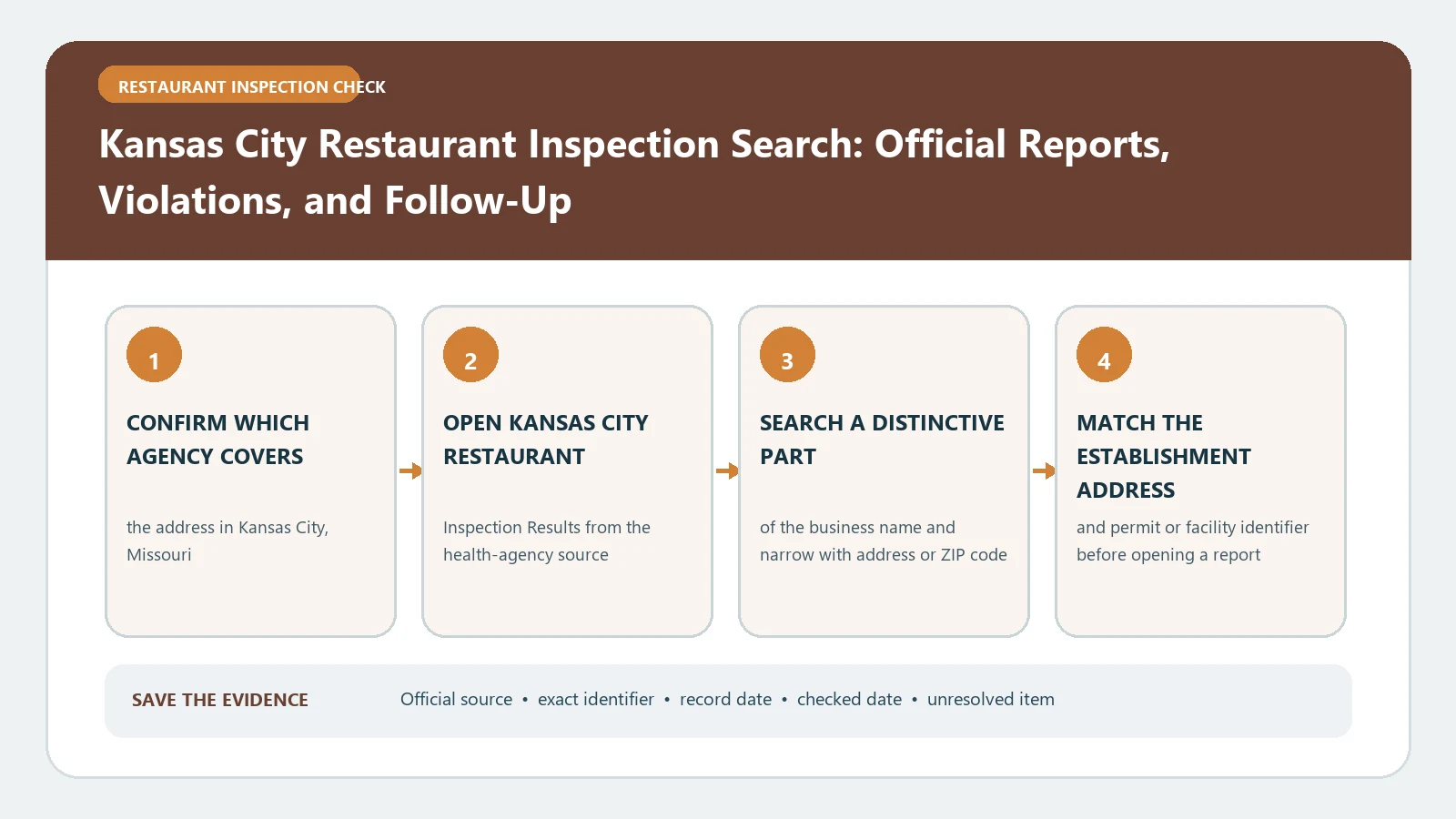
Kansas City, Missouri advises readers to judge a restaurant’s inspection history over time, not by one visit. Open the city’s Restaurant Inspection Results route, match the establishment to its address, and build a dated sequence. The city says the online information is updated daily and that detailed public records can also be examined through the Health Department.
The Kansas City Restaurant Inspection Results page explains the source, update frequency, snapshot limitation, and records contact. The Environmental Health Services page confirms that restaurant inspections and food-vendor complaints belong to the Health Department’s Food Safety Program. These official pages were reviewed August 26, 2026.
Confirm that the address is in Kansas City, Missouri
The regional name Kansas City crosses a state line and includes nearby jurisdictions. A Kansas mailing address, a Kansas City, Kansas location, or a suburban municipality does not belong in the Kansas City, Missouri Health Department search. Write down the street address, state, and ZIP code before opening any result.
Within KCMO, search the exact name and then the address. Chains, shared kitchens, hospitals, schools, and renamed restaurants can create several plausible matches. Preserve any facility or permit identifier shown and do not merge branches simply because their names match.
Assemble the inspection history in date order
For every matched visit, save the establishment identity, address, inspection date, visit type, result, and report link. Then sort the visits from earliest to latest. Kansas City says the reported conditions are those found at the time of inspection and that one inspection should not be used to evaluate the establishment.
Build each row in a fixed order:
- Copy the name, address, and facility identifier.
- Save the inspection date, type, and exact result.
- Link the report or note that only the online summary was available.
- Add the next matching visit and the retrieval date.
The useful question is whether the series shows an initial finding, a later inspection, and a consistent identity. A newer visit adds evidence but does not delete an older one. Keep both, along with the date you retrieved them.
If you need a neutral place to capture the visit fields, use the restaurant health inspection report guide without changing the city’s result wording.
Distinguish online history from the detailed public file
The city places inspection information online, while detailed inspection records are available for examination at the Health Department office during regular working hours. Use the online history for discovery and chronology. Use the detailed file when you need inspector notes, a document not exposed online, or support for a formal claim.
When requesting detail, provide the exact restaurant name, street address, date range, and any identifier from the result. A narrow request is easier to match than a request for every restaurant with a common brand name. Record which source supplied each fact so an online result is not mistaken for a complete paper file.
Follow a concerning result instead of freezing it in time
After a failed or concerning inspection, move forward in the same establishment history. Compare the later inspection type, result, and findings. A reinspection can show what the agency observed later, but it cannot guarantee conditions after that date.
If no later record is visible, note the gap and contact the Health Department’s food-inspection program. Publication delay, a changed permit identity, or a detailed record available only through the office can explain the absence. Do not call the issue corrected or unresolved solely from a blank online interval.
The reinspection follow-up guide can help separate the original observation, later visit, and remaining question.
Send active complaints through the Food Safety Program
Kansas City separates historical inspection lookup from current complaint reporting. The Environmental Health Services page routes restaurant or food-vendor complaints through the Food Safety Program. Use that path when the issue is happening now rather than assuming an old report will trigger action.
Provide the establishment name, address, date and time, and a factual description. Do not embellish the complaint with an unrelated historic violation. Likewise, do not treat the filing of a complaint as proof that the allegation was confirmed or that a new inspection occurred.
Repair identity and search failures
If the restaurant is missing, search a former name, shorten the current name, and test the street address. Check whether the business moved or crosses the Missouri-Kansas jurisdiction boundary. If several results share an address, compare identifiers and facility type before choosing.
Because the city’s online system is updated daily, save the lookup date and recheck when timing matters. A no-result screen does not establish permit status, inspection status, or compliance. Ask the Health Department for the detailed record when the identity remains uncertain.
Keep a short failure log showing the name variants, address format, jurisdiction check, and date range tried. When you contact the department, include that log with the desired inspection window and identifier. It reduces the chance that a broad regional name or a Kansas-side address will be mistaken for a missing KCMO record.
When an online report link opens a document, save its visit date and document identity beside the row. If it opens a general landing page instead, record that limitation and use the detailed-file route. A working link alone is not evidence that the page contains the specific inspection discussed.
Document the outcome of that attempt as report opened, summary only, access failed, or detailed record requested. This gives the next reviewer a concrete starting point and prevents the same shallow link from being treated as a completed inspection review.
Finish with a KCMO chronology, not a rating
The final note should identify the Kansas City, Missouri premises, list the dated inspection results, show any later visit, and distinguish online information from documents examined through the Health Department. Add the retrieval date and unresolved record request.
This site does not issue restaurant ratings or certify current conditions. The city expressly favors results over time, so the most faithful conclusion is a bounded chronology. For locations governed by another agency, use the inspection directory by city before interpreting any result.