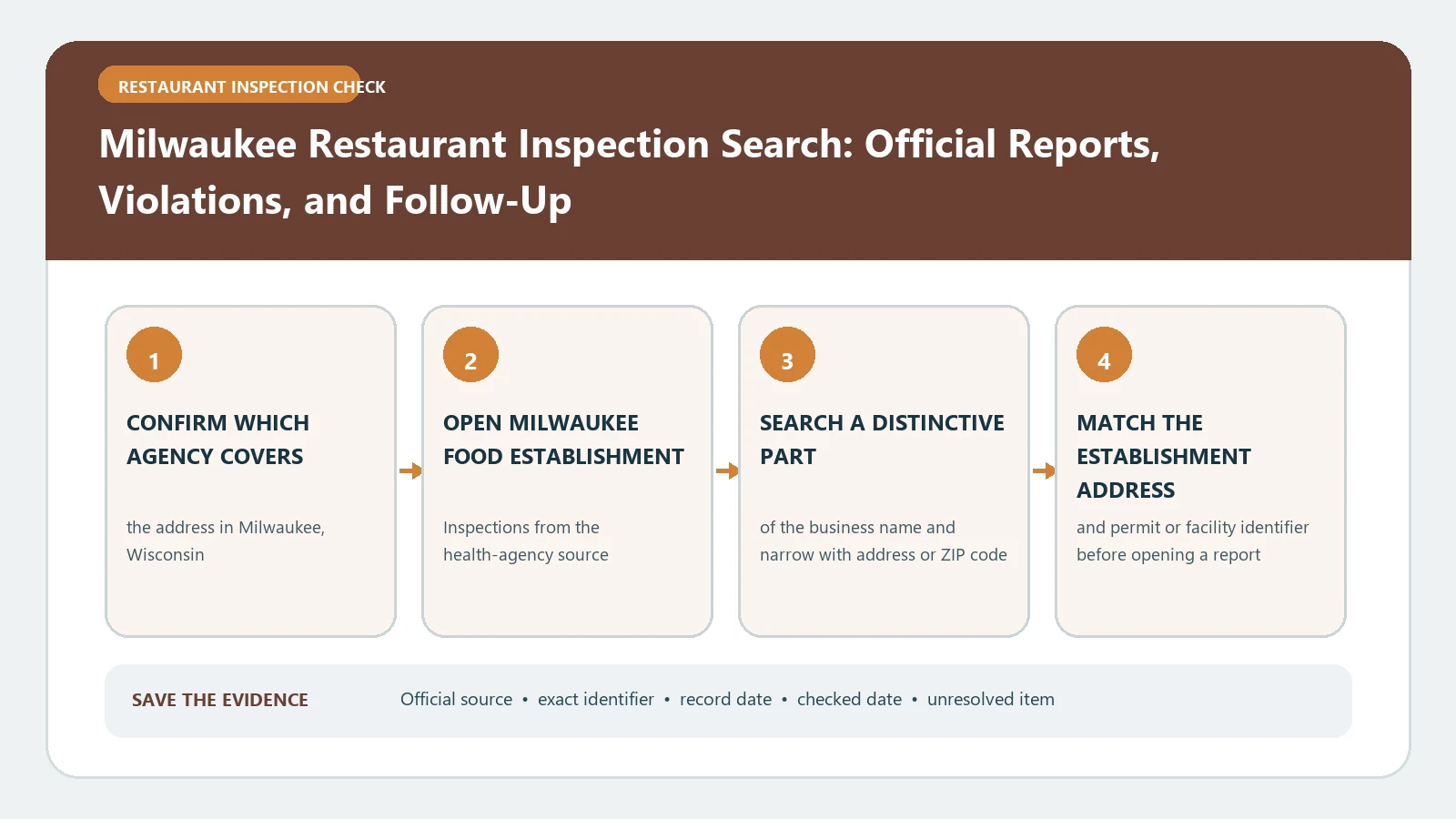
For a Milwaukee restaurant, open the City of Milwaukee’s current food-inspection search, match the exact address, and distinguish the posted letter grade from the score for any single inspection. Milwaukee calculates the displayed grade from as many as three routine inspections using stated weights, so one report cannot be treated automatically as the restaurant’s final posted grade.
The city’s current shortcut, Milwaukee food inspections, leads to the active search system. The Health Department’s food sanitation grading page explains grade thresholds, inspection weights, violation deductions, and placard rules. The city also maintains a historical inspection portal for records from the earlier system. These official sources were checked August 26, 2026.
Take the current-or-historical fork first
Choose the search route according to the date you need. Use the current city shortcut for recent inspections and the historical portal for older records, including records before the current system’s coverage. A historical result can be useful background, but it should not be presented as the restaurant’s latest grade.
Write the portal name and retrieval date beside every saved report. If a search-engine result opens an old city application, return to the Health Department page and follow its current link. Portal age matters because a perfectly matched historical facility can still omit years of newer inspections.
For restaurants outside the City of Milwaukee, identify the responsible jurisdiction through the city-by-city inspection directory. Do not apply Milwaukee’s grading formula to a neighboring municipality merely because the mailing address says Milwaukee.
Match the operation behind the placard
Verify the official facility name, street number, street name, unit, ZIP code, and any establishment identifier. A hotel, arena, market, school, or shared address may contain several licensed food operations. Chain branches must be treated as separate facilities.
When an older operator and a newer business occupy the same address, compare identifiers and opening periods. Do not transfer an old grade to the new operator without an official link. Try shortened names, legal names, and address-only searches if the public-facing name does not return a result.
Save a small identity block before reading scores: the matched official name, address, identifier, current or historical portal, and checked date. This prevents a convincing numerical result from being attached to the wrong location.
Read the letter grade as a weighted history
Milwaukee’s official grading page states that an A corresponds to 100 through 79 points, a B to 78 through 60 points, and a C to a score below 60. A facility scoring below 60 can be closed until the violations are corrected. The letter on the mandatory placard is therefore meaningful, but its calculation still needs context.
The city calculates the final sanitation grade using the three most recent routine inspections when available: 50 percent for the most recent, 35 percent for the second most recent, and 15 percent for the third. A newly opened facility or one without three eligible routine inspections may have a shorter history. Record the component inspections visible in the official system rather than reverse-engineering missing values.
Use the Milwaukee health-score guide to keep these elements separate:
- the score for the latest routine inspection;
- scores and dates for earlier routine inspections used in weighting;
- the calculated final score or letter grade shown by the city;
- any later reinspection, closure, or placard change.
Do not average all visible reports yourself. Complaint, reinspection, or other visit types may not be components of the published weighted grade.
Connect point deductions to violation classes
The Health Department explains that routine inspections begin at 100 points and deduct points according to the violation category: five points for a Priority violation, three for a Priority Foundation violation, and two for a Core violation. Preserve the city’s category and description for each observation.
Priority, Priority Foundation, and Core are not interchangeable labels. A higher deduction signals how Milwaukee applies its grading method; it does not by itself establish that a diner became ill or that the business was ordered closed. Read the inspection result, total score, and any correction information together.
If a report lists repeated items, keep each item attached to its inspection date. A later routine inspection can influence the weighted grade without deleting the earlier report. For a plain-language worksheet, use the food-inspection violations guide, while retaining Milwaukee’s official terms in your evidence.
Trace a closure through the next city action
A score below 60 or an imminent health hazard can trigger closure under the city’s published framework. If you encounter a closure, capture the date, inspection type, score, cited conditions, and the exact operating-status language. Then look for the next official inspection or placard action for the same identifier.
Closure and grade are related but distinct. A historic C or closure does not prove the facility remains closed today. A later reopening also does not erase the report that prompted the action. Build a chronology through the most recent visible visit, and mark the current state as confirmed, superseded, or unclear based on official records.
The closure and permit-suspension check can hold the event sequence without turning a past enforcement action into a present-tense claim. If the question is urgent and the portal has not caught up, contact the Milwaukee Health Department directly.
Explain a missing Milwaukee result cautiously
When the current search returns nothing, repeat the search with the address and legal business name. Check whether the facility is in another municipality, operates inside a larger licensed establishment, or recently changed ownership. Then check the historical portal if the requested period falls within its coverage.
Do not infer an A grade, no violations, or exemption from a blank result. Search tools can have spelling differences, coverage limits, delayed entries, and separate facility records. Preserve the failed query and time checked before requesting assistance from the city.
If the current and historical systems overlap or appear to conflict, keep both records and their dates. Prefer the active system for current status, and describe the historical system only as the source for the older inspection. A clear source boundary is stronger evidence than silently choosing the more favorable grade.
Finish with a Milwaukee inspection card
Your final note should contain the matched facility identity, portal used, routine-inspection dates and scores, weighted final grade as published, violation categories, any closure or reinspection sequence, source links, and retrieval date. Identify gaps instead of filling them with assumptions.
A sound conclusion says that Milwaukee’s official sources displayed a particular grade and inspection history for the matched facility on the check date. It does not guarantee current kitchen conditions, predict the next grade, certify that every violation remains corrected, or replace a direct Health Department answer about an active public-health concern.