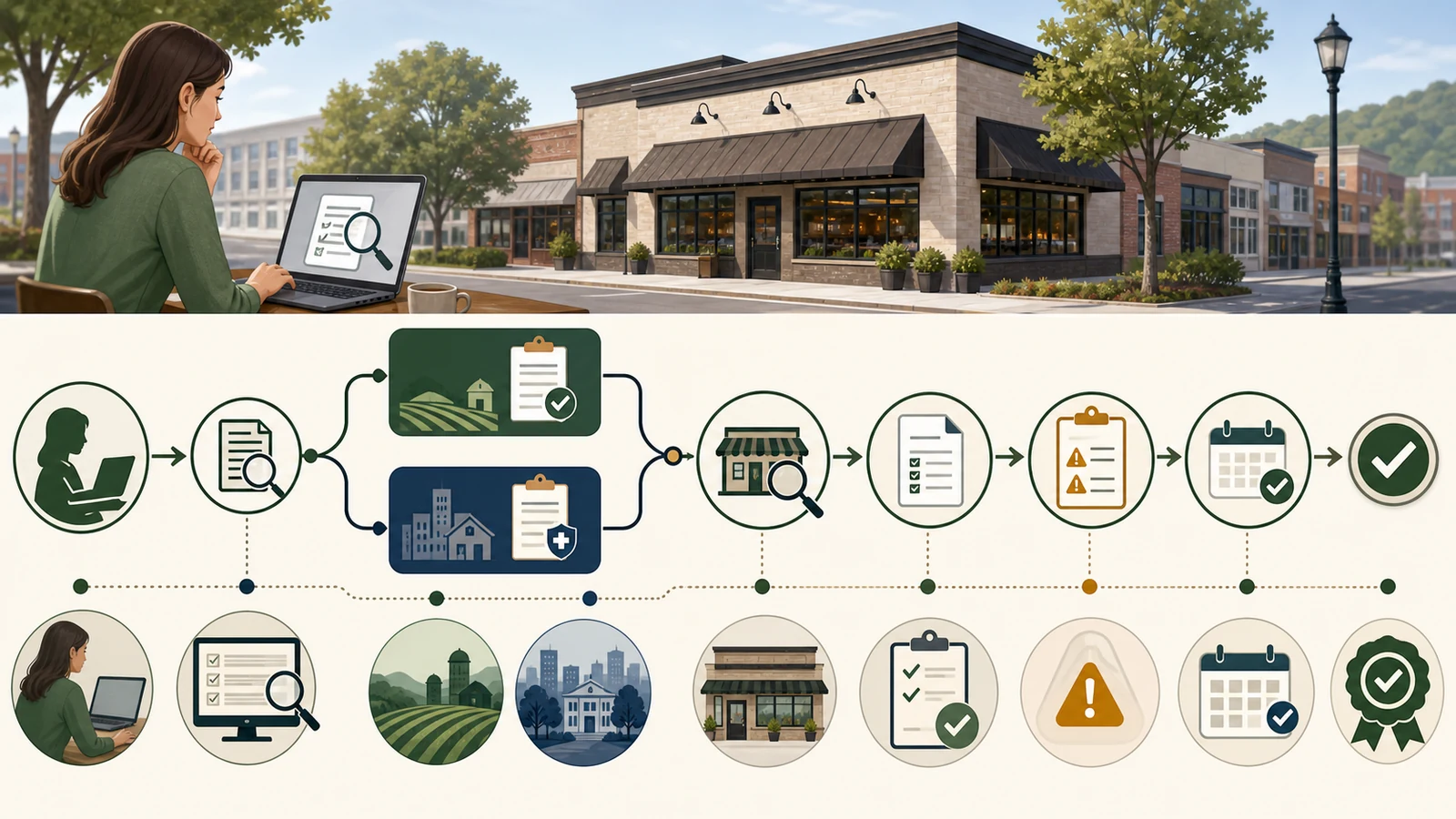
To find a Pennsylvania restaurant inspection report, determine the inspecting jurisdiction for the street address before searching by restaurant name. Use the Pennsylvania Department of Agriculture’s Food Safety Jurisdiction Search first. If the result points to PDA, open the official Search for Inspection Results. If it points to a county or municipal health department, use that local agency’s records route; not every local result appears in the state database.
This address-first step prevents the most common false conclusion: “no state result” does not mean “no inspection.” Pennsylvania divides retail-food licensing and inspection among the Department of Agriculture, seven county health departments, and additional municipal programs. Restaurant Inspection Check is an independent guide, not the Commonwealth or a health department. Official Pennsylvania sources reviewed August 1, 2026.
Find the agency that covers the restaurant’s address
The Department of Agriculture’s Retail Food page says not all retail food facilities fall under PDA. It currently identifies Allegheny, Bucks, Chester, Delaware, Erie, Montgomery, and Philadelphia as counties with their own health departments. It also says some municipalities, boroughs, townships, and cities conduct their own licensing and inspections.
Do not choose an agency from the county name alone. A municipality inside a county can have its own program, and local arrangements can change. Enter or locate the actual facility address in the Food Safety Jurisdiction Search and keep the displayed jurisdiction name with your notes.
| Jurisdiction result | Inspection-report route | Important limit |
|---|---|---|
| Pennsylvania Department of Agriculture | PA Food Safety inspection search | The state system covers PDA records and only local programs that use or post through it |
| County health department | The county’s official inspection or environmental-health page | County methods, portals, and publication schedules can differ |
| Municipal, city, borough, or township program | That local program’s official record or contact | A restaurant may be absent from both a county portal and the PDA search |
| Jurisdiction cannot be confirmed | PDA Retail Food guidance | Do not rely on a name-only search; contact PDA or the likely local agency with the full address |
The statewide Retail Food Inspection Reports page says inspection results on the department website include PDA facilities and county or local departments that have elected to post there. It reports that more than 60 local health-department results can be found in the system, but it also warns that facilities in nonparticipating local jurisdictions will not appear.
That is why the jurisdiction result controls the workflow. The state database can contain local records, but its absence cannot replace an address-specific authority check. The site’s restaurant inspection check by city guide explains the same boundary problem in other states.
Search the PA Food Safety portal without over-narrowing
When PDA or a participating local program is the correct route, open Search for Inspection Results directly. The public form provides fields for an establishment name, most recent inspection compliance status, jurisdiction, street, city, state, county, ZIP code, inspection date range, and an address-radius map search. The stable Retail Food Inspection Reports page also links into this search and explains its scope.
Begin with enough information to identify the branch, but do not fill every field on the first attempt. Exact names are often unreliable because punctuation, corporate suffixes, abbreviations, or licensed names differ from storefront branding. The PDA report page recommends trying only a few letters or part of the name when the expected restaurant does not appear.
- Enter a distinctive part of the establishment name and the city or county.
- If several branches appear, add the street number and street name.
- If no result appears, remove punctuation, corporate suffixes, and unnecessary filters.
- Try the exact street address without the unit, then with the ZIP code.
- Use the jurisdiction filter only after confirming the responsible agency.
- Leave the In Compliance or Out of Compliance filter unset until you have found the facility; filtering by a guessed current result can hide the record.
- Expand the inspection date range if you are looking for an older visit or a former operation.
A chain name can return dozens of locations. The correct result requires an address match, not a logo or familiar name. For shared buildings, universities, hospitals, markets, hotels, and malls, several separately licensed food operations can occupy the same property. Use the restaurant inspection address-search guide to keep units, departments, and former names separate.
Match the facility before opening a report
Treat the public record as an identity chain: inspecting jurisdiction, establishment name, street address, facility identifier when shown, inspection date, and later follow-up. A genuine Pennsylvania report can still be the wrong report if it belongs to another branch, prior operator, or food operation at the same address.
| Inspection detail | What to verify | Mismatch to investigate |
|---|---|---|
| Establishment name | Storefront name, legal or licensed name, spelling | Corporate owner, former tenant, or another branch |
| Address | Street number, direction, unit, city, county, and ZIP | Nearby location or separate department in the same property |
| Jurisdiction | PDA, county, or municipal agency | A portal that does not regulate this address |
| Facility ID | Identifier repeated across dated reports | A new record after an ownership or licensing change |
| Inspection date and reason | Routine, follow-up, complaint, opening, or other listed purpose | A later administrative or follow-up entry mistaken for a routine inspection |
| Current or historical status | Newest matched facility record | Closed business or former operator mistaken for the current restaurant |
If the restaurant recently changed ownership or trading name, do not merge the old and new records on your own. An address can stay the same while the licensed operation changes. Save both facility identifiers and ask the inspecting agency which record applies to the current business.
Open Inspection Details and the full report
The official PDA inspection-report guidance describes two levels of information. Select the food facility name to open Inspection Details, which shows violations from the last inspection, inspector comments, and explanations of why a violation matters. From that facility screen, use view inspection report to open, print, or save the full report.
- Confirm the facility name and address at the top of the report.
- Record the inspection date and the stated reason or event type.
- Read the compliance result together with every listed violation and comment.
- Note which items were corrected during the inspection and which required later action.
- Open any follow-up inspection after the initial visit rather than summarizing the earlier report alone.
- Save the official report URL or PDF and the date accessed if you need a reproducible citation.
The portal also links to a Business Intelligence report with inspection details and visual summaries. Use that dashboard for analysis, but return to the facility-level report before making a claim about a specific restaurant. Aggregated charts can group multiple jurisdictions, inspection types, or time periods and do not replace the source report.
The restaurant health inspection report guide explains common report fields, while the food inspection violations guide focuses on risk, correction, and consequences.
Read compliance and violations under Pennsylvania’s definitions
The PDA reports page warns against counting violations. A restaurant may have several violations and still be in compliance, or it may have one violation and be out of compliance. The type, severity, correction, and inspection context determine the result.
| Pennsylvania report concept | How the state page describes it | How to read it |
|---|---|---|
| Foodborne Illness Risk Factors | Conditions such as employee hygiene, holding or storage temperatures, and approved food sources that can contribute to illness if not corrected | Check whether the item was corrected immediately; an uncorrected risk factor can put the inspection out of compliance |
| Good Retail Practices | Important practices with less potential for a significant foodborne illness than risk factors | Read severity and circumstances; one or two can require correction or follow-up without automatically determining compliance |
| Corrected on site | The violation remains on the report even when corrected before the inspector leaves | Do not erase the finding, but do not describe it as still uncorrected |
| In compliance | The facility met the program’s compliance determination for that inspection | It does not mean no violation was recorded or conditions cannot change later |
| Out of compliance | One or more findings produced that inspection result | Read the findings and later follow-up before describing current status |
On the PDA report page, Foodborne Illness Risk Factors are displayed in red. Color helps locate them but is not a substitute for the text. Read the observed condition, correction language, inspector comment, compliance decision, and next event. A red line corrected during the visit and an uncorrected risk factor have different implications.
Avoid rankings based on raw violation counts. A long report with documented minor items is not automatically worse than a short report with one uncorrected high-risk finding. Pennsylvania’s own FAQ rejects that arithmetic by explaining that one violation can be enough for an out-of-compliance result.
Follow the inspection sequence, not just the newest headline
The reason for the visit matters. The PDA page says eating and drinking establishments are inspected at least once per year under the department’s program, with additional visits possible after complaints or an initial inspection that was not passed. The report identifies the reason for each inspection. Local programs can publish under their own schedules and terminology, so preserve the jurisdiction with the event.
- Start with the latest routine or annual inspection for the matched facility.
- Read the listed findings, correction status, and compliance result.
- Identify any promised correction date or required follow-up.
- Open the later follow-up or reinspection and state what it resolved or left open.
- Check for a still-later routine inspection, closure, reopening, or ownership change.
A clear summary keeps dates and event types together. For a fictional example: “The PDA report listed Example Cafe out of compliance at its June 4, 2026 routine inspection, followed by an in-compliance follow-up on June 12, 2026.” Do not compress the two events into “the restaurant failed” or “the restaurant passed.” Use the restaurant reinspection follow-up guide when several entries must be ordered.
If the restaurant is not in the state database
A missing state result is a routing problem until proven otherwise. Work through identity and jurisdiction before concluding that no record exists.
- Return to the Food Safety Jurisdiction Search and verify the exact address.
- Check whether a county, city, borough, township, or municipal agency is responsible.
- On the state search, try only a distinctive fragment of the restaurant name.
- Search the street number and street name without a suite, then add the city or ZIP.
- Try a legal operator or former name if the business recently changed branding.
- Remove the compliance-status and date filters so they cannot hide the facility.
- Contact the responsible local department if it does not publish through the PDA system.
- For an older or inactive business, ask whether archived reports require a records request.
The Department of Agriculture’s own FAQ says not all Pennsylvania restaurants appear because some municipalities, counties, and cities conduct their own inspections and may not use the department’s inspection system. Phrase the result accurately. For example: “When checked on August 1, 2026, no matching record appeared in the PDA public search for the restaurant’s full name or street address.” That leaves room for a local or archived record.
Use the complaint route for current food-safety concerns
A report lookup does not submit a complaint or request a new inspection. For a current concern, use Pennsylvania’s Report a Food Safety Concern service. The Commonwealth says complaints are reviewed and routed to the correct agency; some go to PDA and others to county or local health departments, depending on the address.
The complaint form covers concerns such as suspected foodborne illness, cleanliness or pests, unsafe handling, allergen or labeling issues, and animals in a facility. Provide the business name, exact address, date and time, food or condition involved, and concrete observations. Do not use an old violation as proof that a current event has the same cause.
For a medical emergency, seek appropriate medical help. The public inspection database is a records tool, not medical advice, an outbreak confirmation system, or an emergency response channel.
What a Pennsylvania inspection report does not prove
Pennsylvania describes an inspection as a snapshot of the day and time of the visit. A report can establish the matched facility, inspecting authority, dated observations, compliance decision, and recorded follow-up. It cannot guarantee present safety, predict a future visit, measure food quality or service, or establish that a cited condition continued after correction.
A missing record does not prove the business was never inspected. An in-compliance result does not mean the report contains no violations. An out-of-compliance result does not prove the same conditions exist today. Keep the official jurisdiction, facility identity, visit type, date, finding, correction, and later event in every summary.
| Avoid this claim | Use a precise description |
|---|---|
| This restaurant has no inspection. | The PDA search returned no match for the full business name or street address when checked on August 1, 2026; the local jurisdiction still needs to be checked. |
| The restaurant is safe. | In this fictional example, the official report listed Example Cafe in compliance at its June 4, 2026 inspection. |
| Five violations means it failed. | In this example, the report listed five findings and recorded the facility in compliance; three items were corrected on site and no separate follow-up was required. |
| It failed and is still failing. | In this example, the facility was out of compliance on June 4, 2026, followed by an in-compliance reinspection on June 12, 2026. |
Questions about Pennsylvania restaurant inspection reports
Is there one database for every Pennsylvania restaurant?
No. The PDA public system includes PDA records and records from local departments that post through it, but some county and municipal programs use separate routes. Check the Food Safety Jurisdiction Search for the address first.
Which counties have their own health departments?
The current PDA Retail Food page lists Allegheny, Bucks, Chester, Delaware, Erie, Montgomery, and Philadelphia. Municipal programs also exist, so the address-specific jurisdiction tool remains the controlling check.
How do I find a restaurant when its exact name returns nothing?
Try a distinctive part of the name, then search by street address, city, or ZIP. Remove compliance and date filters. Confirm whether the responsible local agency uses a separate portal.
Can a restaurant be in compliance with violations listed?
Yes. The PDA page says violations corrected on site still appear, and a facility can have several violations yet be in compliance. It can also have one violation and be out of compliance. Read the category, correction, and result.
Where is the full inspection report?
Open the matched facility’s Inspection Details, then use the “view inspection report” link under the facility name and address. If the responsible local agency does not post through PDA, use that agency’s records route.
Does the public search file a complaint?
No. Use the Commonwealth’s Report a Food Safety Concern service, which routes complaints to PDA or the responsible local department.
The reliable Pennsylvania workflow is: confirm the address in the Food Safety Jurisdiction Search, use the state inspection search or the local portal it identifies, match the facility, open the dated report, and read correction and follow-up together.