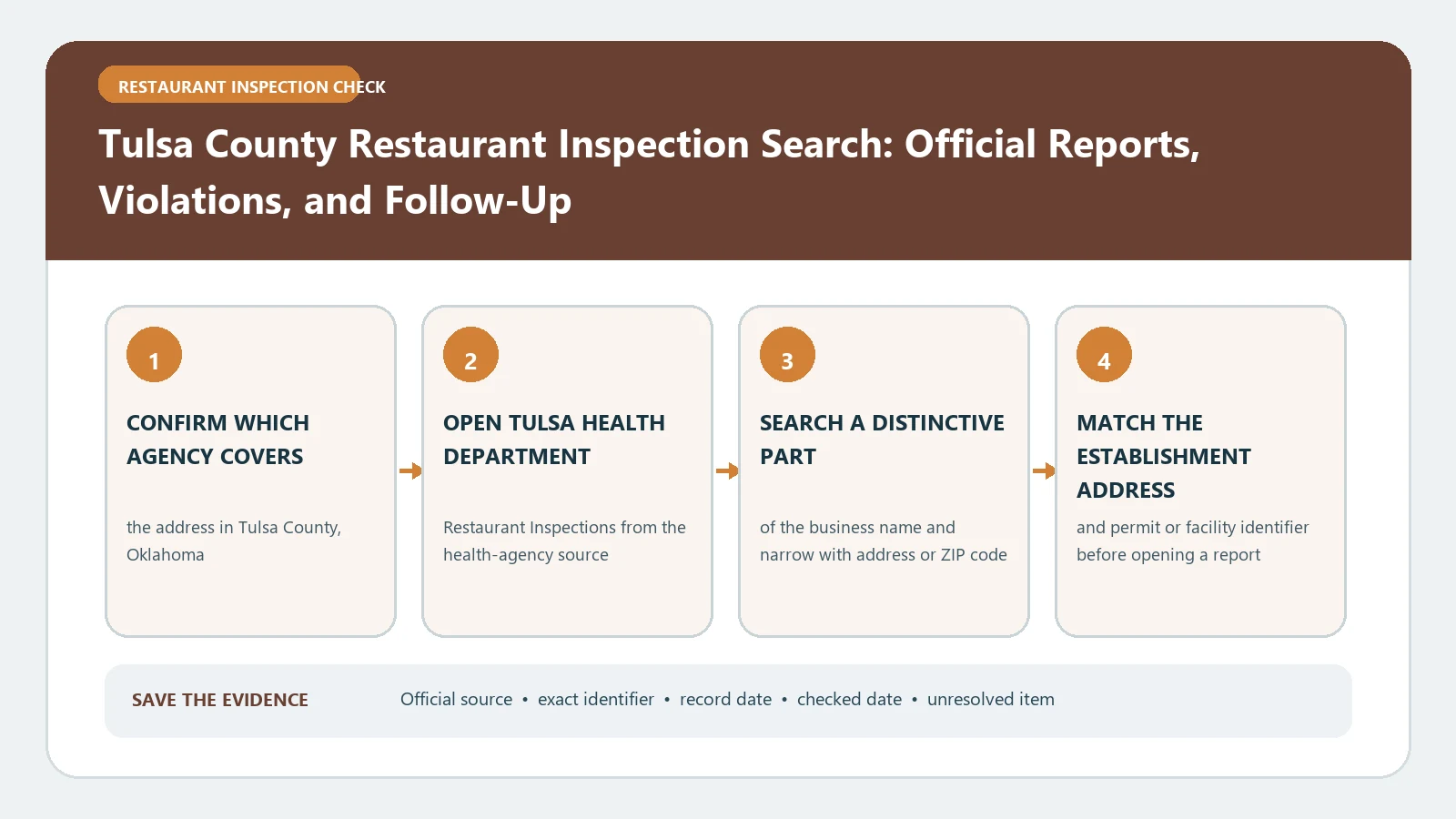
Use Tulsa Health Department’s inspection page to search a Tulsa County food establishment by name, address, or ZIP code. Match the establishment class and premises, then read the newest-first report history by visit type, violation category, correction notation, and later action. One report is a snapshot of a particular day, not a current safety guarantee.
The official Food Service Industry Inspections page contains the public search, local violation categories, inspection types, reinspection and follow-up language, priority ratings, and enforcement explanations. The department’s Food Permits and Inspections page confirms the Food Protection Service Program’s county role and routes food-service inspections and complaints. Both sources were checked August 26, 2026.
Choose quick search or advanced search deliberately
Tulsa’s quick search asks for a keyword and a filter: establishment name, address, or ZIP code. Use it when one strong identifier should produce a short list. Advanced search adds precision, date range, establishment class, and result-count controls. Use those filters when a common name, long history, or mixed facility types make the first list ambiguous.
Record the mode and filters. If quick search finds nothing, do not immediately broaden every field. Try the address filter, then a short name fragment, then advanced search with the correct establishment class and a wider date range. A saved query path makes the result reproducible.
Establishment class can prevent a wrong match
Tulsa’s system covers more than conventional restaurants. The department gives examples such as bars, schools, and mobile food preparation. A shared name can therefore return operations with different classes and inspection expectations. Match the street address, ZIP code, class, and any available facility identifier before opening a report.
Create a facility header containing the official name, address, class, latest inspection date, and report link. If an operator changed names, retain the prior name but do not merge histories without an official identity field. The address-search guide can help resolve suite and alias problems.
Read the history from oldest relevant event to newest
Tulsa publishes reports newest first, which is convenient for a current check but can hide the cause-and-response sequence. After matching the establishment, identify the earliest event relevant to your question and read forward. Keep routine, follow-up compliance, new-establishment, complaint, and other visits under their official labels.
Use one chronology row per event:
- inspection date and visit type;
- priority, priority-foundation, and core findings;
- correction during inspection, when stated;
- reinspection window or follow-up notice;
- warning, ticket, closure, or other action shown;
- next published visit for the same facility.
This approach prevents a later complaint inspection from being mistaken for the planned follow-up to an earlier failed routine visit.
Translate local categories without flattening them
Tulsa explains Priority items as requirements most directly linked to controlling foodborne-illness hazards, Priority Foundation items as the actions or equipment that support that control, and Core items as sanitation, maintenance, facility, or operational requirements. Keep the category beside the actual observation. A category name is not a substitute for the report text.
The department also uses correction-during-inspection language and can issue follow-up notices for items that could not be corrected during the visit. Record those as different states. “Corrected during inspection” is not the same as a future deadline, and a returned operator notice is not the same as an inspector’s later verification.
For a general field layout, use the food inspection violations guide, while the Tulsa page controls the local meaning.
Connect a failed visit to the right later record
Tulsa says follow-up activities occur within two weeks after a failed inspection and describes a documented compliance inspection within that local period, depending on severity. Reports can also state “Reinspection Within # Days.” Treat the report’s own number as the facility-specific instruction; do not assume an exact visit date before the later event appears.
Add the expected window to the chronology, then search the same facility for a follow-up compliance visit. Preserve the original findings. The later report may verify correction, record repetition, or identify a new issue. If no matching visit appears, label it “not found in the checked public history” and save the access date.
The restaurant reinspection follow-up check supplies a two-visit comparison method without changing Tulsa’s labels.
Keep enforcement actions separate from scores
The Tulsa page describes voluntary closure, summary suspension, reinspection, follow-up notices, warnings, and tickets as distinct actions. Do not convert a failed inspection into closure unless the report records that action. Likewise, a later score does not by itself establish that a permit suspension ended; look for the department’s reinstatement or reopening evidence.
When enforcement matters, record the action, date, stated reason, later onsite confirmation, and current permit evidence separately. Use the closure and permit-suspension check to keep those events from disappearing inside a score comparison.
Recover a missing or conflicting Tulsa record
Repeat the search with the address filter, ZIP code, shortened name, prior name, establishment class, and a wider date range. Confirm that the premises are in Tulsa County and fall under the Food Protection Service Program. If two official views disagree, save both URLs, result fields, and lookup times rather than choosing the more favorable one.
Contact the assigned program only after recording the query and facility header. Ask a focused question about a named inspection date, missing follow-up, or identifier. A no-result screen does not establish that an inspection never occurred, especially when the portal may be updating or the operator changed. Include the exact filters and lookup time so the department can distinguish a facility-identity problem from a publication or archive question.
Close with a Tulsa chronology, not a rating
The final note should identify Tulsa Health Department, the facility, the oldest relevant visit, each later action, and the newest published event. Quote the visit types and correction language. Mark any missing link in the sequence as unresolved.
This history cannot certify the restaurant’s current condition or predict the next inspection. Reopen the official Tulsa page before acting, because reports and enforcement information can change after the note was saved. If the location is outside Tulsa County, restart with the city inspection lookup hub.