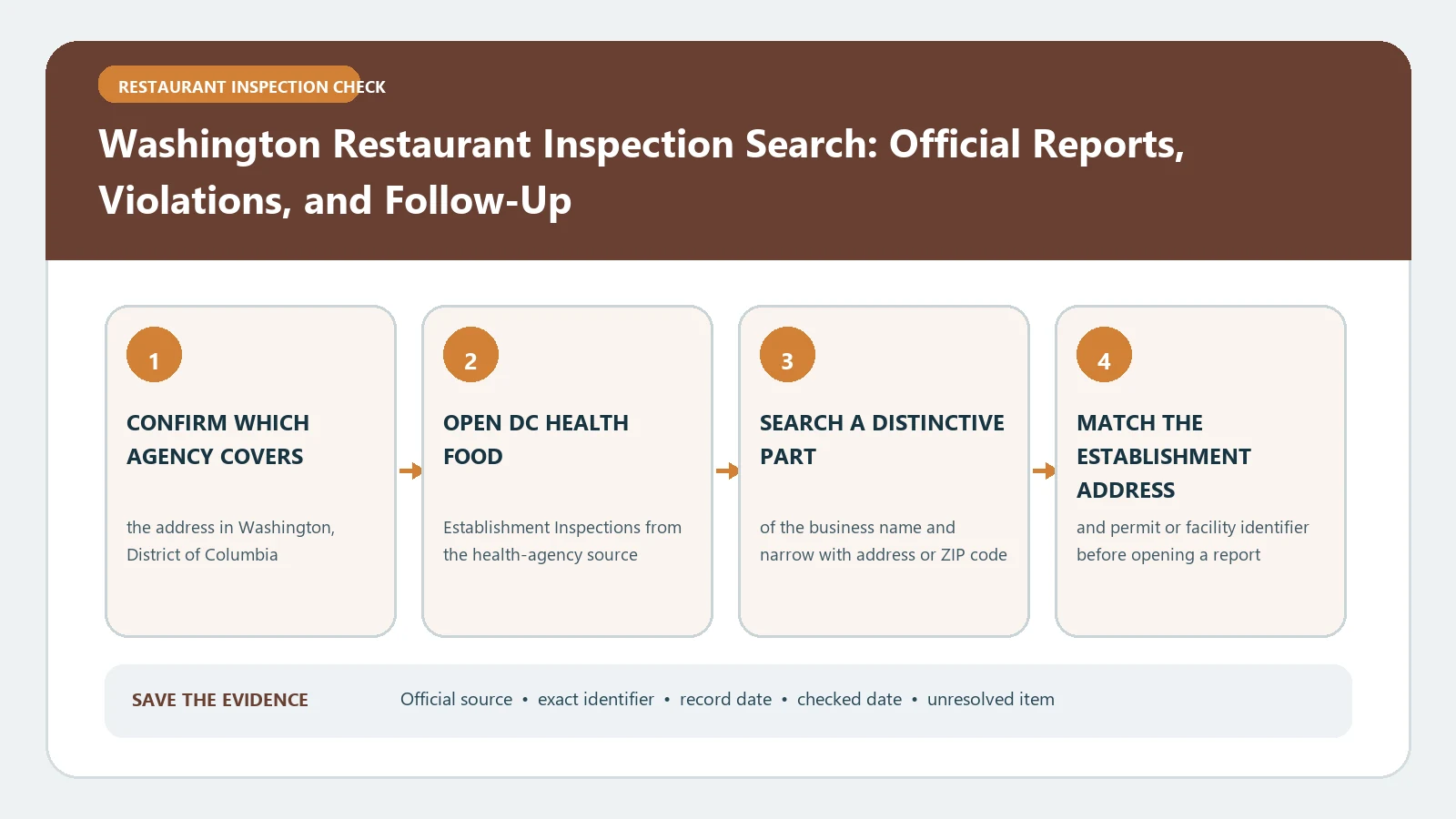
Washington, DC restaurant inspection reports are available in the DC Health inspections database. DC Health uses pass-fail inspections rather than letter grades and places violation tallies at the top of each report. Search the exact food establishment, open every dated report for that address, and check the Division of Food page for separate closure and restoration information.
Checked August 26, 2026 against the current routes published by District of Columbia Department of Health, Division of Food, District of Columbia Department of Health inspection database.
Use the report database, not the operator application portal
The DC Health Division of Food page links both an inspection-report database for the public and an online application portal for operators. They serve different jobs. A diner or researcher looking for an inspection report should use the report database; an application status or remediation-plan account is not a substitute for the public inspection record.
| Task | Correct DC route | Do not confuse it with |
|---|---|---|
| Find a restaurant inspection report | Food Establishment Inspection Reports | Permit application or remediation-plan account |
| Understand pass/fail and report layout | Division of Food guidance | A private letter-grade site |
| Check a closure or restoration | Closure and restoration links on the Division page | Assuming a failed report means the facility remains closed |
| File a complaint | DC Health complaint route | Editing or disputing an existing public report |
Treat pass-fail and the tally as the report headline
DC Health says it performs pass-fail inspections rather than assigning grades. Keep the pass/fail result, inspection date, inspection type, and violation tallies together. The tally is a count shown by the agency, not a complete explanation of severity, correction, recurrence, or the current operating status.
- Pass/fail: the agency’s disposition for that inspection event.
- Violation tally: the report’s top-line count; open the item detail before interpreting it.
- Individual violation: the observed requirement and any correction information in the report.
- Later report: the next official evidence about correction, recurrence, or enforcement.
Build one timeline for the same address
- Search the establishment name and verify the street address.
- Open the newest report and copy the date, visit type, pass/fail result, and tally.
- List the individual violations and any correction notation.
- Open earlier and later reports for that address to identify repeats and follow-up.
- Check the separate closure/restoration route when the report or tally suggests an enforcement event.
| Timeline column | Copy exactly | Why |
|---|---|---|
| Facility | Name, address, and database identifier | Prevents a same-name false match |
| Visit | Date and inspection type | Defines what the inspector was doing |
| Disposition | Pass or fail as displayed | Preserves the agency’s own result |
| Findings | Tally plus individual item text | Separates count from meaning |
| Next event | Follow-up, closure, restoration, or later report | Shows what the official sequence records after the visit |
Closure and restoration answer a different question
A failed report and a closure record are related only when the official sequence connects them. Use the closure/restoration material linked by DC Health to determine whether the department closed the facility and whether a later restoration occurred. Do not infer a current closure from an old failure or a current pass from a missing closure notice.
Recover a restaurant hidden by a name change
If the search returns no exact name, retry the street address, abbreviations, former business name, and legal operator wording. A delivery-app name may not match the inspected establishment. Keep each attempted search and do not merge two locations merely because they share a brand.
| No-match cause | Recovery |
|---|---|
| Brand differs from permit name | Search address and legal/operator name |
| Restaurant moved | Separate the old and new premises histories |
| Suite or street format differs | Retry without suite and compare returned addresses carefully |
| Known report still absent | Contact the Division of Food using the official page and provide the address/date |
A DC Health pass or fail is the disposition of a dated inspection, not a permanent grade, a prediction of current conditions, or proof that a diner did or did not become ill.
Use Washington DC Restaurant Inspection Result Fields for the database fields. Then use the DC reinspection and enforcement timeline to keep the later agency action separate from the original report.
Compare two pass-fail events without claiming causation
When a failed visit is followed by a pass, identify the specific items on the first report and the scope of the second visit. A later pass documents the department’s disposition for that later event; it does not by itself prove which management change caused the result or that every earlier item was independently reviewed. Conversely, a repeated item is evidence of recurrence in the official reports, not proof that a diner became ill.
| Sequence | Defensible statement | Unsupported shortcut |
|---|---|---|
| Fail, then follow-up pass | The later dated event received a pass; compare its scope and items | The first failure had no significance |
| Pass with listed violations | The event passed while the report still recorded the displayed items | Pass means no findings existed |
| Repeated violation | The same requirement appears on stated visit dates | The reports prove an illness |
| Old fail, no closure listing | Check separate closure/restoration evidence | The establishment is closed today |
Cite the event and retrieval date together
A useful citation names DC Health, the establishment and address, the inspection date, the report’s pass-fail result, and when you retrieved it. Link to the facility or report when the database supplies a stable route. If the public interface changes, those details let another researcher repeat the search without relying on your summary or a third-party score.