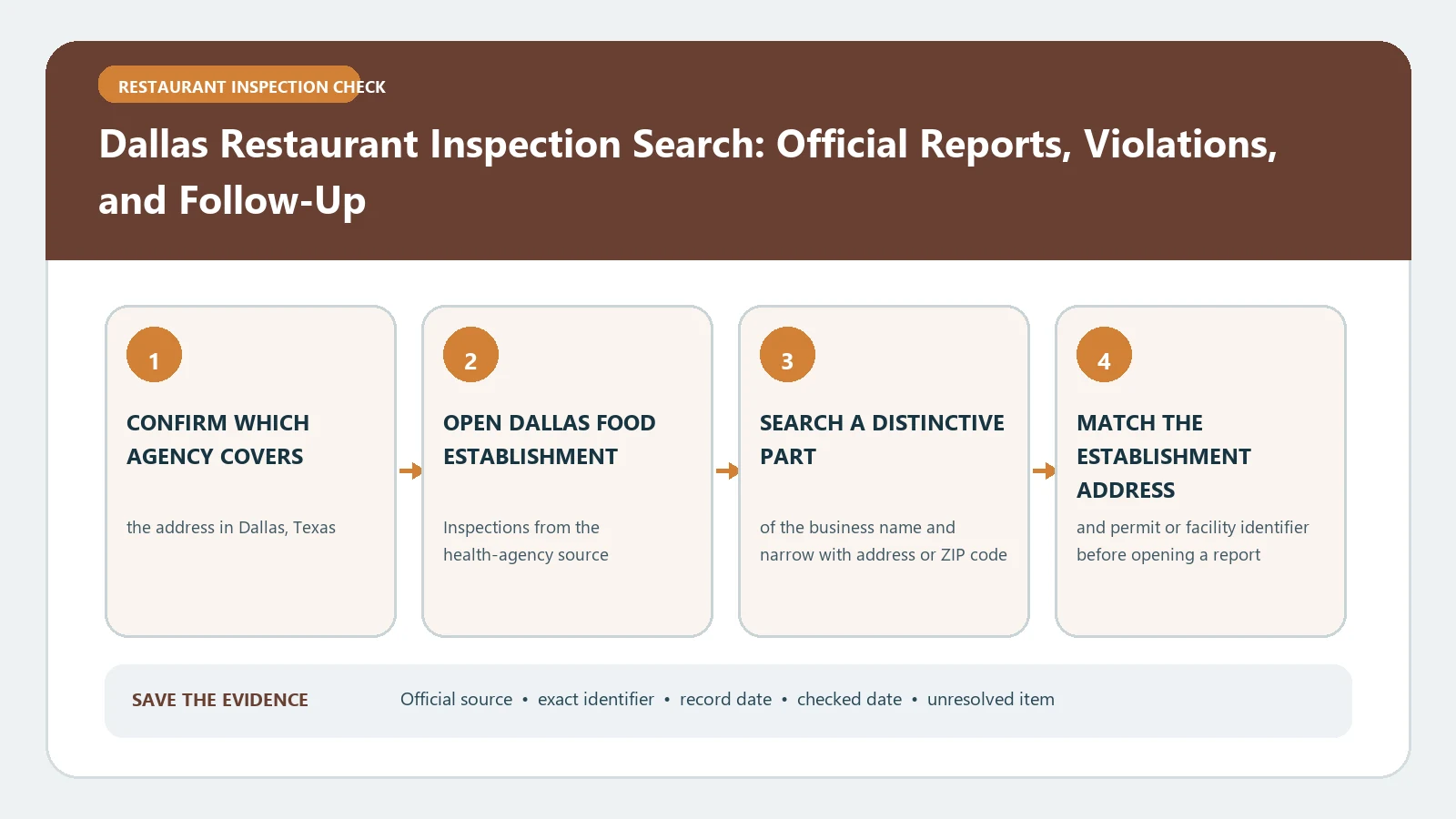
For a Dallas restaurant, identify the exact permitted operation in the city’s open-data inspection rows, then use the Consumer Health score guidance to interpret that dated visit. Repeated names can represent follow-up inspections or separate departments at one location. The address, inspection date, and row sequence matter more than the first familiar name in the results.
Dallas publishes a Consumer Health restaurant food scores page with the current score bands, follow-up timing, and reasons a business may be absent. The Food Establishment Inspections dataset supplies the searchable city inspection records. These first-party sources were checked August 26, 2026.
Anchor the Dallas search to one permitted activity
Start with the full street address and restaurant name. If the premises is a grocery store, hotel, food hall, or shared commercial kitchen, expect more than one permitted activity. Dallas specifically warns that repeated facility names can reflect follow-up visits or different operations such as meat, seafood, and produce departments at the same address.
Choose a row only after the address and business identity agree. Keep any record or permit identifier displayed by the dataset. When ownership changed but the public-facing name remained, separate the earlier operator’s rows from the later operator’s history instead of treating them as one uninterrupted business.
Sort inspections before interpreting scores
Put the matched rows in date order. For each visit, capture the facility name, address, inspection date, inspection type or purpose if shown, score, and record URL. Add a note when a row appears to be a follow-up to an earlier score.
A single score is a snapshot of operational and sanitation conditions observed during one inspection. It does not prove the kitchen stayed in the same condition afterward. Looking at the sequence helps distinguish a routine cycle from a rapid follow-up after a lower result.
The Dallas result-field guide offers a place to organize current and historical rows, but it does not replace the city dataset.
Apply Dallas score bands without importing another city’s rules
The current Consumer Health page groups scores as follows:
- 100 through 80 meets Consumer Health Division standards;
- 79 through 70 requires follow-up within 30 days;
- 69 through 60 requires follow-up within 10 days;
- 59 and below requires follow-up within 24 hours.
Record the band that applied when you checked the official page. Do not attach labels borrowed from an older Dallas page, a review site, or another Texas jurisdiction. Score guidance can change, and the fixed article title is not permission to freeze the thresholds forever.
The city also requires a food establishment to provide its most recent health inspection report to a customer or potential customer upon request. That on-site report can resolve details the summary row does not show.
For a reproducible score note, record the exact score, the official band visible on the check date, the follow-up interval attached to that band, and the next inspection row located. Keep the band-source URL beside the value. If the official guidance later changes, the retrieval date explains which version governed the interpretation.
Do not use arithmetic to reconstruct an unpublished score from violations. The open-data row and the establishment’s most recent report are the evidence. When their dates differ, label them as separate visits and request the document for the specific inspection date that matters.
Where a dataset row contains a program, activity, or unit description, retain it beside the facility name. That field can separate two departments at one street address. If it is absent, say the unit could not be distinguished from the public row and avoid attributing its score to the entire property.
Keep the selected row’s retrieval date with the unit description so later changes can be audited.
Connect a low score to the next documented event
When a score calls for rapid follow-up, search forward for the next row at the same address and permitted operation. Confirm the date and whether it is a follow-up inspection rather than assuming that any later row resolves the earlier one. Preserve both scores in the timeline.
If no later row appears within the stated window, describe the gap and contact Consumer Health or request the record. Online publication timing, an ownership change, or a separate permitted department can explain an apparent mismatch. Silence in the dataset is not proof that no follow-up occurred.
The reinspection follow-up guide can help keep the original visit, expected deadline, later record, and unresolved question in separate fields.
Explain an absent Dallas restaurant carefully
Dallas lists several reasons a restaurant may not appear: recent ownership change, remodeling or construction, or a new establishment awaiting its first inspection. Before concluding anything, search the street address, shorten the trade name, remove punctuation, and look for a former owner.
Check whether the address is actually within the City of Dallas rather than another municipality with a Dallas mailing address. If the location belongs to a different authority, use that jurisdiction’s official search. A no-result page does not demonstrate current compliance, valid permitting, or a lack of inspections.
Use the report when the row is too shallow
The score row answers a narrow question: what Dallas recorded for a dated inspection. It may not show every cited condition or corrective note. Ask the establishment for the most recent report when you are on site, or use the city’s records and Consumer Health contact path for a historical document.
When reading the full report, keep each violation beside its inspection date and any correction notation. The food-inspection violation guide can help interpret structure while Dallas remains the authority for the finding and outcome.
Preserve a Dallas inspection timeline
Finish with a compact timeline containing the exact operation, address, identifiers, dated scores, visit types, expected follow-up interval, next record found, and retrieval date. If several departments share the premises, create one timeline per permit rather than one summary for the whole building.
This record does not certify current safety and should not be presented as an official grade issued by this site. Recheck the Dallas sources for a booking, lease, complaint, or other time-sensitive decision, and state when a needed report or follow-up remains unavailable.