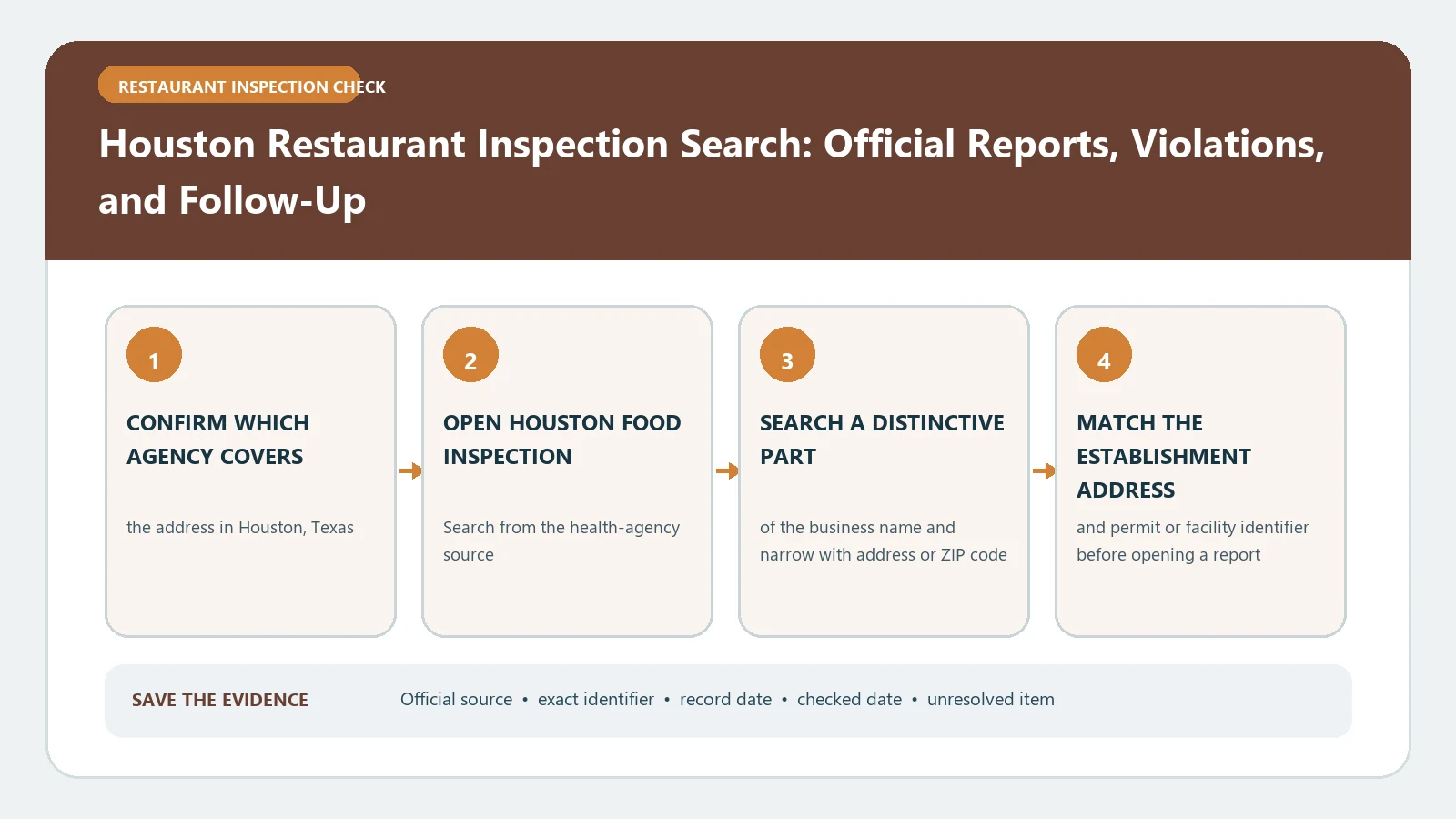
Use the Houston Health Department inspection search only for food establishments inside the City of Houston. Confirm the street address and city jurisdiction first; the department’s food-permit FAQ directs facilities in Harris County but outside Houston city limits to Harris County. For Houston reports, keep the inspection date because the city’s violation terminology changed on September 1, 2025.
Checked August 26, 2026 against the current routes published by Houston Health Department, Consumer Health Services, Houston Health Department, Houston Health Department, Consumer Health Services, City of Houston.
Draw the city-limit line before searching
| Address situation | Correct first move | Why |
|---|---|---|
| Inside the City of Houston | Houston inspection search | Houston Health Department owns the city food establishment report |
| Harris County address outside city limits | Follow the jurisdiction direction on Houston’s FAQ | A Houston mailing address does not always mean City jurisdiction |
| Boundary uncertain | Confirm the municipality or inspecting agency before interpreting results | A no-match in the wrong system is not a clean record |
Keep a map or official address result with your notes when the boundary is close. Do not use a nearby Houston restaurant as a proxy for the establishment you meant to check.
Search the premises with more than the storefront name
- Enter the restaurant name, then repeat with the street address if the result set is broad.
- Compare suite, ZIP code, and facility address before opening a report.
- Try a former name or permit-holder wording when the restaurant was sold or rebranded.
- Save the establishment identifier and every inspection date used in your conclusion.
- Open the detailed violations and any later inspection rather than relying on a search-card summary.
September 1, 2025 separates two violation vocabularies
The Houston food permits page says the city moved from “critical” and “non-critical” violations to the FDA risk-based categories “Priority,” “Priority Foundation,” and “Core,” effective September 1, 2025. Do not treat the labels as identical columns or compare raw category counts across the change without reading the underlying violation descriptions.
| Report period | Labels you may encounter | How to compare responsibly |
|---|---|---|
| Before September 1, 2025 | Critical / non-critical | Keep the original description and the report’s correction or follow-up |
| September 1, 2025 onward | Priority / Priority Foundation / Core | Use the newer report wording and later disposition |
| History crosses the change | Both systems of labels | Compare the observed condition and response, not just category totals |
Read the report as an event chain
Start with the inspection type and date. Then copy each cited condition, whether the report records correction during the visit, and any reinspection, compliance investigation, closure, or other later action attached to the same establishment. A low number of items on a narrow follow-up visit is not equivalent to a full routine inspection.
| Event | Evidence to capture | Unresolved question |
|---|---|---|
| Routine inspection | Date, visit type, full finding list | Which items required later verification? |
| On-site correction | Exact item and correction notation | Did the condition recur at a later visit? |
| Follow-up/compliance visit | Date and disposition | Was every earlier item within this visit’s scope? |
| Closure or permit action | Agency action and date | Is there a later official reopening or restoration? |
Use a records request when the consumer search is incomplete
If the address is in City jurisdiction but a known report is not retrievable, use the City of Houston Public Information Act page and select the Health (Food) custodian for food establishment reports. Ask for existing records by establishment, address, and date range. The public-records route is for obtaining records; it does not require the City to create a new safety analysis.
- Include the facility name, full address, and former names.
- Specify routine, complaint, follow-up, closure, or other report types you need.
- Give a narrow date range tied to the suspected visit.
- Request electronic copies and identifiers that connect related inspections.
Do not turn Houston's report into a private grade
The official report supports a dated statement about the inspected Houston facility. It does not prove current conditions, guarantee that no illness can occur, or authorize a third-party score that the department did not issue.
Use Food Inspection Reports and Violations to compare category, correction, and recurrence. If jurisdiction is wrong, return to the city inspection directory instead of forcing a Houston result.
Keep a jurisdiction note with every Houston result
Houston addresses can be described by mailing city even when the premises is outside the City inspection program. Add a jurisdiction note to the top of your worksheet: the source agency, the address used, and how the boundary was confirmed. If the City search returns nothing, do not immediately move the same claim to Harris County; first verify which authority issued the food permit. This prevents a no-match caused by agency choice from becoming an inaccurate statement about the restaurant.
| Boundary check | Evidence to retain | Decision |
|---|---|---|
| City portal finds exact premises | Facility page, address, and permit identifier | Continue with City of Houston reports |
| Houston mailing address but no exact premises | Search terms and mapped/agency guidance | Confirm jurisdiction before interpreting silence |
| County authority confirmed | Harris County source or agency response | Start a separate county record trail |
| Location changed | Old and new addresses with dates | Do not merge visits across premises |
Quote the terminology that belongs to the inspection date
For visits before and after September 1, 2025, keep the labels exactly as the City report presents them. A comparison can explain that Houston announced a change to Priority, Priority Foundation, and Core terminology, but it should not retroactively rename an older finding unless the City record itself does so. Compare the observed condition, correction status, and subsequent event; those facts remain more useful than forcing two vocabularies into one homemade severity score.