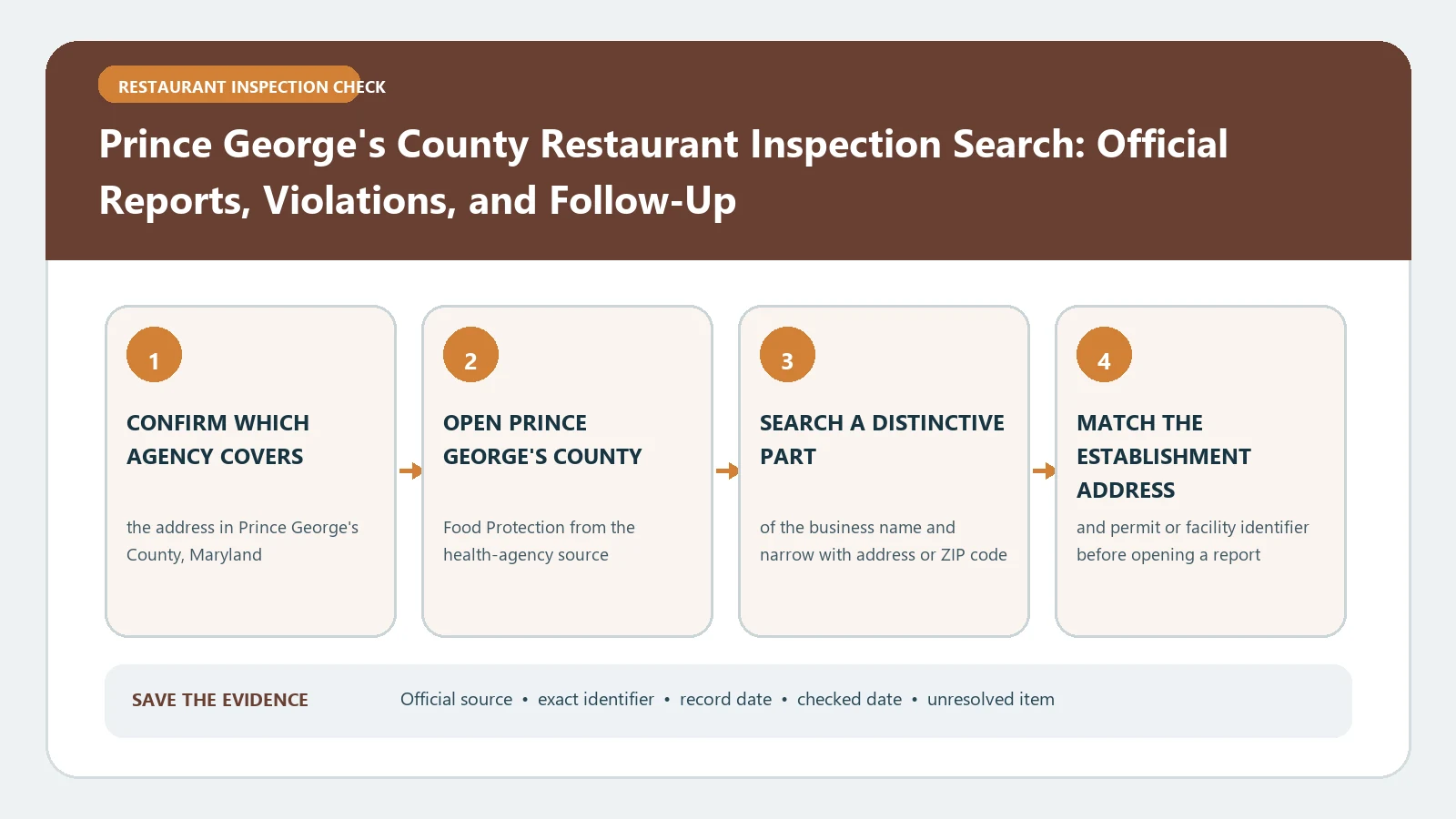
Prince George’s County inspection data is most useful when you group the rows by establishment ID and visit, not when you scan one violation column in isolation. Match the licensed premises first, identify whether the visit was comprehensive, monitoring, complaint-related, or a reinspection, and then look for the later action that answers the original finding.
The county’s Food Inspection dataset is the public record source and states that it is updated daily. The Health Department’s Food Safety, Permits and Inspections page identifies the Food Protection program, complaint route, licensing services, and current contact information. Both sources were checked August 26, 2026.
Use the establishment ID to hold the record together
Search the name and address, then retain the establishment ID from the matching result. Brand names can repeat across the county, and a business can change owners at the same location. The ID, street address, and inspection date provide a stronger match than the name alone.
The dataset exposes establishment identity, category, owner or type fields, inspection type, location, and individual compliance items. Do not join rows from similar names or from different branches. If an ownership change produces another ID, keep separate histories and note the transition date you can support.
Decide what kind of inspection you are reading
Prince George’s County describes three important visit types in the data documentation. A comprehensive inspection evaluates sanitation, maintenance, and food handling across the facility. A monitoring inspection concentrates on critical food and equipment temperatures, general handling, and cleanliness. Complaint investigations respond to a reported concern.
A reinspection serves another job: it checks non-critical violations that had time to be corrected and confirms whether earlier critical corrections were maintained. Because these visits have different scopes, a short monitoring row should not be compared as if it were a complete comprehensive inspection.
Record the displayed type with the date. For general help with report vocabulary, open the restaurant report guide after preserving the county’s exact wording.
Turn compliance columns into one visit card
The dataset includes specific conditions such as food from an approved source, protection from contamination, ill-worker restrictions, rodents and insects, and food-contact surfaces and equipment. Keep each condition beside its value for the same visit. Do not combine the strongest wording from several dates into one composite inspection.
Your visit card should contain:
- establishment ID, name, address, and category;
- inspection date and type;
- each cited or noncompliant condition from that visit;
- any overall status or closure indicator displayed;
- the source link and retrieval date.
This layout shows whether an item was observed in one inspection and whether it appeared again later. It also prevents a blank field from being reported as a passed item.
Compare later visits on identical fields
After assembling the first card, build the next card with the same columns. Compare only the conditions that appear in both visits and preserve any change in inspection scope. A reinspection focused on selected corrections may omit conditions that were reviewed during a comprehensive visit; omission is not the same as a recorded pass.
Use this comparison order:
- Verify that the establishment ID and address are unchanged.
- Confirm the later inspection type and date.
- Match each earlier noncompliant item to the later value when one is published.
- Separate correction evidence from a closure, license, or complaint event.
If the owner name changes while the establishment ID remains visible, note both fields and avoid asserting continuity beyond what the county data establishes. If the ID changes, start another timeline. This prevents a new operator’s record from being used to describe the former permit holder.
Save the raw county row link or export reference with every card. Open-data displays can reorder columns or apply default filters, so the retrieval date and exact establishment ID are necessary for another reviewer to reconstruct the visit. If a field is blank, preserve it as blank or not published; never replace it with compliant.
If the export and browser view differ, capture both formats and identify which display supplied the quoted value. Escalate unresolved field conflicts to the county instead of choosing the version that supports a preferred conclusion.
Treat closure as a temporary license event
The county defines closure as a temporary suspension of the food-facility license. It can follow an immediate health hazard that cannot be corrected at once, failure to correct a non-critical violation within the stated time, failure to meet Health Department requirements, or operation without a permit.
That definition does not tell you that a facility remains closed today. When a closure appears, search for the next reinspection or later status at the same establishment ID. Record the closure date and the later evidence separately. If no reopening record is visible, contact the Food Protection program before stating present operating status.
For organizing this branch, the closure and permit-suspension guide can help, but the county’s case record controls.
Reconcile a missing or fragmented county result
If a name search fails, try the street address, an older trade name, and the establishment ID if you have it. Check spelling variations and corporate suffixes. A dataset row can also appear fragmented because separate compliance items belong to the same visit; group by identity, date, and inspection type before deciding that records conflict.
When the public data lacks a document or later status, use the Health Department contact or county public-information route. For a current unsafe condition, submit it through PGC311 as directed by the official Food Safety page. A historical lookup is not the channel for an active complaint.
State only what the county record demonstrates
A sound conclusion names the establishment ID and address, lists the dated visit type and findings, and reports whether a related reinspection or closure follow-up was located by the check date. It does not label the restaurant permanently safe or unsafe, and it does not treat an absent row as approval.
Keep the evidence card, later-visit search, official links, and retrieval date together. If the premises is outside Prince George’s County, return to the city and county inspection directory and identify the agency that actually owns the address.