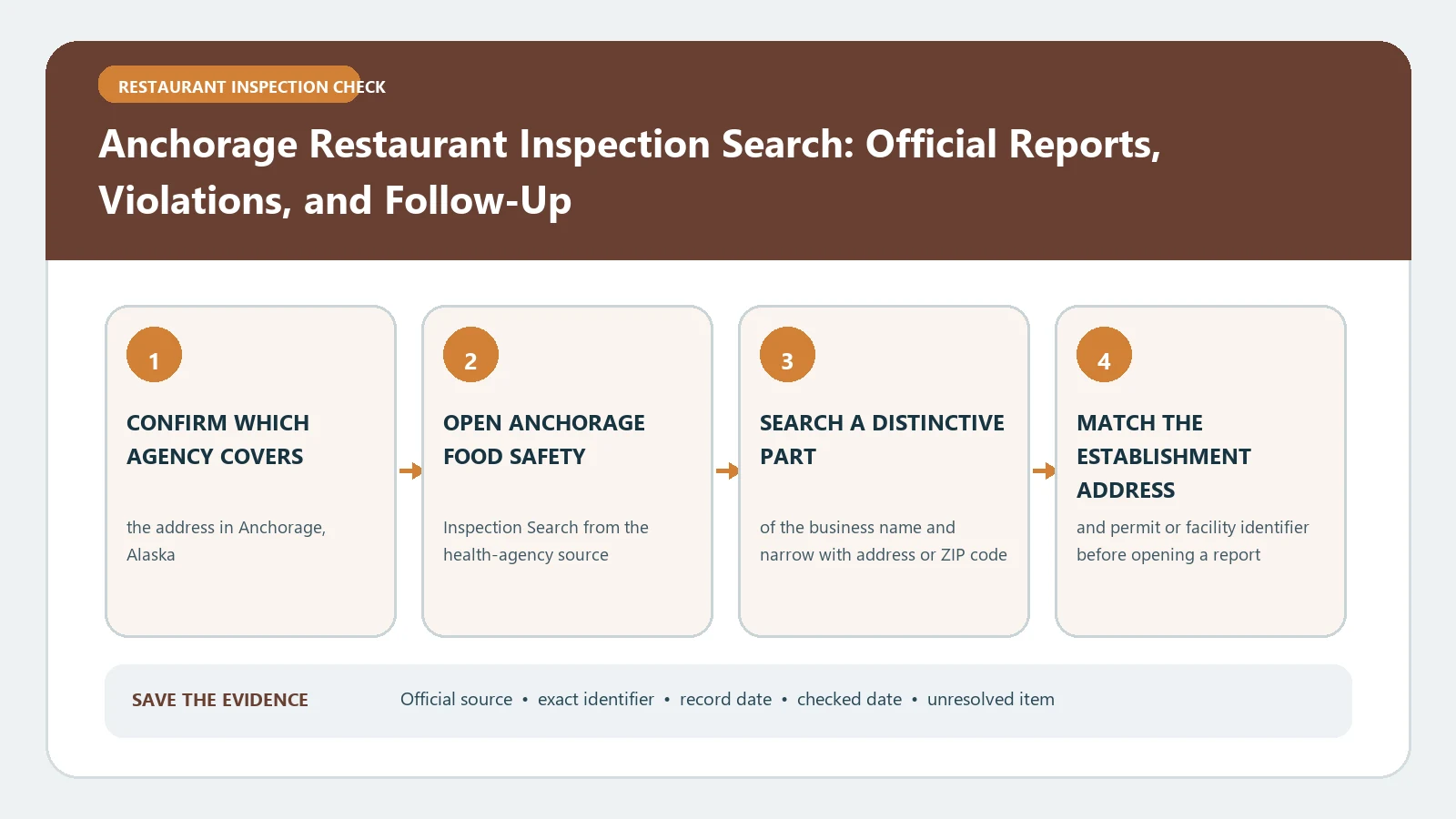
To check an Anchorage restaurant, begin on the Municipality of Anchorage Food Inspections page, follow its link to the posted inspection records, and match the establishment by address before reading any score. The result describes a dated visit. It does not certify the restaurant’s condition today, and an empty search does not establish that the facility has never been inspected.
The municipality’s Food Safety and Sanitation inspection page says that municipal health inspectors use a scoring system and post inspections for food establishments, temporary food service operations, and pool or spa facilities online. The Environmental Health customer-service page provides the official recovery route for questions, complaints, permits, and records that cannot be resolved online. Both municipal sources were checked August 26, 2026.
Enter through the municipal inspection page
Use the municipal program page as the starting point instead of relying on a search-engine result or a third-party restaurant profile. The page identifies who performs the inspections and links to the public records system selected by the municipality. That chain matters because the records interface may use a vendor domain even though the Municipality of Anchorage owns the inspection program.
Before searching, write down the restaurant’s public name, street number, street name, and ZIP code. If the business is inside a hotel, grocery store, airport, or shared commercial kitchen, also note the counter or unit name. The public-facing brand may not be the exact permitted establishment name.
Keep facilities at one address separate
Start with a distinctive part of the name, but require an address match before opening a report. One building can contain a restaurant, bar, bakery, market counter, or commissary with separate records. A chain can also operate several Anchorage branches with nearly identical names.
For each candidate result, preserve:
- the establishment name exactly as shown;
- the complete street address and ZIP code;
- any facility or permit identifier;
- the inspection date and visit type;
- the score or status as displayed;
- the URL and the date of your lookup.
Reject a candidate when the street address differs, even if the brand name looks right. If ownership changed at the same premises, do not merge the old operator’s history into the new operator’s record unless the official system connects them.
Build a chronology instead of saving one score
Open every visible visit for the matched facility and sort the dates from oldest to newest. Keep routine inspections, follow-up visits, complaint investigations, and closure or reopening events distinct when the system labels them separately. A later visit can show what the inspector observed afterward, but it does not erase an earlier finding.
A practical Anchorage chronology has one row per visit. Record the visit date, visit type, score or outcome, main findings, correction language, and any later event that refers back to it. Use the restaurant inspection report guide to keep those fields organized without replacing the municipal record.
Do not compare Anchorage’s number directly with a grade from another city. Inspection systems use different scales, deduction methods, and enforcement rules. The local program’s labels and explanatory material control the meaning of the result.
Read the score beside the visit details
A score without its date and report context is incomplete. First confirm that the score belongs to the matched establishment and inspection. Then read the displayed findings and any correction or follow-up language. If the interface supplies only a summary, state that limitation rather than guessing what the full inspector notes contain.
Separate three questions in your notes: what was observed on the inspection date, what corrective action the record documents, and what later record was available when you checked. Those questions are related but not interchangeable. A high score cannot establish that conditions remained unchanged, while a lower historical score cannot establish that the same condition exists now.
When a finding uses unfamiliar food-safety language, the food inspection violation guide can help you organize the text. Keep the municipality’s wording, date, and inspection identity attached to the interpretation.
Repair a missing Anchorage result methodically
If the full restaurant name returns nothing, shorten it, remove punctuation, and try the street number plus one name word. Search the address without a suite number, then with the ZIP code. Check whether the operation is listed under a legal or former name. For a temporary vendor or shared kitchen, search the operator as well as the event-facing brand.
Preserve the failed query and the retrieval date. A no-result screen may reflect spelling, a publication delay, a changed facility identity, or a record outside the online system’s current coverage. It is not evidence of a clean inspection history.
When the address is outside the municipality, stop and identify the correct Alaska authority. The inspection directory by city is a routing aid, but the responsible agency remains the source for the actual record.
Use customer service for the unresolved question
The municipality’s customer-service route is useful when the public system does not identify the premises, an older report is missing, or two records conflict. Provide the establishment name, exact address, approximate inspection date, and any facility identifier. Ask one focused question, such as whether a report exists for a specific visit or whether two names refer to the same permitted operation.
A current sanitation complaint belongs in the municipal complaint process, not in an interpretation of an old report. The Food Safety and Sanitation page directs residents to file concerns and explains that timely reporting helps an investigation. Keep a complaint reference separate from the public inspection chronology unless the official record later connects them.
Close with a bounded Anchorage finding
Your final note should identify the matched facility, address, visits reviewed, score or findings shown for each visit, later action located, source URLs, and lookup date. Mark missing documents and unresolved identity questions explicitly.
Do not call the note a safety certificate. It is a reproducible account of what the Municipality of Anchorage published for particular inspections as of a stated date. Reopen the municipal source before a time-sensitive decision because another inspection, correction, or enforcement event may have been posted after your check.