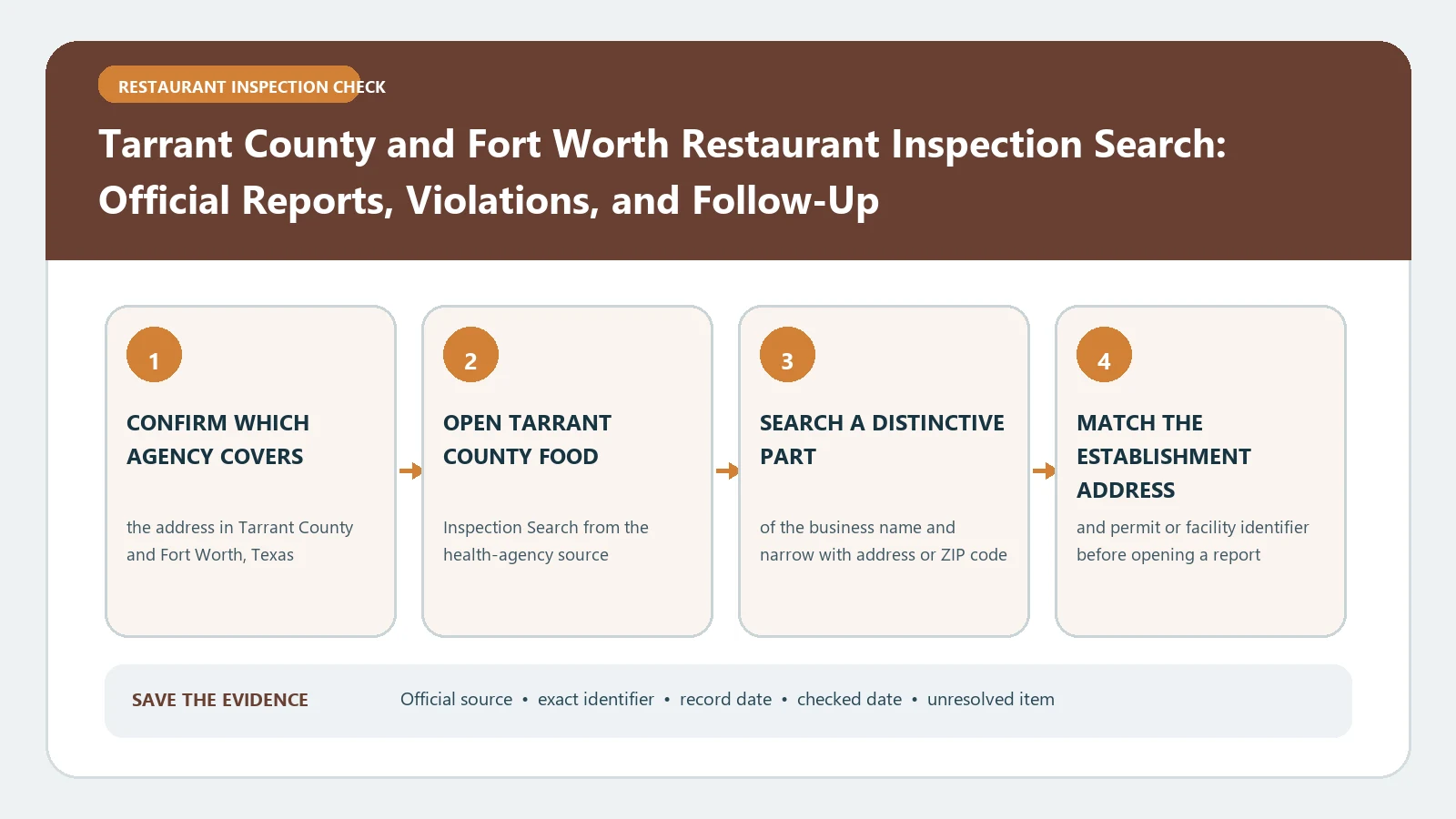
A Tarrant County and Fort Worth restaurant inspection search must begin by choosing the correct authority for the address. Tarrant County Public Health does not inspect fixed food establishments inside Fort Worth, while the City of Fort Worth operates its own Consumer Health inspection program. Searching the wrong system can produce a convincing but irrelevant no-result.
Tarrant County’s Food Safety page links its inspection-score database and states that its contract-city coverage excludes Fort Worth, Arlington, North Richland Hills, and Euless. The City of Fort Worth’s Health Reports page links Fort Worth food-establishment inspections and explains the city’s demerit system. Tarrant County’s inspection portal is the record search for facilities under county authority. These official routes were checked August 26, 2026.
Put the street address through the jurisdiction gate
If the premises is inside Fort Worth city limits, use the Fort Worth Consumer Health reports. If it is in a Tarrant contract city, DFW Airport, a covered school district, or another area served by county Environmental Health, use the county route. Do not decide from the postal city alone; municipal boundaries and mailing addresses can differ.
When unsure, use the contact information on the two official program pages and ask which agency inspected the exact address. Preserve the answer in the lookup note. Jurisdiction is part of the evidence, not a preliminary detail to discard.
Create a jurisdiction card before the facility search:
- Write the complete street address and city-limit status if known.
- Record whether the address is inside Fort Worth or a Tarrant contract city.
- Name the program page that confirms the responsible authority.
- Save the selected inspection portal and lookup date.
- Mark the boundary unresolved when neither agency confirms coverage.
The inspection result does not prove current safety. Its value is limited to the matched premises, issuing authority, and dated visit.
If the boundary answer came from an agency reply rather than a public page, record the reply date and the office contacted without publishing private contact details.
Match the facility inside the selected system
Search the establishment name and confirm the street address. Retain any site, permit, or facility identifier, plus the inspection date and visit type. Chains, grocery counters, schools, and shared kitchens can have multiple records under related names.
Reject a result from another branch. If ownership changed at the same address, separate the operators unless the inspecting authority connects their records. Record the search terms and access date so another person can reproduce the match.
The restaurant inspection report guide can organize the fields, but the selected local authority owns the facts.
Read Fort Worth demerits as Fort Worth defines them
Fort Worth records violations as demerits. The city assigns three demerits to Priority violations, two to Priority Foundation violations, and one to Core violations. The Health Reports page says there is not a failing score, while also explaining the corrective-action requirement when total demerits exceed 30.
Do not reverse the number into a 100-point grade or call a lower demerit total a national rating. Save the total beside the inspection date, then open the report to see which violations produced it. The city warns that the result is a snapshot of conditions when the inspector arrived.
If the report shows corrective action or a later visit, preserve that event separately. A later inspection does not delete the earlier demerits.
Keep the county score in its own local context
For a county-covered facility, use the Tarrant portal and county program explanation. Transcribe the displayed score, inspection type, findings, and dates without applying Fort Worth’s demerit interpretation. The two systems share geography and state rules, but they are not one scoring table.
The food inspection violation guide can help separate finding, correction, and follow-up. Retain the Tarrant record’s labels because a local status or score can carry a meaning that a general guide cannot supply.
Build parallel timelines, not a blended county ranking
For the selected establishment, create one timeline under one authority. List each routine inspection, complaint visit, follow-up, closure, or reopening record by date. If a business moved across a city boundary, start a second timeline under the new authority rather than joining scores from incompatible systems.
A comparison table may show authority, facility ID, inspection date, local measure, report link, and later action. It should not rank a Fort Worth demerit total against a Tarrant score. The useful question is what the responsible inspector published for that premises and what happened next.
Route mobile food units under the current rule
Mobile vendors need an extra jurisdiction check. Tarrant County states that, beginning July 1, 2026, mobile food-unit permitting is administered by the Texas Department of State Health Services, with county inspections performed only when assigned by the state. This change does not convert a Fort Worth fixed-establishment report into the right source for a county mobile unit.
When the target is a truck or mobile unit, use the current mobile-inspection instructions linked by Tarrant County and record the permit authority separately from the location where an inspection occurred. Recheck the rule because this is a recent transition.
Fix a blank search without crossing authorities
If the name returns nothing, try the address, remove punctuation, and search a former legal name. Then recheck the jurisdiction. Do not jump from the Tarrant portal to Fort Worth simply because the first query was blank.
Save both the failed query and the boundary evidence. Contact the responsible agency when a report is missing or a facility identity is ambiguous. For an address outside both scopes, use the city inspection directory to locate the correct issuer.
State the authority in the final finding
The conclusion should name the matched establishment, exact address, inspecting authority, facility identifier, inspection dates, local score or demerits, cited violations, later action, sources, and retrieval date.
It should not certify current safety or imply that every Tarrant County city uses the same system. The most important fact may be that Fort Worth and county Environmental Health are different owners. Recheck the applicable official report immediately before relying on it.