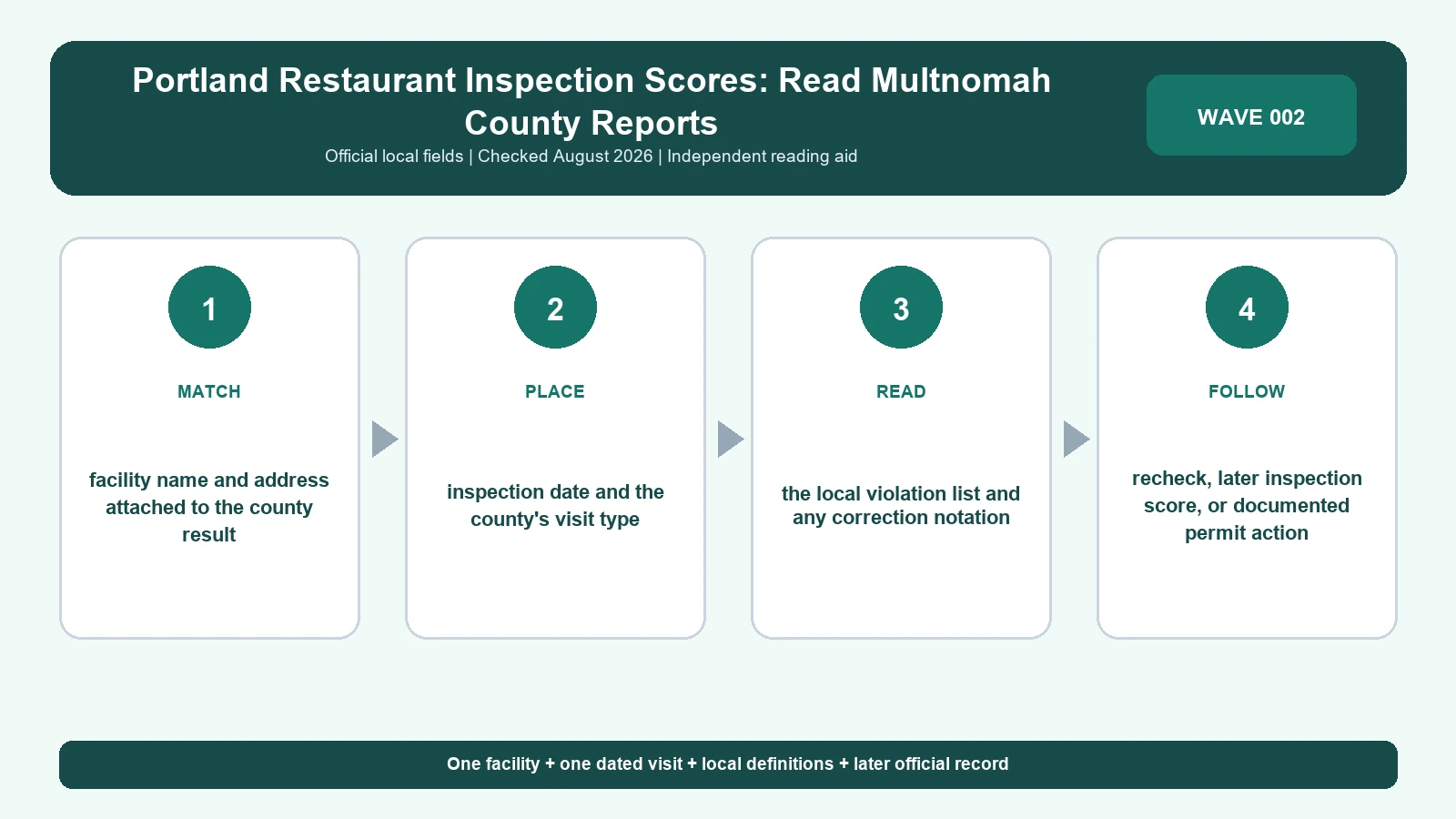
A Portland restaurant score is a Multnomah County result from one routine inspection, not a permanent rating for the business. Confirm the street address, read the inspection type, open the violation details, and keep a later reinspection separate because the county says reinspections are not scored.
Last checked: August 7, 2026.
Begin with Multnomah County current restaurant scores. Multnomah County describes that page as the route for current restaurant scores and says roughly one year of searchable reports is retained there. The broader Multnomah County restaurant licensing and inspections explains the inspection schedule and public placard, while Multnomah County food-service operator resources links operators and readers to Oregon food-code material. Read all three before translating a number into words.
Match the licensed establishment rather than the familiar brand
A Portland name search can return branches, counters inside another business, or a licensed operation whose public-facing name has changed. Record the exact facility name and full address from the county result. If the suite, street number, or city differs, stop. A score from the wrong location is not made accurate by the fact that both locations share a menu or owner.
| Identity clue | Copy from the county page | Why it matters | Do not assume |
|---|---|---|---|
| Facility name | Licensed or displayed establishment name | Starts the match | Every branch has the same result |
| Street address | Number, street, unit, and city | Separates nearby operations | A name-only result is sufficient |
| Inspection date | Date attached to the scored routine visit | Anchors the snapshot | It is the date the web page was refreshed |
| Inspection type | Routine or another county label | Explains whether the number is expected | Every visit receives a score |
| Report link | Stable URL or search route plus access date | Makes the extraction reproducible | A search snippet is the report |
Food halls deserve an extra check. One address can contain a commissary, bar, restaurant, and temporary operator with separate records. Keep one evidence row per licensed establishment. When a name has changed, show the old and new labels with their dates rather than silently combining the histories.
Know which Portland visit receives a numeric score
The county states that licensed establishments generally receive two routine, unannounced inspections each year. A routine inspection can produce the familiar 100-point result. A reinspection is a targeted return visit used to verify uncorrected serious violations, and the county explicitly says that reinspection is not scored. Therefore a blank score on a reinspection row is not a zero and is not missing proof of failure.
| Published element | Local reading | Next evidence to open | Wrong conversion |
|---|---|---|---|
| Routine score | Numeric result for that dated routine visit | The complete violation list | A national percentage of cleanliness |
| Routine inspection | Unannounced program visit | Date and item-level findings | A customer complaint by definition |
| Reinspection | Follow-up on qualifying uncorrected violations | The earlier routine report and later item status | Another scored routine inspection |
| No score on reinspection | Consistent with county procedure | Narrative and correction outcome | Zero points |
| Entrance placard | Public sign reflecting whether the latest inspection passed | The dated report behind it | A guarantee of present conditions |
Keep the score and the violation list together. The number is a compact output of the local system; the individual items explain what the inspector recorded. Two facilities with the same number may have different observations and different follow-up needs. Do not invent a letter grade or place a Multnomah County score on a scale borrowed from Los Angeles, New York, or another Oregon county.
Read Priority and Priority Foundation items through Oregon rules
The operator resources route readers to the Oregon Food Sanitation Rules and materials for Priority and Priority Foundation requirements. Those terms identify the food-safety importance and control purpose of a rule; they are not restaurant review labels. Preserve the cited rule, inspector observation, correction notation, and point value shown in the selected county report.
| Finding layer | Question to ask | Evidence to retain | Claim boundary |
|---|---|---|---|
| Rule category | Is the item Priority, Priority Foundation, or another type? | County report wording and code reference | Category alone does not prove closure |
| Observation | What condition did the inspector document? | Full narrative rather than a keyword | It describes that visit, not today |
| Point deduction | What value did the local report assign? | Item and routine score together | Points are not transferable across systems |
| Onsite correction | Does the report say the item was corrected during the visit? | Item-specific correction text | It does not close unrelated findings |
| Uncorrected serious item | Does county procedure call for correction and reinspection? | Original report plus later reinspection | The first report does not reveal the later outcome |
Use the live food-inspection violation reading guide to separate a rule from an observation, but let the Multnomah County report control the facts. A third-party list may simplify a violation or omit onsite correction. It can help you find a business; it should not replace the county document in a citation.
Treat the public placard as a route back to the report
Multnomah County says restaurants receive a visible entrance placard indicating whether the most recent inspection passed. That placard is useful orientation, but the underlying dated report carries the score and observations. A photograph has a capture date, may predate a newer visit, and may not show the licensed name. Cite the county record when making a claim about the inspection.
If the placard and online history appear inconsistent, record both dates and search again by address. Do not decide that one source is fraudulent or stale without checking the county. Publication timing, a recent visit, a replacement placard, or an establishment identity issue could explain the difference.
Build a Multnomah County inspection card for reuse
A linkable local asset should expose every step between search and conclusion. Use one header row for the facility and one child row per violation. This makes the score auditable and stops an editor from writing a vague phrase such as ‘the restaurant lost points’ without showing why.
| Asset column | Stored value | How a reader verifies it |
|---|---|---|
| Facility | County name and full address | Repeat the official search |
| Visit | Inspection date and type | Open the selected report |
| Routine score | Number exactly as displayed, or not applicable | Confirm that the visit is scored |
| Violation | Rule, category, observation, and deduction | Compare the item row |
| Correction | Onsite status or stated correction need | Read the report notation |
| Reinspection | Later date and item outcome, with score marked not applicable | Open the follow-up record |
| Provenance | Official URL and retrieval date | Reproduce the evidence window |
Publish blanks honestly. If the public view does not expose a field, write ‘not displayed in the selected record.’ Never substitute zero, pass, no violation, or no reinspection. This distinction is particularly important because the current-score search has a finite retention window and may not contain an older event a reader expects.
Account for the roughly one-year public history window
The current-score page says reports are available for about one year. A restaurant may have operated and been inspected before the oldest visible row. Record the access date, save the report URL where permitted, and avoid phrases such as ‘first inspection ever.’ A precise statement is ‘oldest report visible in the county search when checked.’
- Retry the complete address when a business-name search fails.
- Check spelling and former names without merging records prematurely.
- Mark a routine score separately from an unscored reinspection.
- Ask Environmental Health about a material gap outside the visible window.
- Update the asset by adding newer events; never overwrite the older score.
What the score can answer, and what it cannot
The official result can show what Multnomah County documented at a licensed location during a dated inspection. It can support a statement about the routine score, cited items, and a visible follow-up. It cannot certify current food handling, predict illness, rank taste or service, prove that no complaints exist, or guarantee that the online sequence is complete.
For cross-city terminology, consult the restaurant health-score guide. Keep the Portland conclusion local: one licensed establishment, one dated visit, one county score when applicable, the underlying violations, and any later unscored reinspection. That structure is accurate enough to cite and simple enough to update.
Portland score questions
Is a reinspection score of zero?
No. Multnomah County states that reinspections are not scored. Mark the score not applicable and read the follow-up findings.
Does the entrance placard replace the report?
No. It communicates the latest inspection outcome at the entrance; the dated county report contains the evidence needed for a detailed claim.
Can I compare 92 in Portland with 92 somewhere else?
Not without proving that the rules, deductions, inspection types, and publication systems are equivalent. Keep jurisdiction-specific numbers in their own systems.
Quality-check the Portland score extraction
A reliable Portland release keeps the routine score, violation rows, and visit type in the same evidence bundle. Recalculate nothing with an outside formula and never put an unscored reinspection on a numeric chart. Verify that the displayed facility is licensed at the exact address and that the county result falls within the roughly one-year public window. If an older report is unavailable, the asset should say so rather than implying the visible row began the restaurant’s history.
- Identify the report as routine before publishing its numeric score.
- Open every violation detail behind the top-line number.
- Preserve Oregon Priority and Priority Foundation terminology.
- Mark reinspection score as not applicable, never zero.
- Date any entrance-placard photograph used as supporting evidence.
- Keep Multnomah County findings separate from other Oregon jurisdictions.
Use a spot audit to compare the county page with the structured table: address, date, type, score, one sampled violation, correction state, and URL must match character for character where quoted. The editorial explanation may simplify the process, but it should never alter an official value. If the report and placard appear to conflict, publish the dated conflict and request clarification instead of selecting the more favorable status.
Scope: Multnomah County licensed restaurant records and Oregon food-rule context. This independent guide does not issue scores, inspect facilities, or guarantee current safety.