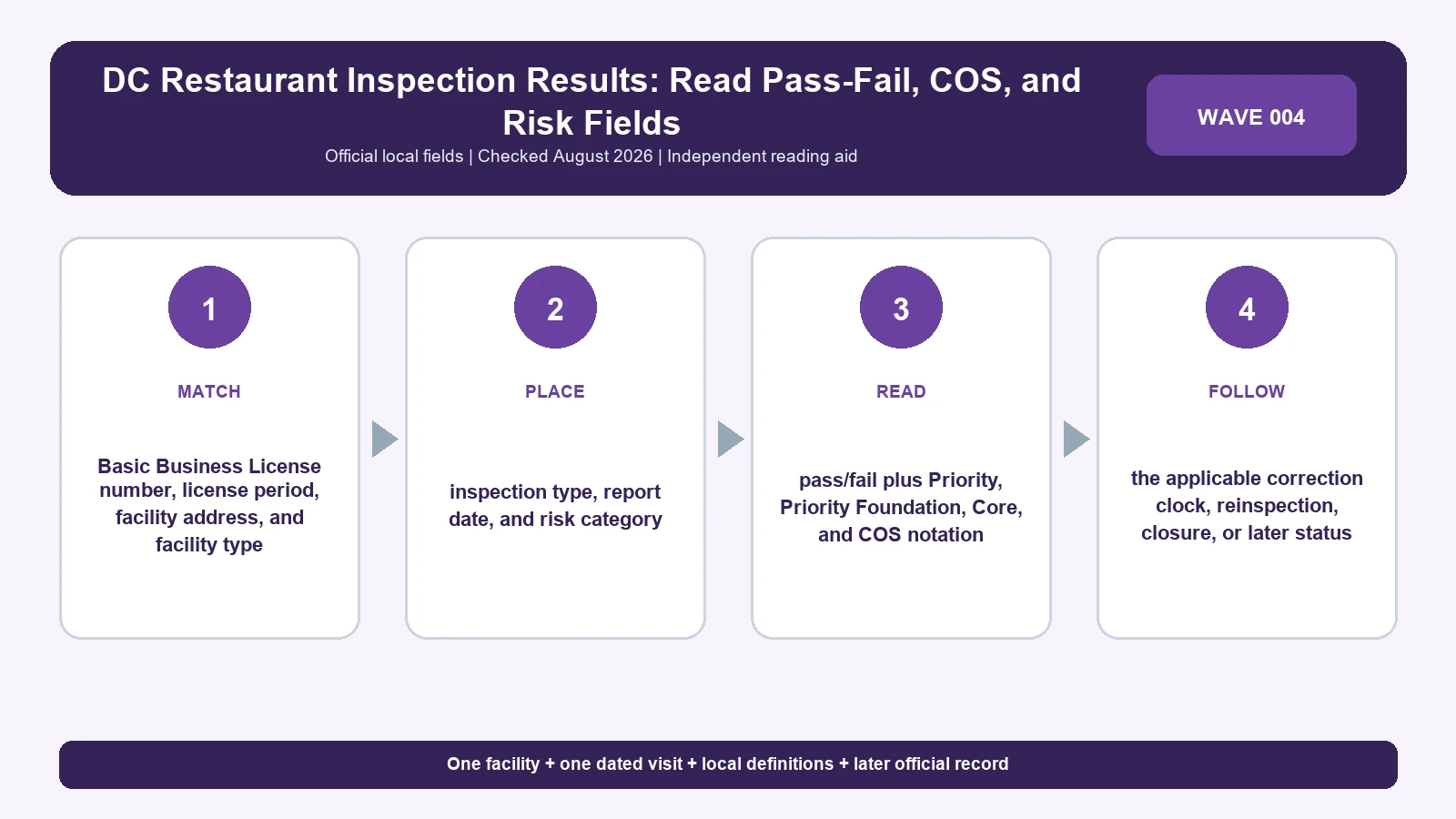
A DC restaurant inspection report is pass-fail, not a letter grade, percentage, or consumer rating. Match the establishment and Basic Business License, note the inspection type and risk category, then read Priority, Priority Foundation, Core, and Corrected On Site fields item by item.
Last checked: August 7, 2026.
Find the official access route at DC Health Food Establishments. Use DC Health guide to food establishment inspections to decode the report header and violation categories, and keep DC Health Division of Food as the responsible program entry point. Those sources establish what DC Health publishes; a review platform, window photo, or search snippet cannot redefine the city’s result.
Verify the DC establishment through its report header
DC Health reports include establishment name, address, telephone number, Basic Business License number and license period, establishment type, inspection type, email, and risk category. Use the BBL and address as the strongest public match. A familiar trade name alone can point to another branch or an operation that occupied the address during a different license period.
| Header field | What to preserve | Research use | Do not infer |
|---|---|---|---|
| Establishment name | Exact name on the report | Locate the candidate business | Every similarly named branch shares the result |
| Address and phone | Complete location and listed contact | Confirm the physical operation | The phone proves ownership |
| BBL number and period | License identifier and covered dates | Separate license histories | Registration guarantees food safety |
| Establishment type | DC’s operation label | Explain facility context | It is a cuisine rating |
| Inspection type | Purpose of the visit | Separate routine and follow-up events | It is the pass-fail outcome |
| Risk category | Program category on the report | Understand oversight context | A restaurant grade |
If the BBL changes, do not automatically merge the new report with the old one. The address may be stable while the legal operator changes. Show both license periods and describe the evidence for continuity. If the report lacks a field, mark it not displayed rather than copying one from a different date.
Read pass or fail as DC Health defines it
DC does not issue restaurant letter grades, percentages, or ratings through this inspection system. Preserve the exact pass-fail language shown on the selected report. Do not count violations and convert the total into A, B, or C, and do not borrow a threshold from another city.
| Displayed result | Local meaning | Next field to inspect | Invalid translation |
|---|---|---|---|
| Pass | DC’s outcome for that inspection | Violation rows, COS marks, and inspection type | Permanent safety certificate |
| Fail | DC’s outcome for that inspection | Uncorrected Priority and Priority Foundation items and required action | Automatic permanent closure |
| COS | Named violation corrected during the inspection | Other items on the same report | The report had no violations |
| Reinspection possible | Selected uncorrected items require later verification | Correction date and later report | The business remains failed forever |
| No grade | The city does not publish A-to-F or percentage conversion | Use the exact report | Create an editorial score |
Pass and violation-free are not synonyms. A report may display cited items that were corrected onsite. Conversely, a failed report does not by itself tell you whether the establishment later corrected the conditions. Keep the visit date and subsequent official record beside every summary.
Separate Priority, Priority Foundation, and Core
DC Health counts violations in three categories. Priority items directly address hazards associated with foodborne illness or injury; Priority Foundation items support control of those hazards; Core items cover broader sanitation and operational requirements. Use the official report’s category, code citation, observation, and correction state rather than guessing category from ordinary language.
| DC category | Correction horizon in current DC guidance | Evidence to quote | Boundary |
|---|---|---|---|
| Priority | Maximum five calendar days when not corrected onsite | Rule, observation, COS or due date | Category alone does not prove closure |
| Priority Foundation | Maximum five calendar days when not corrected onsite | Rule, observation, COS or due date | It is not the same as Core |
| Core | Maximum fourteen calendar days when not corrected onsite | Rule, observation, correction instruction | Zero urgency or optional |
| COS | Resolved during the visit for the marked item | Item-specific notation | All categories cleared |
Older DC material may use legacy critical and noncritical terminology with different correction wording. Do not paste a legacy 45-day noncritical rule onto a report governed by the current Priority, Priority Foundation, and Core system. Date the rule source and keep historical vocabulary with the report from that period.
Use COS precisely
Corrected On Site means the inspector recorded that the named violation was corrected during that inspection. DC Health says a COS item does not count toward possible reinspection. The limit is item-specific: one COS mark cannot close other violations, alter the pass-fail label, or prove conditions after the visit.
The food inspection violation guide helps separate category, observation, and correction. In a DC asset, create one row per violation and a distinct COS column. Never delete the original observation merely because it was corrected onsite; the pair is the meaningful record.
Understand the risk category without turning it into a score
Risk categories reflect the establishment’s operation and inspection needs. They provide context for oversight; they do not rate customer satisfaction or announce that one restaurant is safer than another. Store risk category in the facility header, not in a chart of pass-fail performance.
An establishment type or process can change between license periods. If the risk category changes, record the new date and verify whether the same BBL history continues. Avoid explaining the change unless DC Health supplies that reason.
Build a DC pass-fail evidence card
The strongest link asset exposes the header, event, violation categories, and follow-up status. A screenshot can be useful, but searchable columns and direct report URLs let another reader reproduce the interpretation.
| Card section | Fields | Audit value |
|---|---|---|
| Identity | Name, address, phone, BBL, license period | Matches one licensed operation |
| Context | Establishment type, risk category | Explains the inspected facility |
| Visit | Inspection date and type | Anchors the pass-fail result |
| Result | Exact pass or fail label | Prevents invented grading |
| Violation row | Category, code, observation, COS, correction due | Shows why follow-up may occur |
| Later event | Reinspection, action, or current unknown | Keeps dated history visible |
| Provenance | DC URL and access date | Allows replication after updates |
Where a field is blank, write blank or not displayed. Do not convert it to zero violations, no action, or no license. If two official DC pages conflict, save both access dates and ask the Division of Food which record controls before making a status claim.
Do not confuse imminent-hazard closure with an ordinary failed report
DC identifies conditions that can create imminent health hazards, including loss of hot water, sewage problems, utility failures, fire, vermin, contaminated food, outbreaks, inadequate refrigeration, and flooding. Such circumstances can support immediate closure or license suspension. A routine fail label or violation count alone does not prove that action occurred.
When the report contains an operational action, use the restaurant closure and permit-suspension guide and require the DC action date. Otherwise keep the article about inspection interpretation. This prevents an item-level finding from being inflated into a closure headline.
What a DC report cannot certify
A DC Health report can document what the agency recorded for a named establishment and date. It cannot guarantee current safety, prove that no complaints exist, rate food quality, or predict illness. A past fail is not a current verdict, and a pass is not permission to ignore a later recall or public-health notice.
For the initial record search, use the live DC inspection lookup guide. The defensible reading sequence is BBL and address, license period, visit type, pass-fail result, category-level findings, COS, correction deadline, and later official event.
DC inspection questions
Can I turn pass into an A?
No. DC Health says its system is pass-fail and does not issue grades, percentages, or ratings.
Does COS remove the violation from the report?
No. Preserve the observation and the item-specific onsite correction.
Does a Priority violation always close the restaurant?
No. Read the report’s correction and action fields. Closure requires explicit agency action, not category alone.
Audit the DC pass-fail report without inventing a grade
Read the complete header first: establishment, address, BBL number and license period, establishment type, inspection type, and risk category. Then verify the exact pass-fail result and each Priority, Priority Foundation, or Core item. A COS mark belongs to one violation and does not remove its historical observation. No arithmetic should turn these fields into an A, percentage, or national rating.
- Match the BBL and license period across the selected report.
- Quote pass or fail exactly as DC displays it.
- Keep violation category, code, observation, and COS together.
- Apply current five- and fourteen-day rules only to their categories.
- Do not treat risk category as a performance grade.
- Require explicit DC action before using closure language.
The release check should compare a sampled item in the article with the official report and confirm that its correction window is sourced to the correct era. Older critical and noncritical terminology must not be overwritten by current categories. If a historical rule cannot be established, preserve the report’s language and mark the deadline uncertain. This is safer than making a confident but anachronistic claim.
Scope: DC Health food-establishment reports and current category guidance. This independent guide does not issue grades, inspect establishments, or guarantee present conditions.