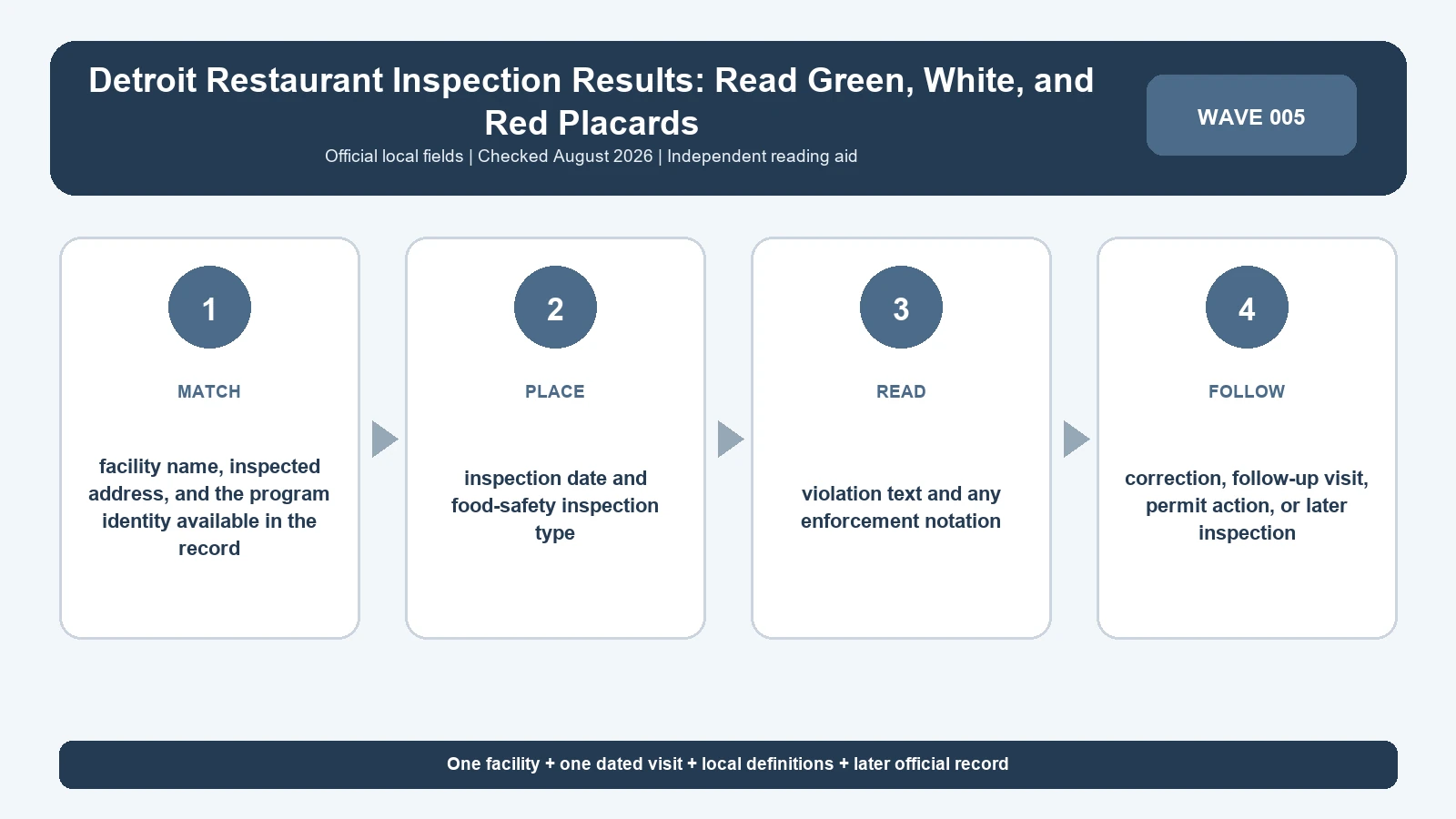
Detroit’s Dining with Confidence placard is a three-color public status display: green means the establishment met the city’s In Compliance criteria, white is informational, and red identifies enforcement or closure. The ordinance took effect October 1, 2024, so older inspection records should not be backfilled with colors.
Last checked: August 7, 2026.
Find inspection records through Detroit Food Safety Program. Use Detroit Dining with Confidence placard program for the current green, white, and red definitions, and keep the official Detroit Dining with Confidence fact sheet with any extracted color. Those Detroit Health Department sources control the meaning; do not substitute a generic traffic-light interpretation or a placard program from another city.
Match the Detroit establishment before reading a color
Copy the licensed establishment name, complete address, inspection date, and available license or record identifier. A downtown building can hold several food operations, and a familiar restaurant name can have more than one location. The placard posted at one door belongs to that licensed facility, not automatically to the entire brand.
| Match element | Evidence to save | Purpose | Mistake to prevent |
|---|---|---|---|
| Establishment name | Exact Health Department display | Finds the candidate | Applying one branch’s color to another |
| Street address | Number, street, unit, city | Fixes the inspected location | Joining businesses in one building |
| License context | Food-service license status or identifier when shown | Supports the placard test | A business registration equals compliance |
| Inspection date | Date tied to the report or placard decision | Anchors the snapshot | Using the photo upload date |
| Placard observed date | Date of official entry or dated image | Shows when the color was current | The color never changes |
If a restaurant changes operators at the same address, separate the histories until the city record connects them. Keep the license status and placard date visible. A new green placard should not be used to erase a prior operator’s red event, and an old street photo should not control a newer official record.
Apply Detroit's green criteria as a checklist
Detroit defines green as In Compliance and publishes several conditions. The establishment must have no serious Priority or Priority Foundation violations unless all were corrected, fewer than five total Priority and Priority Foundation violations, no active progressive enforcement, no required follow-up for overall low sanitation, and a valid food-service license.
| Green requirement | Evidence needed | What it shows | What it cannot promise |
|---|---|---|---|
| No uncorrected serious P/Pf violations | Item rows and correction status | Serious items meet the criterion | No Core findings exist |
| Fewer than five total P/Pf violations | Complete category count | Count falls under Detroit threshold | An A grade or percentage |
| Not in progressive enforcement | Current enforcement field | No active progressive path under the criterion | No historical enforcement |
| No follow-up required for overall low sanitation | Inspection disposition | Follow-up criterion is satisfied | No future inspection |
| Valid food-service license | Detroit license status | Authority criterion is met | The city guarantees every meal |
The checklist is conjunctive. An editor cannot assign green merely because the violation count is low, and a valid license alone says nothing about the other criteria. Cite the city’s placard or complete official inspection record rather than manufacturing a color from partial data.
Read white as informational, not a middle grade
Detroit’s white placard can indicate that the establishment has not yet been inspected under the program, does not currently qualify for green, or is a temporary food establishment. It directs customers to the city’s inspection search. White is not a B grade and should not be ranked halfway between green and red.
| White context | Defensible reading | Next check | Wrong label |
|---|---|---|---|
| Not yet inspected under program | No qualifying program decision displayed | Search current city records | Passed with warnings |
| Not green | Green criteria are not all satisfied | Open inspection and enforcement detail | Automatically closed |
| Temporary food establishment | Informational placard fits temporary operation | Confirm event and license dates | Permanent restaurant received a low grade |
| White photo only | White was displayed at image date | Locate official record | Current city status |
Because white has several possible meanings, always include the reason or mark it not determined. Do not write ‘needs improvement’ unless Detroit uses that phrase for the selected record. The public search is the next step, not speculation about which green criterion failed.
Reserve red for Detroit's enforcement or closure lane
Detroit uses red for enforcement or closed status. Official criteria include a severe health hazard, an invalid food-service license, or the final stage of progressive enforcement. A serious violation or low-looking report does not independently authorize an editor to display red; require the city’s placard or action record.
| Red basis | Required source | Safe statement | Unsupported expansion |
|---|---|---|---|
| Severe health hazard | Detroit determination and action | City placed the facility in the red enforcement lane | Every violation was severe |
| Invalid license | Official license status | The food-service license did not satisfy the criterion | The corporation does not exist |
| Final progressive enforcement | City enforcement record | Detroit reached the stated stage | Permanent closure |
| Red placard photo | Dated image plus facility match | Red was displayed when photographed | No reopening has occurred |
If the result is red, continue with the restaurant closure and permit-suspension guide. The placard communicates a status; the underlying order, reason, effective date, reinspection, and reopening record support the chronology.
Do not assign colors to pre-ordinance records
Detroit says the Dining with Confidence ordinance took effect October 1, 2024. An inspection before that date can be summarized using the report’s own fields, but it should not receive a retroactive green, white, or red label. Put a visible program-start marker in any history that crosses the date.
The absence of a color in an older report is expected and should not be treated as missing data, zero, white, or red. Likewise, a later placard represents a newer program event; it does not change what the older inspection documented.
Build a Detroit placard evidence card
A citation-ready card should reveal both the displayed color and the criteria behind it. Keep the verbatim city status separate from your plain-language explanation. That design lets another reader audit green without accepting a vague claim that a restaurant passed.
| Card section | Fields | Audit question |
|---|---|---|
| Facility | Name, address, license identifier and validity | Is this the correct licensed location? |
| Inspection | Date, type, item categories, corrections | What did Detroit record? |
| Placard | Green, white, red, or not applicable before program start | What public status was displayed? |
| Criteria | Each applicable threshold and evidence | Why does the official color fit? |
| Enforcement | Stage, hazard, closure, or unknown | Is an operational action present? |
| Later event | Reinspection, color change, reopening | What changed and when? |
| Provenance | Official URL, retrieval date, image date | Can the reading be reproduced? |
Use not displayed when an official field is absent. Do not turn absence of green into red, lack of a search result into unlicensed, or a blank reopening field into still closed. Escalate material conflicts to the Detroit Health Department.
Placard colors can change between routine inspections
Detroit explains that colors can change as inspection and enforcement status changes. Therefore every color claim needs a date. Append transitions rather than overwriting them: white to green, green to red, red to green, or another documented sequence. The latest official record is an endpoint, not a permanent prediction.
Use the Detroit inspection lookup guide to retrieve the underlying event and the food violation guide to organize item rows. Detroit’s criteria remain authoritative for the color.
What a Detroit placard cannot guarantee
The placard can communicate the city’s program status for a named facility at a stated time. It cannot certify conditions after the inspector left, predict illness, rate food quality, prove no complaints exist, or describe another branch. Green is not a warranty, white is not a grade, and a historical red is not necessarily current.
Detroit placard questions
Is white a caution grade between green and red?
No. Detroit calls it informational and uses it for several contexts, including not-yet-inspected and temporary establishments.
Does one Priority violation prevent green?
Read the complete criteria. Serious Priority or Priority Foundation items may satisfy the criterion when all are corrected, and the total P/Pf count must also be fewer than five.
Can a 2023 inspection be labeled green?
Not under this program. The ordinance took effect October 1, 2024; preserve the older report’s original terms.
Audit Detroit's color decision against the full checklist
For green, verify every In Compliance criterion rather than counting one favorable field. For white, record which informational context applies instead of calling it a middle grade. For red, require Detroit evidence of enforcement or closure. Finally, check the date: no Dining with Confidence color should be assigned to an inspection before the October 1, 2024 effective date.
- Match the food-service license and complete address.
- Count P/Pf items and preserve correction status.
- Check progressive-enforcement and required-follow-up fields.
- Confirm food-service license validity for green.
- Explain the exact white context when available.
- Date every official placard record or photograph.
Have a reviewer reconstruct the official color from the cited evidence without consulting the editorial summary. If any required green criterion is missing, do not assign green independently. If white appears with no explanation, leave its context unknown and route readers to the city search. If red is historical, pair it with any later Detroit event rather than presenting it as today’s status.
Scope: Detroit Dining with Confidence placards and dated food-safety records. This independent guide does not assign colors or guarantee current conditions.