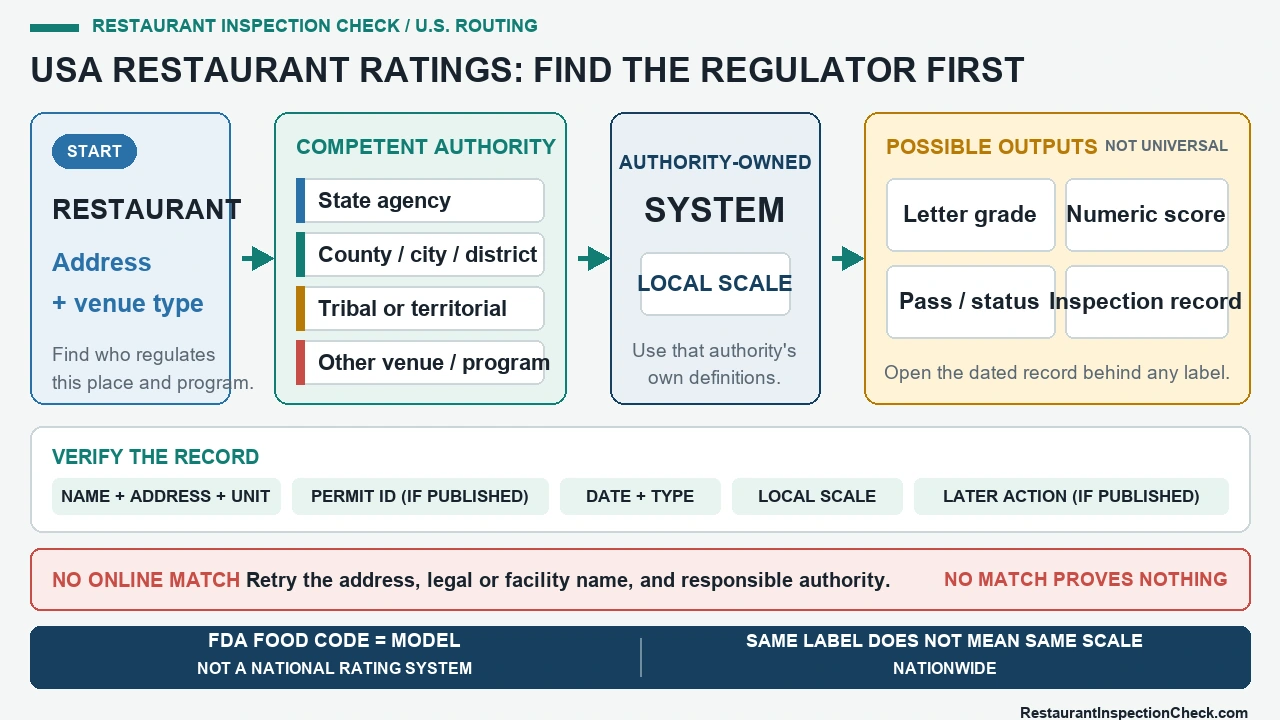
There is no single nationwide food hygiene rating database for every U.S. restaurant. A food hygiene rating USA search usually ends at a state, county, city, or district health authority. Find the agency for the restaurant’s address, match the licensed facility, and read the inspection history under that agency’s own scoring method.
Why the U.S. search is local
The U.S. Food and Drug Administration publishes the Food Code as a model and works with state and local retail food programs, but local authorities commonly conduct inspections and publish results. The FDA retail food protection page is useful for understanding that structure; it is not a national restaurant score lookup.
Search the official health department for the exact restaurant location. State names, county boundaries, independent cities, and special health districts can all affect which portal holds the record.
Examples show why scores cannot be compared nationally
New York City restaurant grades use the city’s inspection system, while Los Angeles County Environmental Health publishes results under its own program. Their displays, terminology, and scoring rules are not a universal U.S. standard.
Use examples only to learn how a portal works. The controlling source for a restaurant is the authority that inspects its address.
Search the licensed facility, not only the brand
- Confirm the full street address, including unit or suite.
- Search the storefront name and then the address alone.
- Try the legal operator or facility name shown on the record.
- Match the license or facility number when available.
- Exclude an older operator or another branch with a similar name.
Delivery-only brands and food halls can be especially difficult because several businesses may operate from one address. The inspection may appear under the licensed kitchen or operator rather than the consumer-facing brand.
Read the local inspection sequence
| Item | What to verify |
|---|---|
| Inspection date | Whether the displayed result is current enough for the question. |
| Visit type | Routine, complaint, reinspection, closure, reopening, or another event. |
| Grade or score | The local authority’s definition and calculation method. |
| Violation detail | The conditions observed during that specific visit. |
| Follow-up | Later correction, reinspection, or status change. |
Do not use a single grade without its date, or assume a later reinspection covered every part of the routine inspection. Read enough of the timeline to distinguish an old corrected event from a current unresolved status.
State and local sites also differ in record retention. One portal may display several years of inspections, while another emphasizes only the latest cycle. State the period you actually reviewed. Absence of an older event from a public portal is not proof that it never occurred.
When an inspection record lists an emergency closure or permit suspension, look for the separate reopening or reinstatement event. A new score displayed on a summary page may not explain the legal status by itself.
What to do when the restaurant is missing
Check the jurisdiction, search by address, and look for a former or legal name. The business may be new, outside the portal’s coverage, or listed in a separate county or city system. Contact the health authority with the address and ask how the licensed facility appears in its records.
Save the authority, facility name, address, ID, inspection dates, score explanation, detailed findings, and source URL. For general search tactics, use Food Hygiene Rating Search. For interpreting an existing result, use Food Hygiene Rating Lookup.