To find a restaurant inspection or health score near you, start with the restaurant’s exact street address, not your phone’s location alone. Identify the city, county, state, council, or regional health agency that inspects that address; match the licensed business name and branch; then open the newest dated inspection and every later reinspection, closure, or reopening entry. A review-site score, delivery-app listing, or placard photo is not the current official record.
This page is a database-finding and record-matching guide. The separate restaurant health score guide explains how to read a local scale after you have found the right record. Restaurant Inspection Check does not inspect restaurants, assign ratings, or speak for any health department.
“Near me” is only a discovery clue. Search engines can infer an approximate location, but an inspection database needs the restaurant’s jurisdiction and facility identity. Confirm the full address yourself, especially near city or county lines, inside malls or hotels, and for chains with several nearby branches.
Official source routes reviewed July 28, 2026. Search systems, inspection methods, publication delays, and displayed status can change. Reopen the responsible authority’s live record before relying on it.
Find the health department that covers the restaurant address
There is no universal restaurant health-rating database. In the United States, the FDA retail-food protection page says state, local, and tribal agencies have primary responsibility for regulating and inspecting restaurants and other retail food establishments. The FDA provides a model Food Code and support, but the consumer inspection record normally comes from the agency with jurisdiction over the restaurant.
Start with the full street address and determine the city, county, state, local authority, council, or regional health unit that covers it. The agency name may not match the postal city. A restaurant just outside city limits can appear in a county system, while two branches of the same chain can be inspected by different programs and use different rating methods.
Use the search controls provided by that authority. The Food Standards Agency food hygiene rating search, for example, accepts a business name, street, town or postcode, location search, map view, or local-authority route. King County’s official safety-rating search instructs users to search by business name or address and open the History link for recent inspection history.
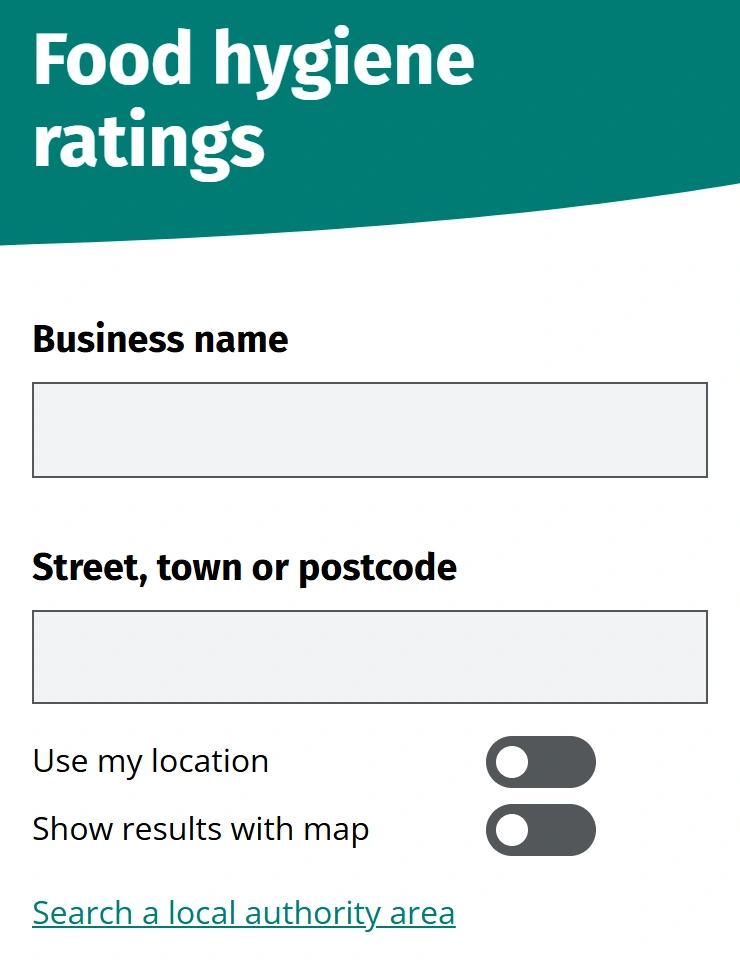
Confirm that the page belongs to the agency or its named public-data service. An official database should identify the public authority, geographic coverage, and the type of record being shown. A search engine result, business directory, review platform, delivery app, or reposted spreadsheet may help you discover the agency name, but use the official-source versus review-site guide before treating it as evidence.
If you know the jurisdiction but cannot find its database, open the health department, environmental health, food safety, licensing, public health, or council page and search within that official site. The health department restaurant lookup and international inspection-source directory provide additional routing steps.
Match the establishment before reading the rating
The name on a storefront or delivery app can differ from the licensed facility name. One brand can have several branches, a hotel can contain multiple food operations, and a restaurant can keep the same location after a change of owner or trading name. Search by address as well as name before opening a rating.
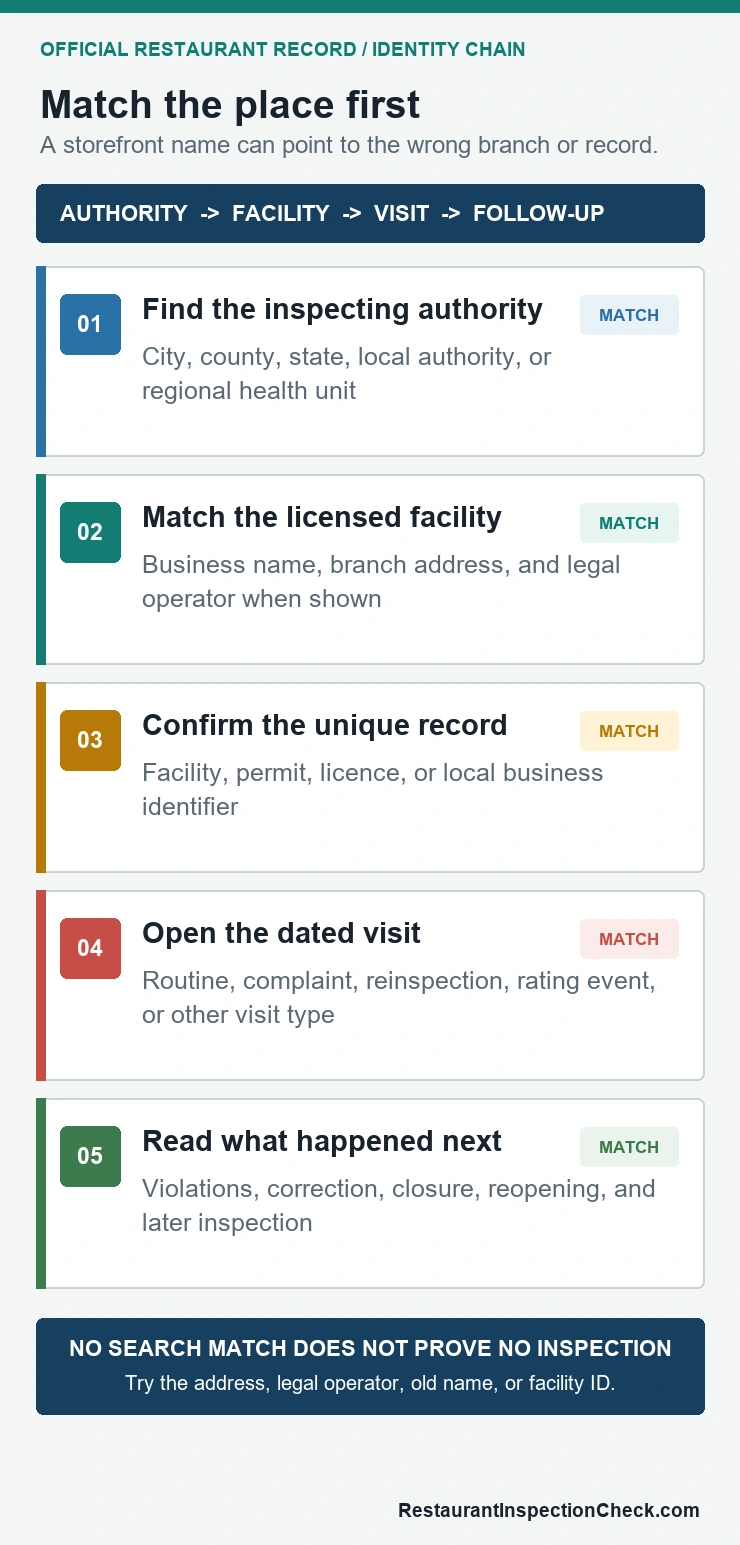
Treat facility identity as a chain: inspecting authority, licensed name, branch address, facility or permit identifier, inspection date, and later follow-up. If one link points to another branch or a former operator, the grade may be real but unrelated to the restaurant you intended to check.
| Database field | What to compare | Mismatch to watch for |
|---|---|---|
| Business or facility name | Storefront name, legal operator, former name, and spelling | A chain result from another branch or a prior tenant |
| Street address | Number, direction, street, unit, city, and postcode or ZIP code | A nearby location, mall unit, hotel outlet, or delivery-only kitchen |
| Facility, permit, or licence ID | Identifier repeated across inspection entries | Two records with similar names but different licensed operations |
| Authority or local area | City, county, council, state, or regional health unit | A result from outside the responsible boundary |
| Operating status | Open, inactive, closed, changed owner, or other local label | A historical record mistaken for the current business |
| Inspection date | Newest visit and the date of any later event | An older grade shown ahead of a reinspection or reopening |
Use the inspection search by address guide when a name returns many results. Start with the exact address, then try a shortened legal name, former name, operator, or facility number. Avoid selecting the closest-sounding result simply because the database search is awkward.
For mobile vendors, food trucks, caterers, kiosks, shared kitchens, and temporary events, the public record may use a commissary, permit holder, vehicle, or event identifier rather than the customer-facing location. The food truck inspection guide explains why the service location and licensed record can differ.
Read the newest inspection and its follow-up
After matching the establishment, sort or scan by date and identify the event type. A routine inspection, complaint visit, reinspection, preopening inspection, closure, reopening, or administrative update can carry different meaning. The newest row is not always a full routine inspection, and the largest score on the page is not automatically the current rating.
- Open the latest routine or rating inspection. Record the date, event type, displayed grade or score, and facility identifier.
- Read the detailed findings. Note the cited item, the authority’s severity or risk label, and whether it was corrected during the visit.
- Look for required follow-up. Check for a due date, reinspection, permit condition, enforcement action, closure, or other consequence.
- Open every later event. A reinspection, reopening, appeal, or newer routine visit can change how the earlier result should be described.
- Keep the local definitions attached. Use the authority’s explanation of its grades, points, stars, colours, or status words.
| Event shown | What it can establish | What to check next |
|---|---|---|
| Routine inspection | Findings observed during a scheduled program visit | Rating method, violations, correction, and later events |
| Complaint inspection | The agency investigated a reported concern | Whether the concern was substantiated and what action followed |
| Reinspection or follow-up | The agency returned or reviewed required correction | Items corrected, remaining findings, and new status |
| Closure or suspension | The authority restricted operation under its rules | Effective date, stated reason, and whether reopening appears |
| Reopening or reinstatement | The authority permitted operation to resume under stated conditions | Reinspection result, conditions, and later routine history |
| Inactive or historical record | The record may belong to a former operator or closed establishment | Current licence holder and any replacement facility record |
Separate the inspection date from the date a portal published or refreshed the row. The visit date tells you when the inspector observed conditions; the upload date tells you when the public system changed. When both appear, record both and use the restaurant inspection date guide to avoid presenting a newly posted old visit as a new inspection.
The inspection report guide explains common report sections, while food inspection reports and violations focuses on findings. Use the reinspection follow-up guide and closure or permit-suspension guide when the history includes a later agency action.
Keep dates in the same sentence as the result. “The database showed a conditional pass” is incomplete. “The official database showed a conditional pass at the inspection dated July 1, followed by a pass at the July 8 reinspection” identifies the branch, sequence, and date needed to understand the public record.
Understand what the local rating means
Do not apply one jurisdiction’s scale to another. Programs use letters, numbers, points, stars, colours, placards, pass or fail labels, risk categories, or inspection-result text. In one system a lower point total can be better; in another a higher score or star count can be better. Some authorities publish violations without assigning a consumer grade at all.
Read the authority’s current methodology next to the inspection date. Grade thresholds, violation weights, frequency rules, and display requirements can change. The restaurant letter-grade guide and score versus grade guide explain the distinction without pretending that the systems convert directly.
The Food Standards Agency states on its official search that a food hygiene rating is not a guide to food quality. More broadly, a health rating does not measure taste, service, value, menu quality, or every condition that may have changed after the inspector left. It summarizes what the responsible program publishes about a dated inspection or rating event.
A permit to operate also does not mean that no violation was found, and a past violation does not prove that the same condition exists today. Read the findings, correction status, later visits, and current operating status together. If a person is ill or sees an immediate food-safety risk, use the authority’s complaint or illness-reporting channel rather than relying on an old database entry.
Official restaurant inspection routes by location
Use the route that matches the restaurant’s location. These examples demonstrate how responsibility and publication differ; they are not interchangeable rating systems.
| Location | Official route | What it helps you do | Important limit |
|---|---|---|---|
| United States | FDA retail-food protection | Understand that inspection responsibility is mainly state, local, and tribal | It is not a national restaurant-rating search |
| Seattle and King County | King County rating lookup | Search by business name or address and open recent history | Use the county’s own rating definitions and current data notes |
| United Kingdom | Food Standards Agency ratings | Search by name, address, location, map, or local authority | The rating concerns hygiene, not food quality |
| Canada | CFIA restaurant-inspection route | Find provincial, municipal, and regional health-authority contacts | The federal route points to the responsible local or regional system |
| Toronto | Toronto DineSafe | Search inspected establishments and see pass, conditional pass, or closed notices | Match the Toronto establishment and dated inspection |
| Australia | Australian Government food standards and safety | Understand national standards and state or territory enforcement roles | Use the relevant state, territory, or local authority for the restaurant record |
| New South Wales | NSW Scores on Doors | Understand the rating program and participating councils | Businesses may volunteer in participating council areas, so no displayed score does not prove no inspection |
For city-specific walkthroughs, use the NYC restaurant grades guide, LA County inspection search, Toronto DineSafe guide, Chicago inspection lookup, or San Francisco inspection lookup. Reopen the linked authority whenever the guide and live database differ.
For an Iowa address, use Iowa restaurant inspection reports to confirm the responsible official database before matching the facility and reading the newest visit with any later follow-up.
What a missing or stale record can mean
No search match does not prove that the restaurant was never inspected or is operating without oversight. The facility can be listed under a legal operator, former name, abbreviated name, hotel or market name, separate mobile-vendor record, or another authority. A newly opened restaurant may also appear after the agency’s publication process catches up.
- Remove punctuation and search only a distinctive word from the business name.
- Search the full street address, then the street number and street name without the unit.
- Try the legal operator, former name, or facility number shown on a permit or prior report.
- Confirm whether the address belongs to a neighboring city, county, council, or health unit.
- Check the authority’s data-update notice, system-status page, archive, or separate closure list.
- Contact the food-safety program with the address and ask which public system covers the facility.
A visible result can also be stale. The Food Standards Agency terms say ratings change as local authorities update them and place responsibility on users to use the current rating or indicate the update date. Other authorities publish their own delay, migration, correction, appeal, or data-quality notes. Record those notices instead of assuming every portal refreshes in real time.
When an inspection page and a placard photo disagree, compare the facility ID, inspection dates, later visits, and the agency’s posting rules. Do not decide which one is current by photo upload date alone. Contact the authority if the discrepancy matters for a complaint, news report, business decision, or public statement.
Save a reproducible result without overstating it
A useful lookup note lets another person find the same public record. Save the official URL, authority name, licensed facility name, branch address, facility or permit ID, inspection type, inspection date, displayed result, later event dates, date accessed, and any portal warning. Keep the authority’s definitions with the result.
| Avoid this claim | Use a bounded statement | Reason |
|---|---|---|
| “This restaurant is safe.” | “State the exact result and inspection date shown in the official record.” | A dated result is not a guarantee of present conditions |
| “The restaurant failed.” | “Record the authority’s status, visit type, visit date, and any later event in one chronological sentence.” | Local labels and follow-up determine meaning |
| “It has no inspection.” | “List the name and address searches attempted and the date the portal was checked; say only that no public match appeared.” | A no-match can result from identity, coverage, or publication issues |
| “Its score is worse than another city’s.” | “The scores use different authority methods and were not compared.” | Numbers are not portable across jurisdictions |
Do not publish an entire live result page merely to prove that you searched it. A screenshot can expose an unrelated address, owner name, account state, map tile, or later-stale rating. Link to the official source and quote only the fields needed for the point, with the inspection and access dates. Preserve a private research copy when your work requires an audit trail.
If you are reporting a possible foodborne illness, unsafe condition, or unpermitted operation, use the complaint route named by the responsible authority. A public database lookup is background; it does not submit a complaint or trigger an inspection.
Questions before relying on a restaurant health rating
Is there one US database for every restaurant?
No. State, local, tribal, county, and city agencies carry primary retail-food inspection responsibility. Identify the agency covering the address and use its current inspection system.
Does no result mean the restaurant was not inspected?
No. Try the address, licensed operator, former name, facility ID, and neighboring jurisdiction. Check the portal’s update notice or contact the authority before drawing a conclusion.
Can I compare a 90 in one city with an A in another?
Not without proving that the methods are comparable, which they usually are not. Read each authority’s thresholds, violation weights, event types, and effective dates separately.
Is the newest row always the newest full inspection?
No. It may be a reinspection, complaint visit, reopening entry, administrative update, or another event. Read the event type and the sequence of later records.
Does a pass or high rating guarantee the restaurant is safe today?
No. It is a dated result under a local program. Conditions can change, and an inspection cannot observe every moment or eliminate all risk. Use current official records and report immediate concerns to the authority.
Which details should I record?
Record the authority, official URL, licensed name, branch address, facility ID, inspection type and date, local rating, findings, follow-up, access date, and any update warning. Those details keep the lookup tied to the correct establishment and time.
The reliable sequence is simple: find the inspector for the address, match the licensed establishment, open the dated visit, read what happened next, and describe only what the official record can support.