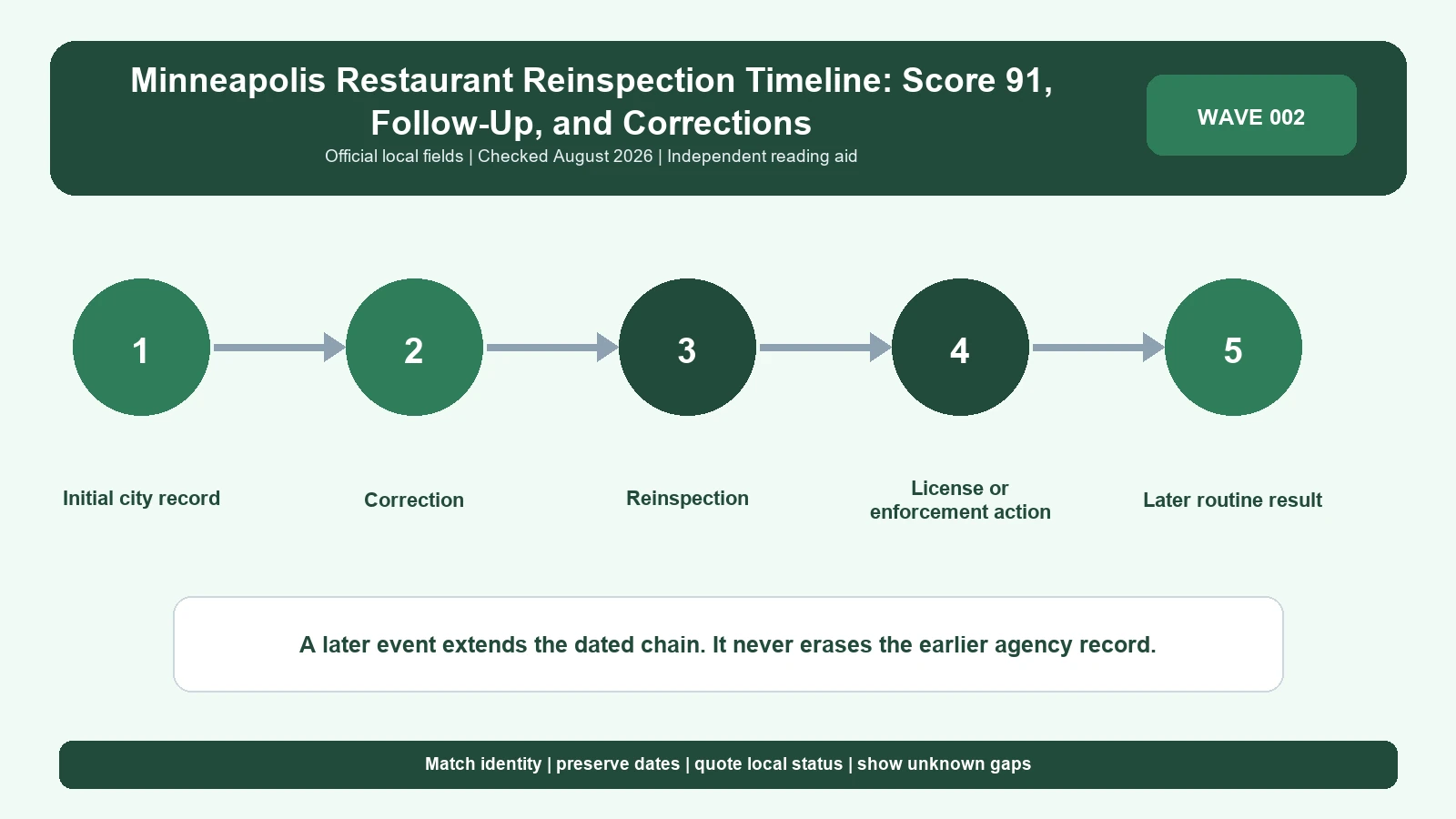
A Minneapolis reinspection timeline turns on two local rules: a score of 91 or lower requires follow-up, and a higher score may still receive follow-up when the inspector identifies significant issues. The city says the return visit is generally about 14 days later, but the actual dated record—not calendar arithmetic—proves that it occurred.
Last checked: August 7, 2026.
Retrieve the history through Minneapolis Health Inspection Lookup Dashboard; verify scoring, posting, and follow-up policy at Minneapolis Health Inspection Reports; and use Minneapolis bulk-data field descriptions to preserve the exact facility, inspection, violation, and comment fields. Each timeline connection should be reproducible from HealthFacilityIDNumber, InspectionIDNumber, and DateofInspection.
Lock the Minneapolis facility and inspection identifiers
A business may operate more than one health-regulated facility under one roof. Begin with HealthFacilityIDNumber and FacilityCategory, then confirm BusinessName and FullAddress. Every visit receives its own InspectionIDNumber. If two rows share an address but not the facility identity, keep them in separate chains.
| Identifier | Timeline function | What to verify | Invalid shortcut |
|---|---|---|---|
| HealthFacilityIDNumber | Groups events for one regulated facility | Stable facility context | Joining by business name alone |
| InspectionIDNumber | Names one city inspection event | Unique event and associated violations | Treating every violation row as a separate visit |
| DateofInspection | Orders events | Actual date rather than publication date | Starting a clock from dashboard access |
| InspectionType | Explains routine or follow-up scope | City label for each event | Comparing unlike visits as equal |
| FacilityCategory | Separates co-located operations | Restaurant, grocery, truck, or other type | Combining the whole building |
Reconstruct the original score before assigning the follow-up lane
Count the Priority 1 and Priority 2 violation rows for the baseline inspection: four points are deducted for each Priority 1 item and two for each Priority 2 item; Priority 3 subtracts zero. Preserve the city’s displayed score and your calculation. A mismatch is a verification issue, not permission to choose whichever number supports the desired story.
| Baseline outcome | Published procedure | Timeline entry | Do not claim |
|---|---|---|---|
| 91 or lower | Follow-up required | Mark the visit as entering required follow-up | The restaurant was automatically closed |
| Above 91 with significant issues | Follow-up at inspector discretion | Record only when report or later visit supports it | Scores above 91 never receive follow-up |
| Above 91 without visible follow-up | No return event located in selected records | Show the checked date and visible window | The inspector waived every correction |
| Score unavailable | Threshold cannot be applied from the number | Use violation and report directions | Infer a score from a third-party summary |
The score threshold chooses a procedural lane; it does not describe current risk and is not a grade boundary. Write ‘the city states that this score triggers follow-up,’ then cite the later report separately. This keeps policy evidence and event evidence from collapsing into one assumption.
Use about 14 days as an expectation, not a fabricated date
Minneapolis describes follow-up inspections as occurring about 14 days after the original visit. Holidays, scheduling, corrective work, and agency practice can affect the observed interval. Record the actual return date from DateofInspection. If no row appears, state that the later event was not located; do not publish a calculated appointment date.
| Date field | Meaning | How to display it | Risk if confused |
|---|---|---|---|
| Original DateofInspection | Baseline visit | Day 0 event | Clock starts from page publication |
| Expected interval | City says about 14 days | Policy note, not event date | Approximation becomes a deadline |
| Follow-up DateofInspection | Actual return visit | Separate dated row | Predicted day substitutes for evidence |
| Dashboard access date | When the researcher viewed data | Provenance field | It is treated as inspection date |
| Posting window | Reports may take up to seven business days | Lag note | A recent absent row is declared nonexistent |
Compare FoodCodeItem and comments across visits
Use FoodCodeItem, FoodCodeText, ViolationPriority, and InspectorComments to connect a baseline finding to the return visit. Do not rely on the score alone. A follow-up may revisit selected high-priority conditions, and a new score or result does not explain which earlier items were examined.
For each baseline violation, assign one of four states: explicitly corrected, repeated or still cited, not mentioned in the selected follow-up, or not verifiable because the later report is unavailable. ‘Not mentioned’ and ‘corrected’ must never be merged. The first describes a data observation; the second is a city outcome.
| Item state | Required evidence | Safe description | Unsupported conclusion |
|---|---|---|---|
| Corrected | Later city row or comment resolves the item | Minneapolis recorded correction for the named item | All conditions are safe |
| Still cited | Same rule and condition appear again | The later visit again records the finding | Continuous violation between visits |
| Not mentioned | No matching item in the selected follow-up | The public follow-up does not display the item | It passed |
| New finding | Later visit adds another item | The return visit documents a new observation | It existed during the original visit |
| Unavailable | Expected report is not public or retrievable | Outcome could not be verified | The city took no action |
Keep RiskLevel out of the performance trend
RiskLevel is based on food-preparation processes, not previous inspection performance. It can help explain whether routine inspections occur on a 12-, 18-, or 24-month cycle, but it should not rise or fall in a chart as if it were a score. Store it as facility context outside the event outcome.
A change in FacilityCategory or RiskLevel may signal a material operational change. Flag it and confirm whether the same facility history should continue. Do not assume that a menu expansion, ownership change, or co-located license has no effect on identity.
Build the Minneapolis follow-up ledger
Use two complementary views: an event table that shows when and why Minneapolis visited, and a violation crosswalk that tracks what happened to each cited item. Preserve the city’s exact field values in dedicated source columns, and place plain-language interpretation in separately labeled reader notes.
| Ledger layer | Columns | Purpose |
|---|---|---|
| Facility | HealthFacilityIDNumber, name, address, category, RiskLevel | Defines the regulated operation |
| Baseline event | InspectionIDNumber, date, type, result, score | Starts the timeline |
| Score audit | P1 count, P2 count, formula, displayed value | Explains threshold routing |
| Violation child row | FoodCodeItem, text, priority, comments | Preserves original findings |
| Follow-up event | InspectionIDNumber, actual date, type, result | Documents the return visit |
| Crosswalk outcome | Corrected, repeated, absent, new, or unknown | Prevents blanket pass claims |
| Provenance | Official URLs, filters, access date | Makes the chain reproducible |
Version the ledger rather than replacing rows. The original score remains a historical fact even when a later visit records correction. A newer routine inspection starts a fresh snapshot and should not be presented as the completion of an earlier follow-up unless the city record creates that connection.
Separate follow-up from closure or license action
A score of 91 or lower requires follow-up; it does not automatically prove closure. Add a closure, suspension, or reopening row only when the responsible Minneapolis agency publishes that specific action and date. Likewise, a favorable follow-up is not a reopening document unless the city says it restored authority to operate.
Use the restaurant closure and permit guide when a true operational action appears. For an ordinary correction chain, the reinspection follow-up guide is sufficient as a reading aid; Minneapolis sources remain the evidence.
Handle a missing or late report
- Verify the facility and inspection identifiers.
- Click the dashboard score bar to expose violations.
- Allow for the city’s seven-business-day posting statement.
- Check the current year and three prior years.
- Record the actual filters and failed result.
- Contact the city if the gap changes an enforcement conclusion.
An event older than the public window may no longer be visible. Preserve the known identifier and source date, mark the document unavailable, and avoid reconstructing comments from a later report. A complete-looking timeline with invented detail is worse than an honest gap.
What the last event can support
The endpoint can say that Minneapolis conducted a follow-up on a stated date and recorded particular item outcomes. It cannot guarantee the restaurant’s current condition, prove no later complaint exists, or certify that every food-code requirement was reviewed. Keep the conclusion tied to the named facility, visit, and public fields.
Minneapolis follow-up questions
Is day 14 always the reinspection date?
No. The city says about 14 days. Use the actual DateofInspection when a return visit is published.
Does 92 rule out a follow-up?
No. Minneapolis says inspectors may require one above 91 when significant issues are present.
Does a corrected item disappear from history?
No. Preserve the original finding and append the city-recorded correction as a later state.
Check the Minneapolis threshold logic and actual dates
Verify the baseline score and formula before labeling the follow-up lane. Scores of 91 or lower require follow-up, while higher scores may still receive one when the inspector identifies significant issues. About 14 days is the city’s general timing description, not an appointment date. The chronology must use the actual DateofInspection from the later event and expose the seven-business-day publication allowance.
- Use one HealthFacilityIDNumber throughout the chain.
- Recalculate the baseline score from P1 and P2 counts.
- Distinguish required and discretionary follow-up.
- Crosswalk FoodCodeItem and InspectorComments across visits.
- Mark absent later items as not shown, not corrected.
- Separate any closure or license action from the score threshold.
Ask a reviewer to trace one Priority 1 item and one Priority 3 item across the event ledger. The first affects the score; the second does not, but both remain inspection findings. If a later report lists neither, the timeline should not silently close them. If a new routine inspection appears, label it a new snapshot unless the city record explicitly connects it to the earlier follow-up requirement.
Scope: Minneapolis inspection scores, violation data, and dated follow-up events. This independent chronology is not a live health or licensing determination.