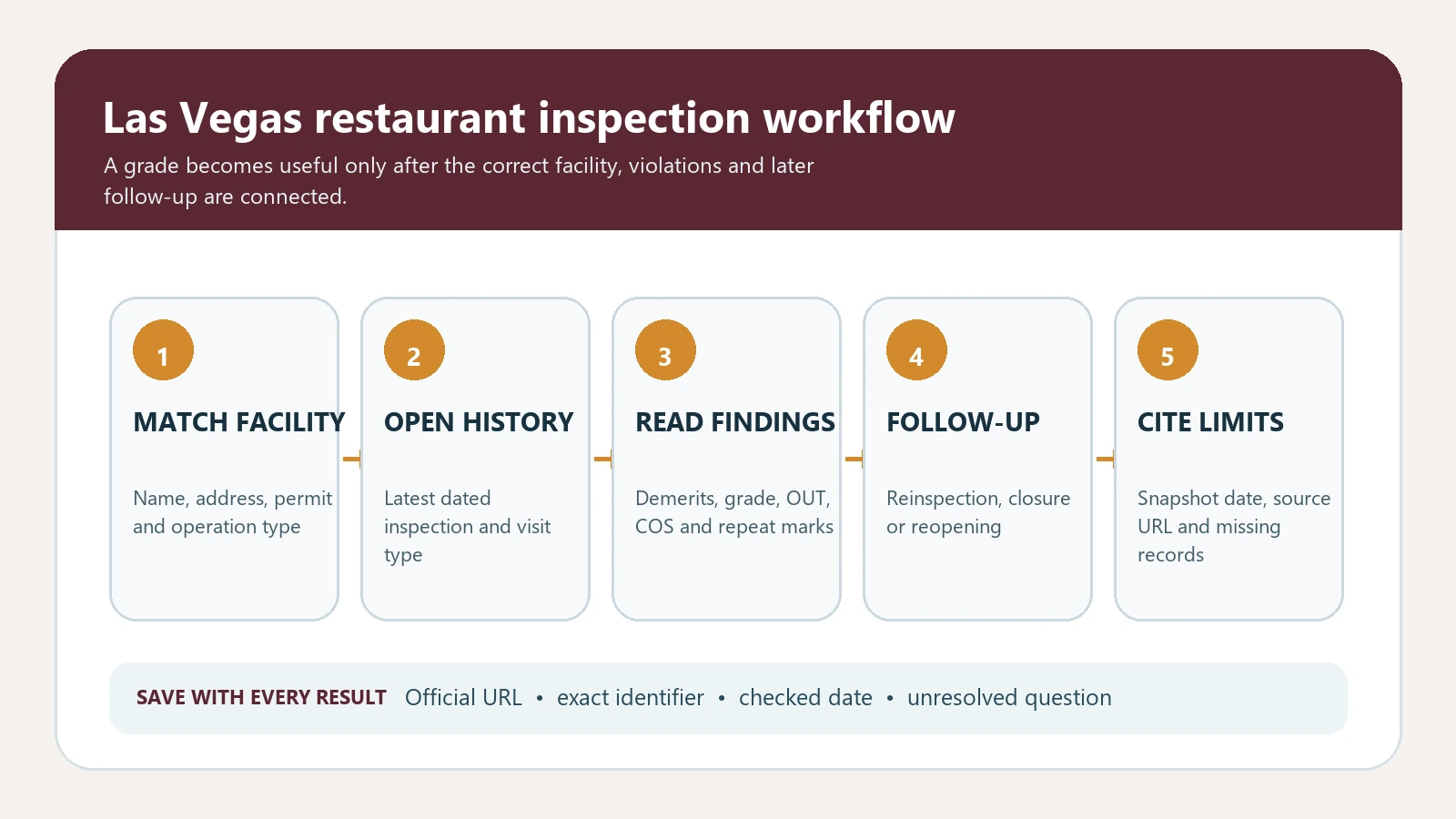
Quick answer: For a Las Vegas restaurant inspection, search the Southern Nevada Health District's official system, match the facility address and permit record, and open the latest inspection plus any follow-up. Read the posted grade or card with the inspection date and violation details.
Use the SNHD record for Las Vegas-area inspections
- Confirm that SNHD is the responsible authority for the facility.
- Separate routine, complaint, reinspection, and closure-related records.
- Check whether later correction or reopening information changes the older result.
What this result does not prove
An A, B, C, closure, or other posted result is a dated regulatory outcome, not a permanent prediction of current conditions.
Verify the live rule at SNHD restaurant inspection search. Then continue with the reinspection and follow-up guide for the next step.
The SNHD Restaurant Inspection Search covers food-establishment records regulated by the Southern Nevada Health District in Clark County. SNHD says inspections are unannounced, generally posted online about five business days after the inspection, and represent a snapshot of conditions at that date and time. Its page also warns that some records may be delayed during a system transition and directs users to a public-records request when a specific record cannot be found.
Match the correct Las Vegas-area facility
Restaurant names are weak identifiers. A casino, hotel, resort, food hall, airport, grocery store, or chain can contain several separately permitted kitchens, bars, buffets, kiosks, pools, banquet operations, and retail food units at one address. Search the exact location and compare the permit or facility details before treating an inspection as belonging to the restaurant you mean.
| Match field | What to compare | Common error |
|---|---|---|
| Establishment name | Legal or permitted name plus familiar trade name | Choosing a similarly named location |
| Street address | Number, street, suite, casino or resort property | Using the correct brand in the wrong hotel or shopping center |
| Permit or facility identifier | Exact identifier shown in the official record | Combining separate kitchens or operations |
| Facility type | Restaurant, bar, mobile unit, market, pool food service, banquet or other operation | Assuming every result covers the dining room |
| Inspection date | Latest inspection and later follow-up dates | Quoting an older downgrade after a reinspection |
| Status | Current grade, closure, reopening or other recorded status | Reading only a search-result badge |
How to search and save the official record
- Open the official SNHD inspection search rather than a review site or a copied score list.
- Search a distinctive part of the establishment name. If results are broad, add the street, cross street, hotel, casino, neighborhood, or permit identifier.
- Match the exact facility and address. Treat separately permitted outlets at one property as separate records.
- Open the full history and identify the most recent inspection by date, not by the order of a search snippet.
- Record the inspection type, demerits, grade or closure status, violation item numbers, repeat indicators, and corrections made during the visit.
- Look for a later reinspection, reopening, or follow-up. A later record may materially change how the earlier downgrade should be described.
- Save the official URL, facility identifier, inspection date, and date checked. Quote the record narrowly and distinguish the inspector’s finding from your interpretation.
- If a specific record is missing, follow SNHD’s current public-records route rather than assuming that no inspection occurred.
SNHD A, B, C, and closure thresholds
SNHD’s food establishment inspection report form publishes the grading framework used on the form. The table below reorganizes that public framework for quick comparison. Always read the current live report and any later agency update because repeat priority or priority-foundation violations can affect the grade, and operating status can change after reinspection.
| Recorded result | Demerit framework on the SNHD form | What to check next |
|---|---|---|
| A | 0 to 10 demerits, subject to the form’s repeat-violation rule | Read all violations and corrections; an A is not a guarantee of future conditions |
| B | 11 to 20 demerits, or an identical repeat priority or priority-foundation violation | Find the scheduled or completed reinspection and whether the result returned to 10 or fewer demerits without the specified repeat |
| C | 21 to 40 demerits | Check the reinspection, fee and any additional administrative action; do not stop at the downgrade date |
| Closure | 41 or more demerits on an initial inspection, or an imminent health hazard requiring closure | Confirm the closure date, reason, required correction, and official reopening or continued-closed record |
| Failed follow-up | The form describes lower-grade or closure consequences when required reinspection conditions are not met | Use the actual later report; do not predict the outcome from the first inspection |
Demerits are not a consumer rating invented by a review platform. The form assigns different weights to priority, priority-foundation, and core items and includes repeat-violation logic. Two inspections with the same total can therefore require different contextual reading. The safest summary states the official grade, date, total, key cited items, whether corrections occurred during the visit, and what the next official record shows.
Read violations by risk and correction status
| Report signal | What it means in the form | Responsible wording |
|---|---|---|
| OUT | The item was marked not in compliance | State the cited item and inspection date |
| COS | Corrected on site during the inspection | Report both the violation and the documented on-site correction |
| R | Repeat violation indicator | Check whether repeat logic affected the grade and compare the earlier report |
| Priority item | Higher-weight foodborne-illness risk factor on the form | Describe the exact item; do not replace it with a vague claim that the restaurant was unsafe |
| Priority foundation item | A practice or equipment foundation supporting priority controls | Read the observation and whether it was corrected or repeated |
| Core item | Sanitation and facility requirement listed in the core section | Keep it in context with the overall report and follow-up |
| Imminent health hazard | A condition the form says requires notification and cessation as directed | Use the agency’s stated condition, closure and reopening record |
Our food inspection violations guide explains how to separate a cited item, correction, and later follow-up. Use the restaurant reinspection guide when the latest search result is a B, C, closure, or other record requiring another visit.
How to read inspection history, not one snapshot
Start with the newest inspection, then move backward. Identify routine, complaint, reinspection, pre-opening, closure, or other visit types exactly as the official record labels them. A downgrade followed by a satisfactory reinspection is different from a repeated pattern across several routine visits. A clean older record does not erase a current closure, and an old closure does not prove the facility is currently closed after an official reopening.
| History pattern | Useful interpretation | What not to say |
|---|---|---|
| Routine A with minor cited items | The recorded visit ended with an A; read the individual findings and date | The restaurant is always safe or violation-free |
| B or C followed by qualifying reinspection | The later official visit documents whether required conditions were met | The earlier downgrade never happened |
| Repeated priority-related findings | The pattern may deserve closer review across dates and corrective actions | A diagnosis, motive, or future outcome not stated by SNHD |
| Closure followed by reopening | Report both official events and their dates | Currently closed, unless the latest official status says so |
| No result found | The spelling, facility identity, posting delay, or database coverage may be unresolved | The business was never inspected |
Coverage, posting delay, and missing records
SNHD’s Food Establishment Operations page says its program regulates food establishments throughout Clark County and explains that inspection frequency depends on compliance history and risk category. The search page says records are usually posted about five business days after inspection, while also warning that some records may be absent for up to 60 days during a computer-system upgrade. Because those statements can change, cite the page and checked date when explaining a missing or recent record.
- Try the permitted business name, trade name, partial name, exact street, hotel or casino, and facility identifier.
- Check whether the operation is regulated under a separate permit or another authority.
- Allow for the current posting period stated by SNHD when the inspection was recent.
- Use the public-records route shown by SNHD when a specific record remains unavailable.
- Do not turn an empty search into a statement that the restaurant passed, was never inspected, or is safe.
A citation-ready inspection capture table
A compact evidence table makes an inspection summary useful to readers and easier to update. Copy only public fields needed to identify the facility and explain the record; avoid publishing personal information that is irrelevant to the inspection.
| Capture field | Value to record | Quality rule |
|---|---|---|
| Facility | Official establishment name, address, permit or facility ID | Match the correct outlet before copying results |
| Inspection | Date, type, demerits, final grade or closure | Use the full official record, not a third-party snippet |
| Findings | Item number, risk group, observation, OUT/COS/R marks | Separate cited fact from summary language |
| Follow-up | Reinspection, reopening, continued closure or later routine visit | Use the latest dated official record |
| Source | SNHD URL and date checked | Keep the page link with any screenshot or quotation |
| Limit | Snapshot date and unresolved posting or identity issue | Do not claim the record guarantees present conditions |
For searches outside Southern Nevada, start with the restaurant inspection check by city. To compare grading systems that use different numbers, letters, or dispositions, use the restaurant health score and grade guide. The restaurant closure and permit suspension guide covers the separate step of confirming whether an agency has authorized reopening.
Las Vegas restaurant inspection FAQ
Does an A grade mean there were no violations?
Not necessarily. Read the report items, demerits, correction marks, and repeat indicators. The grade summarizes the inspection framework; it does not replace the detailed findings.
Is a B or C grade permanent?
No. Use the official history to find the required reinspection and later grade or status. Report the downgrade and follow-up as separate dated events.
Does a closure mean the restaurant is closed now?
Only the latest official status can answer that. A closure may later be followed by an authorized reopening, while a failed follow-up can continue the closed status.
Why can’t I find a recent inspection?
Check the name, address and permit identity, then consider the posting period or system-transition notice on SNHD’s current search page. Use the agency’s records-request route rather than assuming no inspection exists.
Inspection records, grades, posting notices, and operating status can change. Verify the live SNHD record before relying on a result. Last reviewed August 6, 2026.