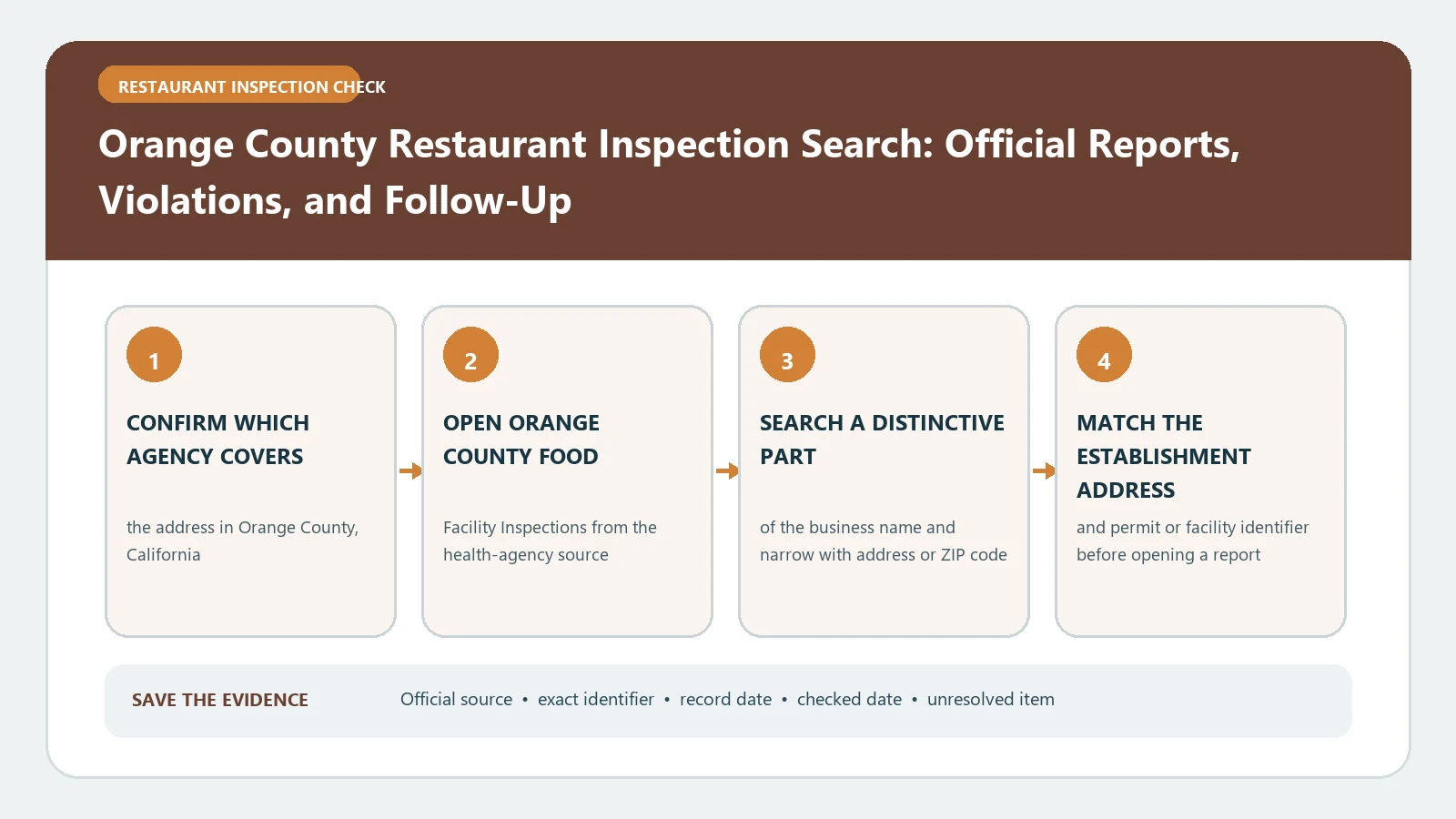
For an Orange County, California restaurant, start from the county Health Care Agency, search the exact address in its current inspection portal, and keep the inspection report, public notification seal, closure event, and reopening action separate. Those records answer related but different questions. Combining them into one grade can make a scheduled reinspection look like a closure or make a reopened facility look permanently shut.
Orange County’s Food Safety page links restaurant inspection records and closure information. Its linked inspection search is the facility lookup route. The county’s Environmental Health records page provides a separate path for inspection reports and other records that are not available through the ordinary search. Sources were checked August 26, 2026.
Enter through Orange County Environmental Health
Several U.S. jurisdictions are named Orange County. Use the California Health Care Agency page as the doorway instead of trusting a generic search result. That page separates restaurant inspections from closures and other food-safety services, which prevents a result from another state or a private rating site from becoming the evidence source.
Follow the county’s inspection link to the current portal and save the final URL. Vendor-hosted portals can change while the county page remains the authoritative route. If a bookmarked portal behaves differently from the link on the county page, use the county’s current path and record the retrieval date.
For a different California county, return to the city and county inspection directory instead of applying Orange County’s notification terms to another agency.
Match the permit location, not just the restaurant brand
Search the business name, then verify the street number, street name, unit, city, and ZIP code. A chain may have many Orange County branches. A food hall, resort, market, or hospital can contain separate permitted food facilities. An address may also retain reports from a prior owner.
Create a facility identity line before opening any inspection:
- official facility name and available permit or record number;
- complete physical address and unit;
- facility type when displayed;
- inspection date range returned by the search;
- current operator name if the record supplies it.
If the public name and permit name differ, keep both. If two permit records share one address, do not merge their histories until the county record clearly shows they are the same operation. The correct record is the one whose identity fields match the facility you mean, not the one with the most recognizable name.
Separate the four Orange County public signals
Orange County’s notification system exposes several signals. The inspection report records an inspector’s observations for a visit. A notification seal communicates a public-facing status at the facility. A closure listing records an inspector-initiated suspension event and can include a later reopening date. An Award of Excellence is a separate recognition and should not replace the report history.
Write each signal on its own line with its source and date. A PASS seal does not mean no violation ever existed. A reinspection-due notice is not the same as a closure. A closure that includes a reopening date is not evidence that the facility remains closed. The Orange County result-fields guide explains how to keep PASS, Gold PASS, reinspection, and closure fields from collapsing into one label.
Read major and minor findings inside their report
Open the report for the selected inspection date. Preserve the county’s own wording for major and minor violations, correction notes, and any scheduled follow-up. Do not turn the count of findings into a homemade letter grade. Orange County’s public materials distinguish violations associated with foodborne-illness risk from other sanitation findings, but the report context controls what happened at that facility.
For one visit, capture the inspection type, date, cited item, observed condition, correction status, and next action. Then move to the next dated report. If the same subject appears again, determine whether the later entry is a verification, a repeated finding, or a new observation. The food-inspection violations guide provides a neutral reading framework without changing the county classification.
Pair every closure with the reopening field
When the closure list or report shows a permit suspension, record the closure date and stated reason. Then look for the reopening date and the inspection or verification that supports it. Orange County’s food-safety page explicitly treats closures as a distinct public record and indicates whether a facility has reopened.
Use four possible states: closed with no later action found, reopened on a stated date, reinspection scheduled while operating, or status unclear. Avoid the broad word failed when the official source supplies a more exact state. For a detailed chronology format, use the Orange County closure timeline guide.
A social-media post, online ordering page, or open front door does not replace the official reopening record. When current operating status matters, check the live county source and contact Environmental Health if the public timeline ends before a decision.
Request the missing document rather than guessing
The ordinary portal may not expose every historical report, complaint file, attachment, or enforcement document. The county’s Environmental Health records page lists restaurant and market inspections and closures among available food-safety records. If the portal summary lacks the report you need, prepare a focused request.
Include the facility name, exact address, permit number if known, inspection date or narrow date range, and the specific record type. State whether you need an inspection report, closure and reopening document, or another public record. A precise request is easier to match than a request for everything connected to a popular chain.
If a report link fails, save the broken URL and the portal result that identified it. Do not copy a third-party summary into the evidence gap. Mark the item requested and unresolved until the county supplies or explains it.
Resolve duplicate names and ownership changes
When a name search returns many branches, switch to the address and compare permit identifiers. When an address search shows an old and new operator, make two timelines. A prior operator’s violation history does not automatically transfer to the new operator, while a new sign does not prove that the permit record changed.
If the inspection portal and closure list use slightly different names, match on address, permit identifier, and event date. Keep the discrepancy visible. If those anchors do not agree, ask Environmental Health which records belong together instead of forcing a match.
Save an Orange County evidence packet
Keep the facility identity line, inspection reports in date order, major or minor classifications as displayed, notification seal, any closure and reopening dates, record-request status, official links, and checked date. Note which page led to the current vendor portal.
The narrow finding is that Orange County’s official sources displayed particular inspection and status records for the matched facility on the retrieval date. It does not guarantee current food safety, prove that no unposted report exists, or authorize this guide to declare a facility open or closed. Recheck the county source before acting on a time-sensitive result.