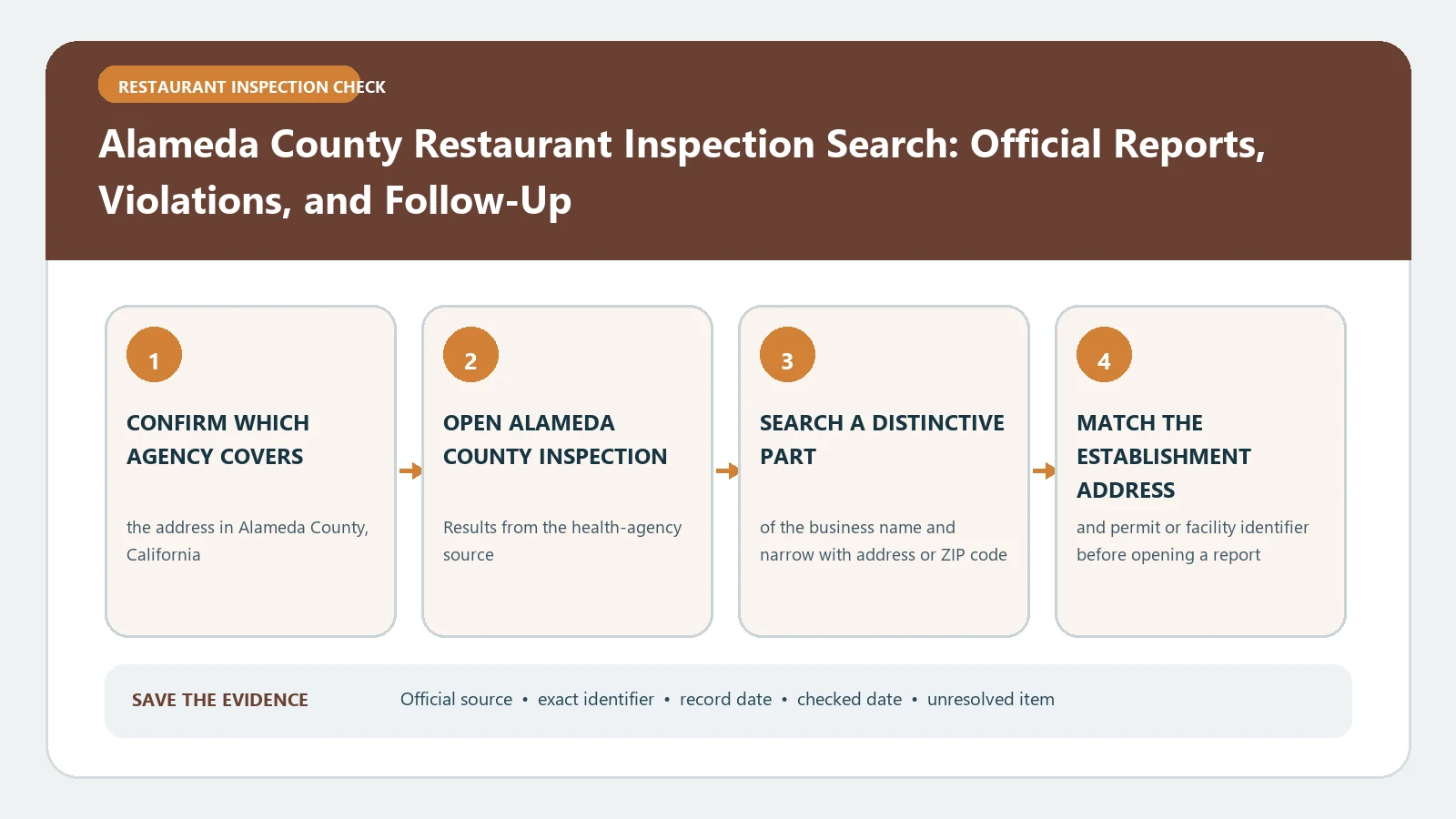
Alameda County restaurant inspection reports are temporarily unavailable in the county’s online portal while Environmental Health moves to new software. For a specific restaurant, use the current inspection-results notice and call 510-567-6700 for its inspection history. Confirm first that the address is in Alameda County’s program and not in the City of Berkeley, which is outside this county program’s stated scope.
Checked August 26, 2026 against the current routes published by Alameda County Health, Environmental Health Department, Alameda County Health, Environmental Health Department, Alameda County Health, Environmental Health Department.
The missing search box is a system transition, not a clean record
The county’s current notice says Retail Food Facility results will not be available through the online portal during its software transition. A failed old bookmark or blank search therefore cannot support a conclusion that the restaurant has never been inspected. Preserve the restaurant details and use the telephone route the department provides.
| Before you call | What to write down | Why it matters |
|---|---|---|
| Jurisdiction | County program or Berkeley; verify with the Food Safety scope page | The wrong agency can return no matching history |
| Premises | Street address, city, ZIP, and suite | A chain name can cover several independently inspected sites |
| Business identity | Current name, former name, and operator if known | Inspection files may follow a permit holder rather than the storefront brand |
| Time period | The dates or years you need | A focused request is easier to locate and review |
Ask for the visit sequence, not only the latest placard
Request enough of the file to see what happened after a cited condition. The useful minimum is the most recent routine inspection, any re-score or follow-up tied to it, the displayed placard outcome, and the violation descriptions. If you are checking work under an earlier restaurant name, ask staff to search the address and former permit holder as well.
- State the exact restaurant address and spell the business name as shown on the storefront or receipt.
- Ask for the inspection date, inspection type, score or placard, and the full violation detail for each returned visit.
- Request the later re-score or reopening record when the first document shows a conditional result or closure.
- Record the date of your call and which dates the department said were covered by the response.
A color tells you the disposition; the report explains why
The county’s food-safety FAQ describes a green placard as PASS, yellow as CONDITIONAL PASS, and red as a failed inspection with the facility CLOSED. It also distinguishes major risk-factor violations from minor retail-practice violations. Those elements answer different questions: the placard summarizes the inspection outcome, while the report identifies the observed conditions and whether a later visit changed the disposition.
| County record element | Use it for | Do not use it to claim |
|---|---|---|
| Green placard | The department’s pass disposition for that inspection | That no violation was recorded or conditions cannot change |
| Yellow placard | A conditional result that needs the related report and follow-up | That the facility is permanently unsafe |
| Red placard | A failed inspection and closure at that point in the official sequence | That it remained closed after a later authorized reopening |
| Major/minor violation text | The actual condition, severity framework, and correction trail | A medical diagnosis or proof that a diner became ill |
Turn the documents into a dated correction trail
- Match every document to the same street address and facility identity.
- Put routine, complaint, re-score, closure, and reopening visits in chronological order.
- For each cited condition, copy whether it was corrected during the visit or left for follow-up when the report states that information.
- Attach the later inspection that verifies correction instead of describing an operator promise as a completed fix.
- Leave the current condition unverified unless a recent county record actually addresses it.
An Alameda County inspection report records what the department observed at a named facility on a named date. It is not a guarantee about conditions before or after that visit.
If the address changed hands, keep both identities in the search
A sale, rebrand, suite change, or move can split the record. Search and request by the premises first, then separate visits by operator and date. Do not transfer a violation from one address to every location in a chain, and do not erase an older premises history merely because a new business name now appears there.
For help interpreting the returned rows, use Food Inspection Reports and Violations. If the address is outside this program, return to Restaurant Inspection Check by City and choose the agency that actually owns the record.
Make the telephone result reproducible while the portal is offline
A telephone answer can be useful evidence, but only if another person can understand what was requested and what the department returned. Start a call log before dialing. Keep the facility details separate from your interpretation, and ask whether the response covers all visits in the requested period or only the documents immediately available to the staff member. If a report is sent later, retain the email or delivery date with the report rather than treating the call summary as the report itself.
| Call-log field | What to record |
|---|---|
| Identity supplied | Business name, former name, full address, suite, and ZIP |
| Scope requested | Routine, re-score, complaint, closure, and reopening records for a stated date range |
| Agency response | Dates located, documents offered, and any stated archive or jurisdiction limit |
| Delivery trail | Email address used, file names received, and receipt date |
| Unresolved point | The specific missing visit or field that still needs confirmation |
Treat a no-record response as a routing result
No returned record can mean the address belongs to Berkeley, the inspected business used another name, the date range was too narrow, or the transition system has not exposed the file through the route you tried. State which possibility the County confirmed, if any. Otherwise describe the outcome as an unsuccessful search on the recorded date. That wording preserves the difference between no evidence found and evidence that no inspection exists.