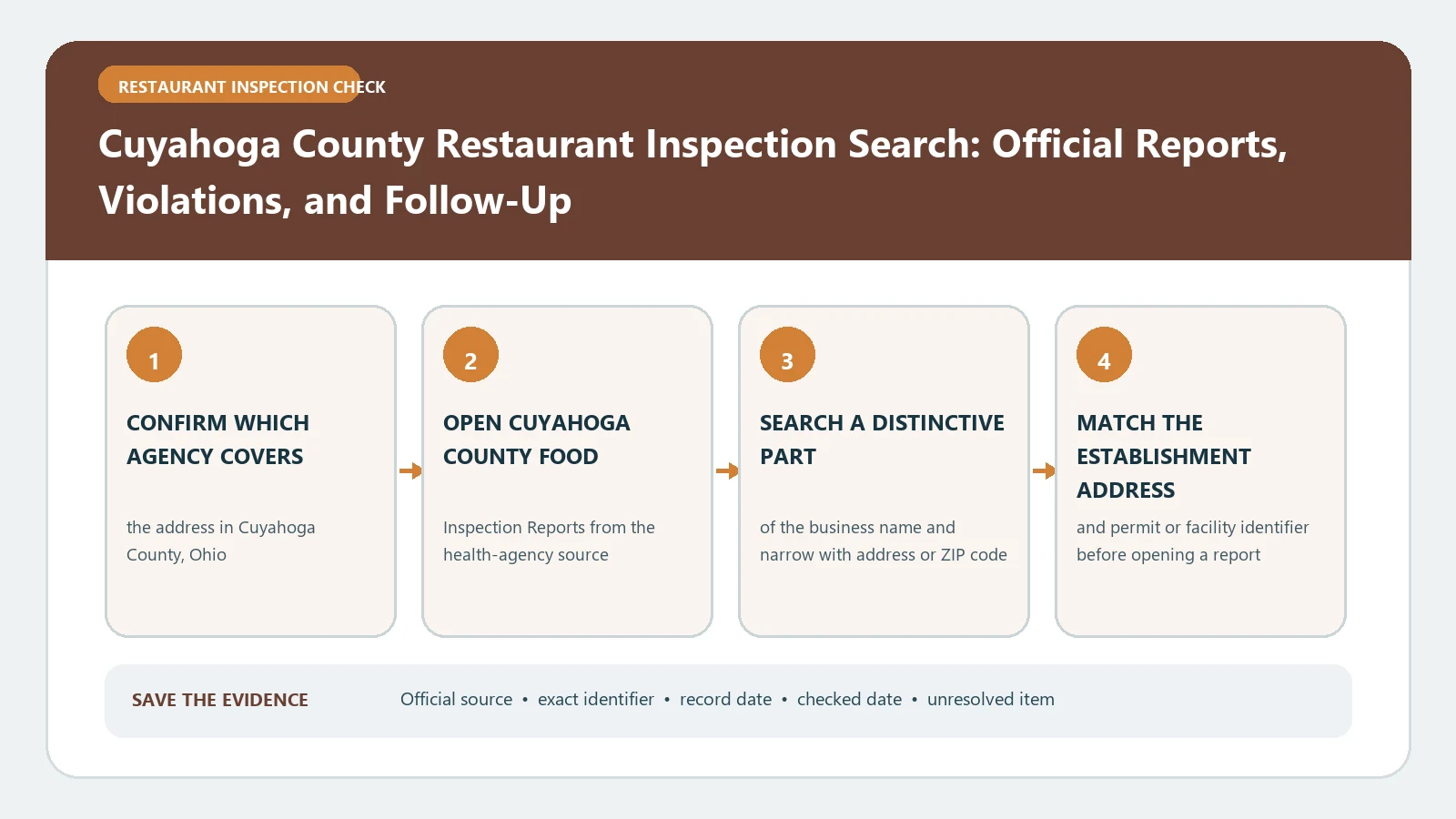
For Cuyahoga County food inspection reports dated March 1, 2024 or later, start at the Cuyahoga County Board of Health report page and follow its link to the current My Health Department search. For an older report, call CCBH at 216-201-2000. Match the street address before comparing violations because a finding applies to the inspected location, not every branch under the same brand.
Checked August 26, 2026 against the current routes published by Cuyahoga County Board of Health, Cuyahoga County Board of Health contracted inspection portal.
March 1, 2024 decides where the report lives
| Inspection date | Official route | What to retain |
|---|---|---|
| March 1, 2024 to present | CCBH My Health Department portal | Facility page, address, visit date, inspection type, report detail |
| Before March 1, 2024 | Call CCBH at 216-201-2000 | Name/address supplied, requested date range, copy or assistance received |
| Date unknown | CCBH Food Inspection Reports page | Search the current portal first, then ask about the earlier archive |
Do not keep retrying an old HealthSpace bookmark when the report belongs on the newer system. The county page is the durable routing source because it states the cutoff and points to the live search.
Build the facility match from the address outward
- Enter the restaurant name, then narrow to the correct municipality and street address.
- Try a shorter legal or trade name when punctuation, franchise numbers, or delivery-app wording returns nothing.
- Open the facility record and verify the address before reading any violation row.
- Sort the visits by date and distinguish routine, complaint, licensing, and follow-up activity where the report identifies it.
- Save the report URL or PDF together with the facility name and date you checked it.
Use the next visit to test whether a cited condition changed
CCBH explicitly calls an inspection report a snapshot of observations during the inspector’s visit. Its official explanation says a single report may not represent long-term conditions and points to quick correction on subsequent reports as one measure of operator responsiveness. That makes a one-report violation count an incomplete comparison.
| Evidence row | Question to answer | Safe interpretation |
|---|---|---|
| Original visit | What exact condition was observed and on what date? | A dated finding at this location |
| Correction notation | Was it corrected during that visit? | Immediate action recorded by the inspector, not proof of future practice |
| Subsequent visit | Did the same item recur or appear resolved? | Later documented response at the same premises |
| No later report | Is follow-up absent, delayed, archived, or handled another way? | An information gap that should be checked with CCBH |
Compare branches only after separating their premises
A violation at one restaurant does not become a violation at every location owned by the same company. Make one timeline per street address. If a restaurant moved, preserve the former address as a separate record; if an address changed operators, keep the inspection dates attached to the operator shown on each report.
- Same brand, different address: separate facilities.
- Same address, new operator: one premises history with an ownership boundary.
- Name mismatch: search address, former name, and license-holder wording.
- No current portal match: check the date cutoff before calling the agency.
Escalate a missing report with a reproducible search note
Before calling, capture the search terms, exact address, approximate visit year, and the empty or mismatched result. Ask whether the facility is under CCBH’s inspection program and whether the report predates March 1, 2024. This gives the sanitarian enough detail to distinguish an archive question from a spelling problem.
A Cuyahoga County report supports a statement about one inspected operation on one visit date. It does not certify the chain, predict today’s conditions, or replace the agency’s later record.
Use the Restaurant Health Inspection Report Guide to decode report sections, then compare the cited item with the violations guide without turning the count into an unsupported safety score.
Create a two-report comparison sheet before judging responsiveness
The County’s snapshot warning makes the comparison method important. Select one finding from the original visit and carry its full wording into a row beside the next relevant report. A later report with fewer items may be a targeted follow-up, so record its inspection type and scope before calling the earlier condition resolved. If the portal displays an onsite correction, keep that notation in a separate column from later verification; they answer different questions.
| Comparison field | Original visit | Next relevant visit |
|---|---|---|
| Event identity | Date, type, report link | Date, type, report link |
| Requirement | Code and full observation | Same code, related wording, or not reviewed |
| Immediate action | Corrected onsite, pending, or not stated | Do not copy the earlier status forward |
| Documented outcome | Disposition shown on first report | Correction, recurrence, escalation, or unresolved gap |
Call CCBH when the archive boundary changes the answer
A phone request is justified when the relevant visit predates March 1, 2024, when the current facility page starts after a known inspection, or when a later report refers to an event you cannot open. Give the department the exact missing date or range, not a request for everything about a popular chain. Ask how the older facility was indexed and whether its permit name differs from the public-facing name.
- Attach a screenshot or note showing the newest and oldest dates visible in the current portal.
- Identify the specific earlier event mentioned by a newer report, if one exists.
- Ask for the report and its related correction or follow-up rather than a verbal safety rating.
- After receiving material, verify that its street address matches the facility page you researched.