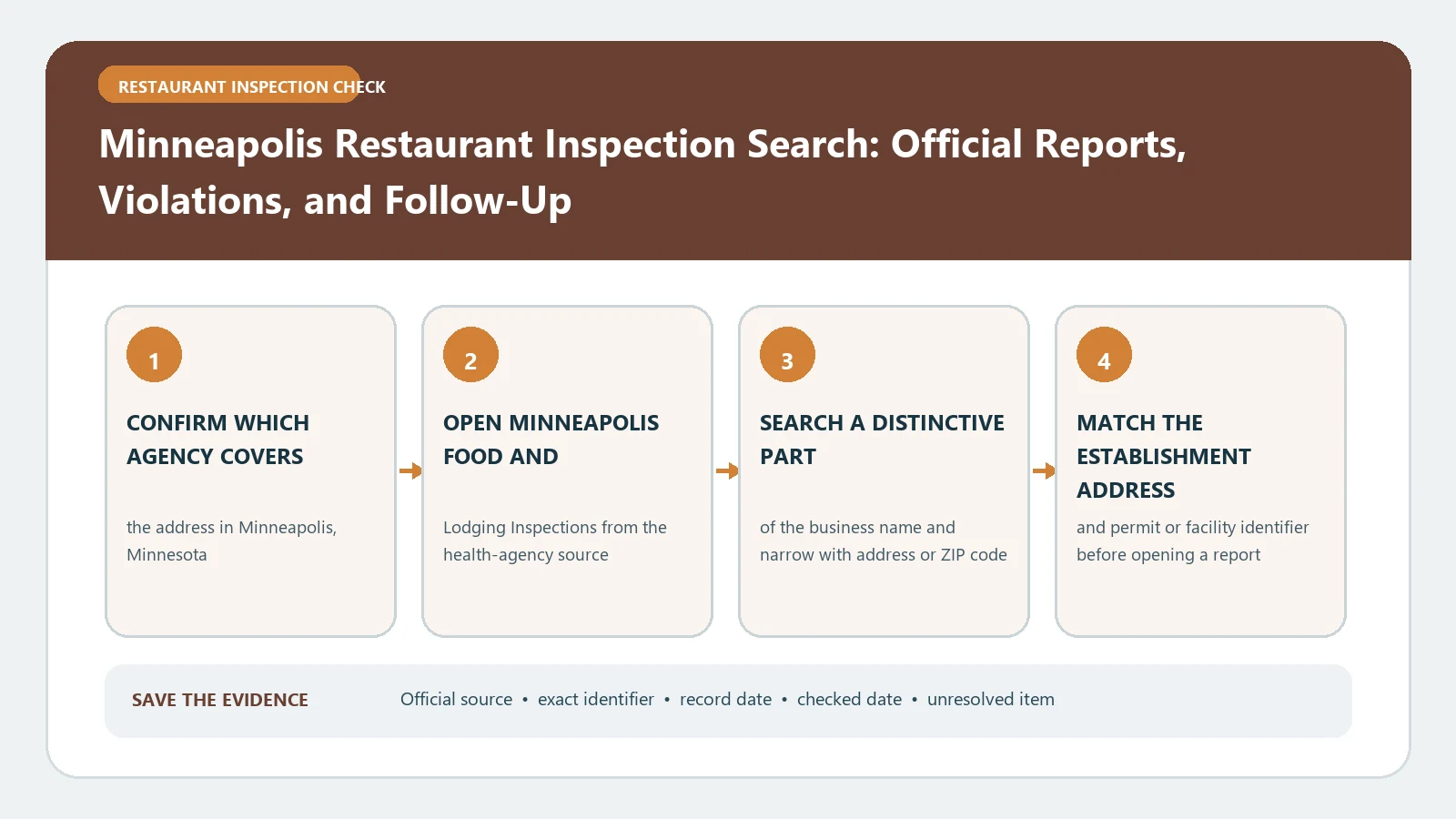
Use the City of Minneapolis health inspection dashboard for an individual business, then use the city bulk data only when you need to compare several dated visits. Match the business by name and street address before reading the score. A report records what an inspector observed on one visit; it is not a promise about conditions today.
The city’s health inspection reports page links both official routes and explains the report calendar, scoring, and follow-up process. The Health Department’s bulk-data field descriptions define fields used to connect inspections and violations. Both sources were checked August 26, 2026.
Choose the individual report or the bulk file
Open the individual dashboard when the question is about one restaurant and one visit. It is designed for finding a business and opening its health inspection reports. Use bulk data when you need a repeatable timeline, want to group violation rows under an inspection, or must compare more than one location. Do not combine rows merely because the public names look similar.
The online collection includes routine and follow-up reports for the current year and three previous years. That boundary is important. A blank result outside that period is not evidence that an older inspection never occurred. It means the online collection may not answer the question.
Lock the business before reading a score
Search with the business name, but verify the street number, street name, and any facility identifier shown. A hotel kitchen, grocery counter, restaurant, and shared commercial space can have separate records at one address. A chain can also have several Minneapolis locations with almost identical names.
Save an identity line before interpreting anything:
- business name exactly as displayed;
- physical address and ZIP code;
- inspection date and inspection type;
- inspection or report identifier, if shown;
- lookup URL and the date you checked it.
If the name changed, keep the old and new business records separate unless the city data supplies an identifier that connects them. Address alone cannot establish that two successive operators are the same permitted establishment.
Read Minneapolis points in their local context
Minneapolis reports begin at 100. The city says violations carry zero, two, or four points, depending on priority. Priority 1 violations receive four points and concern the most direct food-safety risks. Priority 2 items receive two points and support control of those risks. Priority 3 items receive zero points and generally concern maintenance or cleanliness.
That local method means a score should remain attached to its inspection date and violation rows. Do not compare it as if it were interchangeable with a letter grade, demerit total, or pass-fail label from another jurisdiction. For a field-by-field reading, keep the Minneapolis inspection result guide beside the official record.
The bulk dictionary also matters when several rows belong to one visit. Inspection year, violation status, violation points, calculated inspection score, and the violation identifier answer different questions. Group the rows by the city’s inspection identity before adding or comparing anything. Otherwise, one visit can look like several inspections.
Reconcile the dashboard with the downloadable rows
When both city routes cover the same visit, require the business identity, inspection date, visit type, and score to agree before joining them. Use the individual report for the readable visit document and the bulk file for repeatable grouping. Preserve the violation identifier so a corrected row is not mistaken for a new violation.
The bulk dictionary describes data for currently active food businesses. That scope can exclude a closed or inactive operator that still matters to historical research. If a former business appears in an individual report but not the current bulk file, document the scope difference instead of deleting the older report from the timeline.
If a score or status differs between official views, record both values, the URLs, and the access time. Check whether one view was refreshed later and ask the Health Department to resolve a material conflict. Do not manufacture a blended score. The objective is a traceable city record, not a cleaner-looking spreadsheet.
Connect a score of 91 or lower to the next visit
The city states that a routine score of 91 or lower leads to a follow-up, normally within about 14 days. Inspectors may also follow up on significant issues after a score above 91. A follow-up is therefore a separate dated observation, not an automatic erasure of the routine report.
Build a small chronology with one line per event:
- Record the routine inspection date, score, and priority findings.
- Note every correction the report says was made during the visit.
- Calculate the expected follow-up window without inventing an exact appointment date.
- Open the later report and record what it actually says was corrected or remained open.
- Preserve any later routine inspection as a new event rather than rewriting the earlier history.
The Minneapolis reinspection timeline guide can help organize that sequence. The city record remains the evidence.
Allow for the city’s posting delay
Minneapolis says reports are posted within seven business days after an inspection. If a restaurant displays a recent inspection date but the dashboard has not yet caught up, count the business days before declaring the report missing. Record the date of your search and try again after the stated window.
If the report still does not appear, repeat the search with a shorter business name, the address alone, and any prior name associated with the location. Check whether the business is active, whether it falls inside Minneapolis city jurisdiction, and whether the visit is older than the online period. Use the city’s contact route only after saving the exact terms and dates already tried.
Keep a compact Minneapolis evidence packet
A useful packet contains the identity line, official report URL, visit type, inspection date, score, priority level, violation status, and the next published event. Add a note explaining whether you used the individual dashboard or grouped bulk rows. That makes another reader able to reproduce the same result.
The packet does not establish that a kitchen is safe now, that every reported correction remained in place, or that no later inspection exists. Before a reservation, complaint, transaction, or public statement, reopen the official source and confirm that the matched facility and latest visit have not changed. For readers who landed on the wrong city, the city inspection lookup hub provides a jurisdiction-first route.