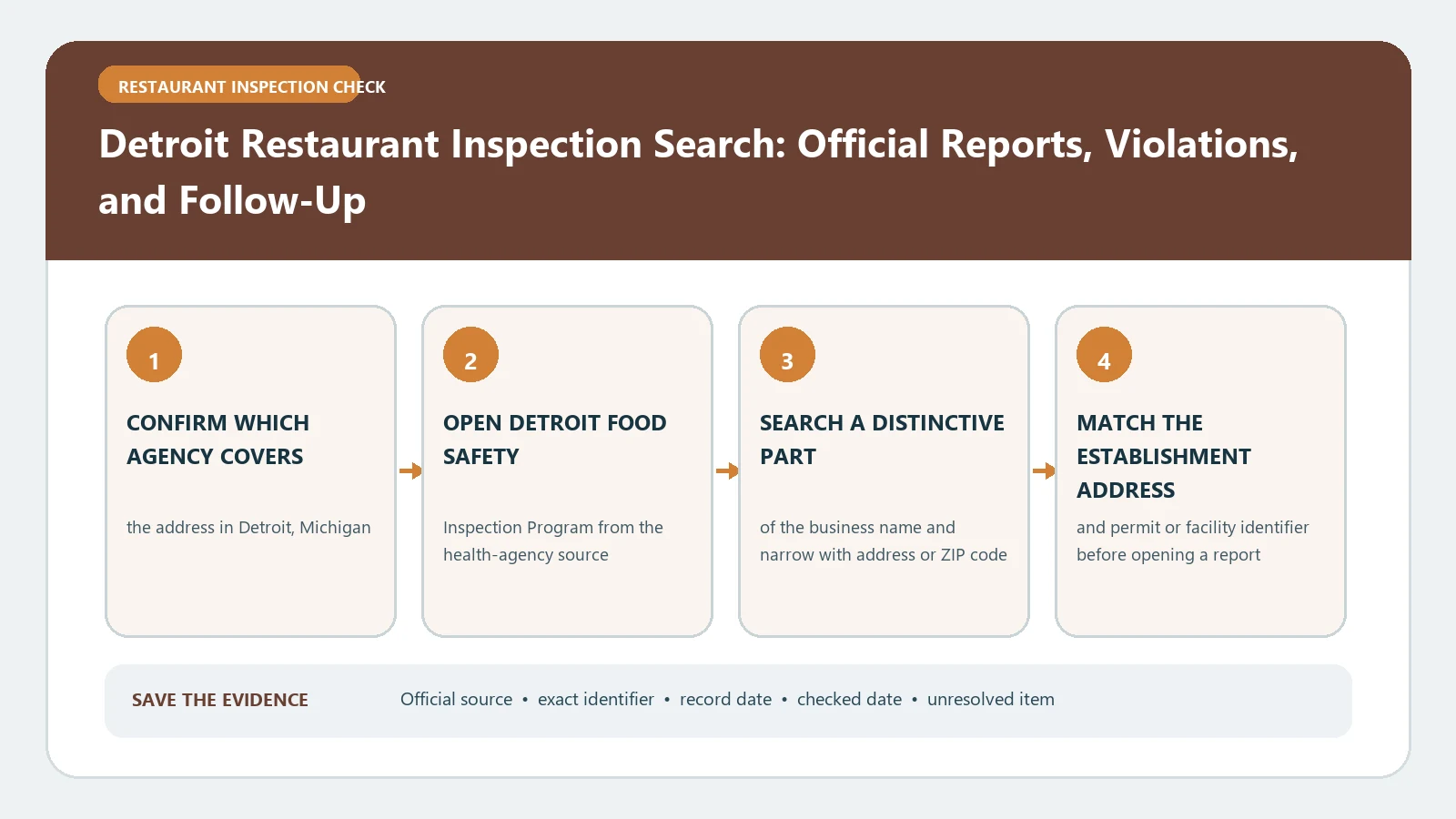
For a Detroit restaurant, open the Detroit Health Department’s Food Safety page, search the inspection record, and read the dated violations before relying on the color of the entrance placard. The placard is a current public signal under Detroit’s Dining with Confidence program, while the inspection history explains the visits and findings behind that signal.
The Detroit Food Safety page links the restaurant-inspection search and the city’s complaint route. The official Dining with Confidence placard page explains the green, white, and red placards introduced under the 2024 ordinance. Both sources were reviewed August 26, 2026.
Match the Detroit premises before reading the color
Search the establishment name, but verify the street address and any license or facility identifier in the result. Detroit has multiple branches of the same chain and food operations inside markets, venues, hotels, and shared buildings. The placard at one entrance and the online record for another branch are not interchangeable.
Write an identity card with the displayed business name, complete address, license or facility number, and the most recent inspection date. If a restaurant changed ownership at the same address, keep the former and current operators separate unless the city record establishes continuity.
The Detroit result-field guide can help arrange the identifiers, but the Health Department search controls the match.
Use the placard as a route into the record
Detroit’s program uses a green In Compliance placard, a temporary white placard, and a red placard associated with closure or enforcement conditions. A green placard requires more than the absence of an obvious problem: the city’s page describes serious-violation, total-violation, enforcement, follow-up, and licensing conditions. A white placard can cover different procedural situations, including a facility that does not yet qualify for green or is awaiting its next routine inspection. A red placard can reflect a severe health hazard, lack of a valid license, or final progressive enforcement.
Because the meanings are specific, do not translate white into “failed” or green into “permanently safe.” Record the color, the date observed, and the linked inspection details. Placards can change after a complaint inspection, correction, closure, or reopening.
Build the inspection sequence behind the placard
Open the online inspection search and capture each matched visit in date order. Keep routine inspections, follow-ups, complaints, and enforcement events separate. For every visit, preserve the inspection date, result, cited violations, documented corrections, and any next action.
Use this order for a placard-to-report check:
- Photograph or note the placard color, premises address, and observation date.
- Match the restaurant in the Health Department search by name and address.
- Open the most recent inspection and copy its date, result, and cited findings.
- Look for a later correction, follow-up, closure, or reopening event.
- Record any gap between the visible placard and online chronology for agency confirmation.
This keeps a street-level observation from being attached to the wrong branch or an old online report.
If a white or red placard is shown, look for the inspection or enforcement event that explains it. If the online search does not yet contain that event, state that the connection was not located and use the Health Department contact route. Do not attach an older violation to a newer placard without a case-specific link.
Use the Detroit reinspection and enforcement timeline guide to keep events in order while retaining the city’s own wording and dates.
Read serious violations in context
The Dining with Confidence criteria refer to Priority and Priority Foundation violations. Preserve the classification that appears in the Detroit record and read any correction notation beside it. An item corrected during a visit is still part of that dated inspection; the correction note explains what the inspector documented at that time.
Do not use the placard page to invent details that belong in the report. When a violation description, correction deadline, or follow-up outcome matters, cite the matched inspection. The violation-reading guide can help separate the cited condition, correction, and later verification.
Explain a color change with dates
A useful Detroit timeline may show green, then red after a complaint inspection, then white on reopening, and later green after compliance. That is only an example of the sequence the city says can occur; never assign it to a restaurant without records showing each event.
For the actual premises, write one dated row for every placard observation or official status change and connect it to the supporting inspection or notice. If the connection is unclear, mark it unresolved. A photograph without a date or address is not enough to reconstruct the history.
Repair a missing or conflicting result
If the search returns no exact business, shorten the name, try the street address, and search a former trade name. Check whether the operation uses a separate licensed name. If the entrance placard and online search appear inconsistent, record both dates and ask the Health Department which event controls the current display.
A no-result screen is not proof of no license or no inspection. Publication delay, an identity change, or a search mismatch can cause silence. Keep the failed query and the date, then use the Food Safety page’s inquiry or complaint route with the exact address.
Use the complaint route for a current concern
An old inspection is not the right tool for reporting foodborne illness or sanitation observed today. Detroit’s Food Safety page provides a complaint and inquiry form for city food establishments. Submit the current facts there and retain the reference number separately from your inspection-history notes.
Do not state that a complaint proves a violation. It starts an agency process. Add it to the chronology only when the city later publishes an inspection or enforcement event connected to the facility.
Finish with a Detroit status-and-history note
Your conclusion should name the matched establishment and address, most recent placard information found, inspection dates reviewed, violations and corrections documented, later action located, official URLs, and retrieval date.
It should not guarantee present safety or predict the next placard. Detroit’s records and entrance signs can change after an inspection or enforcement decision. Recheck the Food Safety search and the placard explanation immediately before relying on the result.