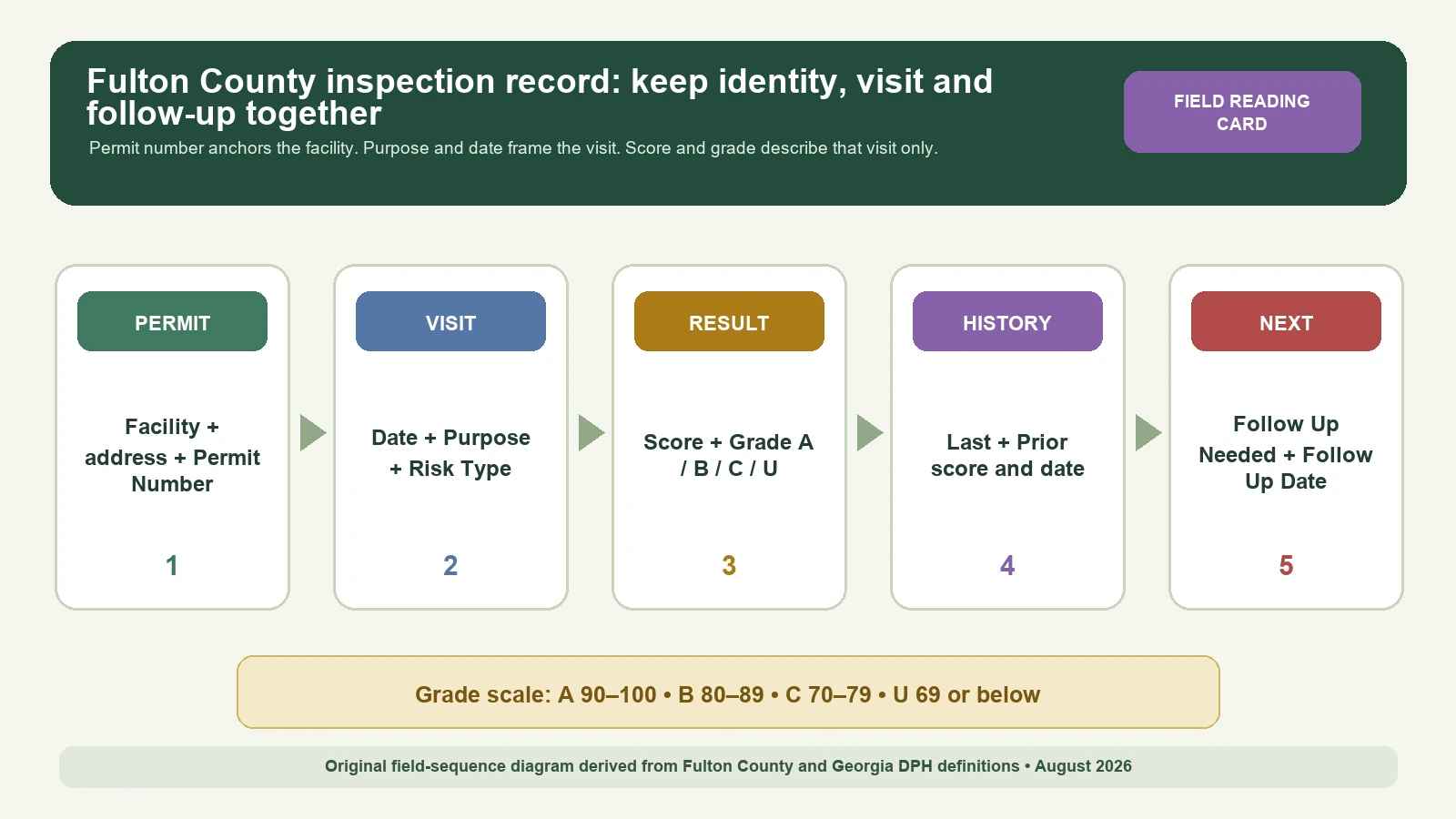
A Fulton County inspection result should be read as a chain: match Facility, Address, and Permit Number; identify Date and Purpose; then read Score and Grade beside Risk Type and Follow Up Needed. The public dataset also carries Last and Prior inspection fields, which help establish sequence. None of those fields alone guarantees a restaurant’s current condition.
Last checked: August 7, 2026.
The Fulton County Food Service Inspections dataset defines the local fields and publishes records for food-service inspections conducted by the county health program. The Georgia Department of Public Health Food Service program supplies the statewide regulatory context, while Georgia’s current Food Service Rules and Regulations define the A, B, C, and U ranges.
Permit Number is the facility anchor; Inspection ID is not
Fulton’s metadata makes an important distinction. Permit Number is an alphanumeric identifier used for the permit required to operate the establishment. Inspection ID is a numeric record identifier generated while extracting data and is not part of the source inspection data. Use Permit Number with the facility address to connect visits; use Inspection ID to reproduce a dataset row.
| Fulton field | Official definition or role | Reader action | Interpretation limit |
|---|---|---|---|
| Inspection ID | Dataset-generated numeric record identifier | Save it when citing or troubleshooting the row | The establishment’s permit number or original report number |
| Facility | Food-service establishment name | Match it with address and Permit Number | A unique location or current legal owner by itself |
| Address, City, State, Zipcode | Published facility location | Compare every address component | That a mailing name places the restaurant under another county |
| Permit Number | Identifier for the permit required to operate the establishment | Use it to group the same permitted facility across visits | A current permit-status guarantee without a live status check |
| Date | Date the inspection was conducted | Order the visit history by this field | Publication date, correction date, or current status date |
Atlanta is only one city within Fulton County. A result with a Roswell, Alpharetta, or another Fulton County city address can still belong in the county dataset, but it should not be relabeled Atlanta. Preserve the City field exactly. This keeps location-based searches and citations honest.
Georgia's letter grade is tied to the score for that visit
Georgia’s official Food Service Inspection Report form and DPH guidance publish the same four ranges: A for 90 through 100, B for 80 through 89, C for 70 through 79, and U for 69 or below. U means Unsatisfactory Compliance in this system; it is not a D or F and should not be renamed.
| Score | Georgia grade | Official wording | What to check next |
|---|---|---|---|
| 90-100 | A | Food Safety Excellence | Purpose, detailed findings, and later inspection history |
| 80-89 | B | Satisfactory Compliance | Cited items, correction context, and any follow-up field |
| 70-79 | C | Marginal Compliance | The report, required correction, and subsequent visit |
| 69 or below | U | Unsatisfactory Compliance | Follow-up timing, enforcement, and a later recorded grade |
Georgia DPH’s current Food Service Rules and Regulations say an establishment graded U that does not earn at least C within 10 days may face voluntary closure or permit suspension or revocation action. That rule describes a regulatory path, not the present status of every historical U row. Check Follow Up Needed, Follow Up Date, the later inspection, and any current agency action.
Purpose tells you why the inspector was there
Fulton defines Purpose as Initial, Routine, FollowUp, or Temporary. The label changes what a fair comparison looks like. An Initial inspection is part of entry into operation, a Routine visit is periodic oversight, FollowUp belongs to an earlier compliance sequence, and Temporary concerns a temporary context.
| Purpose | Question the row answers | Comparison that makes sense | Common mistake |
|---|---|---|---|
| Initial | What the agency recorded at the initial inspection | Compare with later Routine history after confirming the same Permit Number | Treat it as an ordinary recurring visit |
| Routine | What was observed during periodic oversight | Use as a baseline, then look forward for follow-up | Assume the grade remains current indefinitely |
| FollowUp | What happened in a correction or verification sequence | Pair it with the triggering visit and its findings | Read it without the earlier row |
| Temporary | What was recorded for a temporary operation or context | Compare only with the relevant temporary record | Rank it against a fixed restaurant’s routine visit |
A later date is not automatically a more comparable record. If the latest row is FollowUp and the prior row is Routine, show them together. If the latest row is Temporary, confirm that it belongs to the same operation the reader means.
Risk Type is an inspection-frequency signal, not the grade
The county metadata defines Risk Type as 1, 2, or 3 based on menu items, food-preparation processes, and previous food-safety history. Risk Type 3 is the highest risk category and requires the highest inspection frequency. It does not mean the establishment received grade C, had three violations, or failed the visit.
Keep Risk Type beside the score because it helps explain the regulatory context and frequency, but never substitute it for Score or Grade. A high-risk operation can receive an A on a particular visit; a lower-risk operation can have a cited issue. The fields answer different questions.
Last and Prior fields form a compact timeline
Fulton publishes Last Score, Last Grade, and Last Date for the immediately preceding inspection, plus Prior Score, Prior Grade, and Prior Date for the inspection before that. These columns make a three-visit view possible without joining three separate rows, but they still require a Permit Number and address match.
| Timeline position | Fields | Use | Quality check |
|---|---|---|---|
| Current row | Date, Score, Grade, Purpose | Describe the visit represented by this row | Facility, address, and Permit Number match |
| Immediately preceding | Last Date, Last Score, Last Grade | Identify the prior inspection outcome | Do not confuse last with latest/current |
| Earlier preceding | Prior Date, Prior Score, Prior Grade | Add one more historical point | Blank fields can mean unavailable history, not zero |
| Next action | Follow Up Needed, Follow Up Date | Show whether the row calls for a later visit | Confirm the later visit actually occurred |
Do not calculate a trend from grades alone. A sequence A, C, A means something different if the C was a routine visit followed quickly by a follow-up A than if the rows have different Permit Numbers or temporary purposes. Preserve dates and purposes in every comparison.
Follow Up Needed is a flag, not proof of completion
Follow Up Needed indicates that a follow-up inspection is required. Follow Up Date is the scheduled date when supplied. A true flag does not prove the follow-up happened; a date does not prove the establishment earned a new grade; and a blank date does not automatically cancel the requirement. Find the later row or ask the county program.
- True with a date: record the scheduled date and look for a later matching Permit Number.
- True without a date: treat timing as unresolved and consult the detailed report or agency.
- False: report only that the dataset flag is false for that row; do not claim no other action exists.
- Later FollowUp row: pair it with the triggering visit and compare cited findings, not just grades.
- Conflicting fields: preserve the row, access date, and exact conflict for the county data contact.
- Missing historical row: consider retention, extraction, or identifier changes before concluding no visit occurred.
The Fulton County and Atlanta inspection search guide helps locate the correct facility first. The restaurant reinspection and follow-up guide provides a separate workflow for tracing the required later visit.
Open the related violation data before judging the number
The county description says this inspection dataset is related to separate Food Service Violations, Food Service Violation Comments, and Food Service Temperature Violations datasets. That relationship is a warning against treating Score and Grade as self-explanatory. The number summarizes an inspection; the finding-level records explain what was observed.
Use the food inspection report and violation guide when reading the cited items. Match Inspection ID or the official join field provided by the dataset, keep comments attached to the correct item, and distinguish a finding from its later correction. If the datasets do not join cleanly, do not attach another facility’s violation to the score.
Create a Fulton source-dated evidence record
A defensible record separates identity, visit context, result, history, and follow-up. It also preserves the county’s field names. That makes the note quotable without pretending the guide is the official database.
| Evidence layer | Fields to save | Reason |
|---|---|---|
| Facility identity | Facility, full address, Permit Number | Connects the visit to the intended permitted establishment |
| Dataset row | Inspection ID and official URL | Makes the public extraction reproducible |
| Visit context | Date, Purpose, Risk Type | Prevents unlike inspections from being compared |
| Result | Score and Grade exactly as displayed | Preserves Georgia’s local classification |
| History | Last and Prior dates, scores, and grades | Places the row in a three-visit sequence |
| Follow-up | Follow Up Needed, Follow Up Date, later visit located | Separates a requirement from completion |
| Freshness | Dataset update date and access date | Shows when the public evidence was checked |
What the Fulton record cannot guarantee
A grade describes one inspection. It cannot guarantee conditions today, prove that no unlisted issue existed, establish restaurant quality, or replace an outbreak investigation. A Permit Number helps identify the facility but does not by itself certify active status, ownership, or freedom from enforcement.
Do not compare a Fulton A with a Dallas 90 or an Austin 90 as if all three programs deduct points and trigger follow-up in the same way. Georgia supplies a local letter grade. Dallas supplies local follow-up bands. Austin publishes its own passing line. Keep the issuing authority beside every result.
Questions about Fulton County inspection fields
Is Inspection ID the restaurant's permit number?
No. Fulton says Inspection ID is generated during data extraction. Permit Number is the alphanumeric identifier for the permit required to operate the establishment. Save both for their different jobs.
What does a U grade mean in Georgia?
U means Unsatisfactory Compliance and corresponds to 69 or below. Do not rename it D or F. Read the follow-up and enforcement record for that visit.
Does Risk Type 3 mean the restaurant failed?
No. Risk Type 3 is the highest foodborne-illness risk category in the dataset definition and influences inspection frequency. Score and Grade report the visit outcome.
Can Follow Up Needed prove the reinspection occurred?
No. It records a requirement. Confirm completion with a later matching inspection row, detailed report, or county response.
Scope: Fulton County food-service inspection fields and Georgia DPH score and grade definitions. This independent guide does not inspect facilities, issue permits, or guarantee current safety. Official sources last checked 2026-08-07.