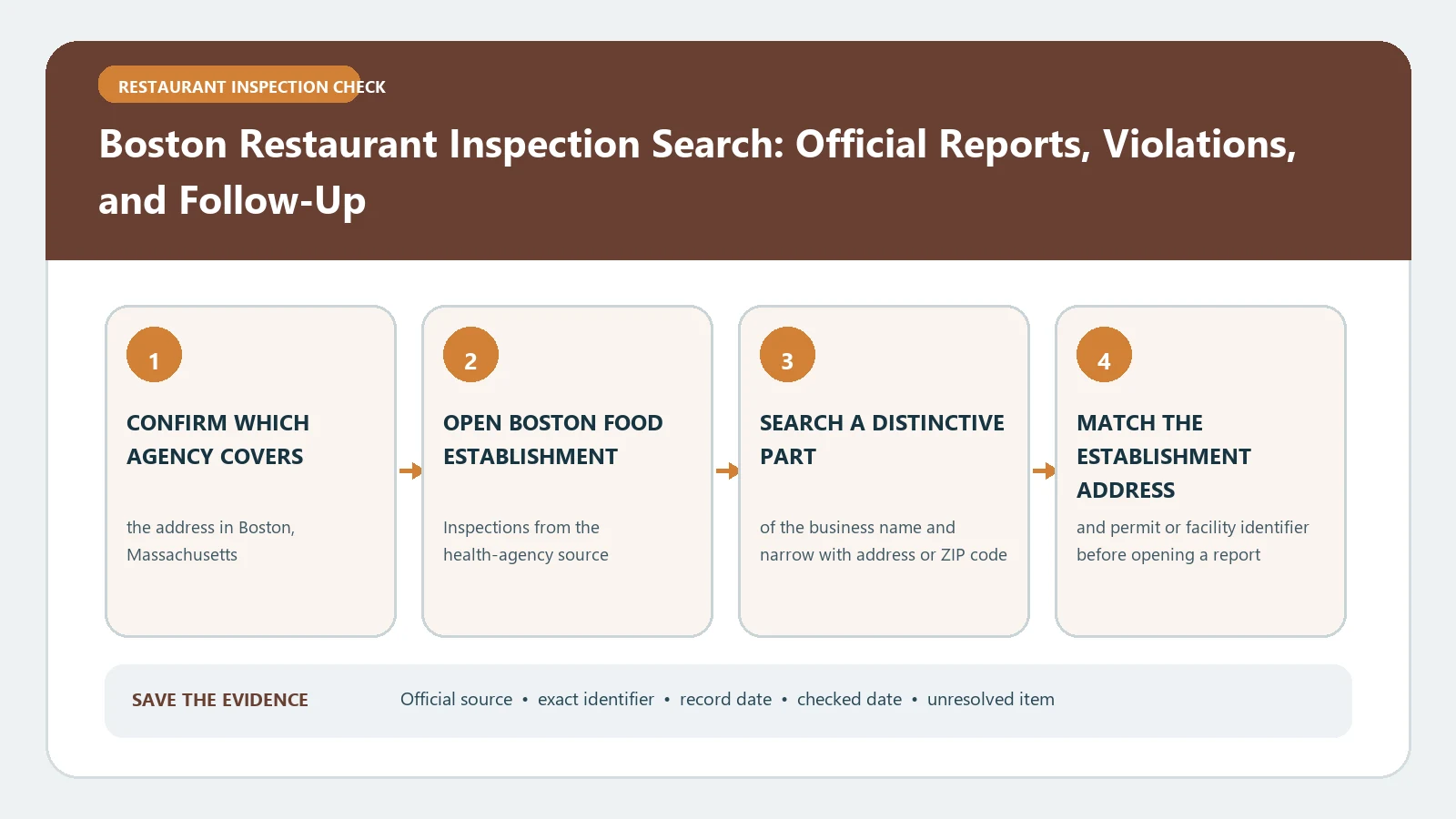
For a Boston restaurant, begin with the City of Boston’s Mayor’s Food Court, match the establishment by both name and street address, and read every inspection visit in date order. The useful answer is not a single violation label. It is the chain connecting the correct licensed site, the inspection date, the cited code, any later compliance visit, and the restaurant’s permit status when you checked.
The Mayor’s Food Court is the city’s public route for eating-establishment inspection and license data. Boston’s Health Division explains that Inspectional Services enforces food and sanitary laws, performs routine and compliance inspections, and responds to complaints. Both sources were checked August 26, 2026. Reopen them before relying on a record because establishments, permits, and follow-up activity change.
Begin with the Boston record that owns the address
A familiar restaurant name is not enough to identify the inspected operation. Chains can have several Boston locations, a hotel can contain more than one food operation, and a storefront can change owners without changing its public-facing name. Write down the full address, including street number, direction, unit, and ZIP code if available, before searching.
Compare the result’s establishment name and address with the place you mean. If the name is abbreviated, look for a license or record identifier and keep it with your notes. Do not merge two branches because their names are nearly identical. A report for the same brand on another street says nothing about the location you plan to visit.
The Mayor’s Food Court also provides separate routes for Boston Public Schools cafeterias and temporarily suspended permits. Use the school search for a cafeteria rather than forcing it through the restaurant workflow. For locations outside Boston city limits, return to the city-by-city inspection directory and find the authority that actually covers that address.
Reconstruct one inspection instead of collecting loose violations
Open a visit and capture its date before reading the findings. Then keep every code tied to that visit. A business may have a routine inspection, a complaint response, and a compliance inspection close together. Sorting isolated violations without their dates can make a corrected item look current or make a later problem appear to belong to an earlier visit.
For each inspection, record:
- establishment name, address, and available identifier;
- inspection date and inspection type as displayed;
- violation code, description, and classification;
- any correction or disposition shown for that visit;
- the next visit that appears to follow the same issue;
- source URL and the date you performed the lookup.
This produces a small chronology rather than a screenshot with no context. If you need help translating common report fields, use the restaurant health inspection report guide while leaving Boston’s own wording unchanged in your evidence note.
Read Boston’s three violation classes literally
Boston’s official page groups findings as Foodborne Illness Risk Factor Critical Violations, Critical Violations, and Non-Critical Violations. These labels are not interchangeable. The city describes a foodborne-illness risk-factor critical violation as a practice or procedure associated with leading contributors to foodborne illness or injury. A critical violation is more likely than other violations to contribute to contamination, illness, or an environmental health hazard. A non-critical violation does not seriously affect public health under the city’s stated classification.
Preserve the exact class shown beside the code. Do not turn every cited item into an emergency, and do not dismiss a non-critical item as meaningless. The point of the classification is to show how Boston categorized that observation during that inspection. The separate guide to reading food-inspection violations can help you distinguish an observation from its correction status without inventing a score the city did not publish.
Let the next visit answer the correction question
The Health Division says inspection frequency depends on establishment type and that compliance inspections are used to verify that violations have been corrected. When a concerning finding appears, move forward through the same establishment’s history. Look for a later compliance or follow-up visit and compare the specific code or condition, not merely the existence of a newer date.
A later clean-looking visit can be relevant evidence, but it does not erase the earlier report. Conversely, the absence of a later online visit does not establish that no correction occurred. The record may be delayed, filed under a different inspection type, or require confirmation from Inspectional Services. Mark the state as follow-up found, follow-up not found, or follow-up unclear. That is more accurate than declaring the matter resolved from silence.
Use the reinspection follow-up check when you need a compact way to compare the original finding, the required action, and the later verification.
Check permit suspension as a separate branch
Mayor’s Food Court includes a search for establishments whose permits were temporarily suspended during the last 30, 60, or 90 days. The city also explains that establishments may reopen after the violations are corrected or the hazardous condition no longer exists. A suspension record therefore needs two dates: the suspension event and the status or later action visible when you checked.
Do not convert a past suspension into a statement that a restaurant is closed today. Open the current record, look for later activity, and use the city’s contact route if the operating status matters immediately. A temporary suspension can involve an imminent health hazard such as a fire, flood, extended utility interruption, sewage backup, toxic-material misuse, an apparent outbreak, or another grossly unsanitary condition. The case-specific record, not a generic list, must support any claim about one restaurant.
Recover from a missing or mismatched Boston result
If the exact name returns nothing, shorten it and search the street address. Try the legal business name from a receipt, storefront permit, or ordering page. Remove punctuation and corporate suffixes. If several records share one address, compare identifiers and active dates rather than choosing the first result.
When an old record exists but the current tenant appears different, preserve both identities and stop treating them as one continuous operator. When the portal and the physical placard disagree, save the lookup time, photograph the posted information only if you are lawfully on site, and ask Inspectional Services which record is current. A no-result page is not a clean inspection, a valid permit, or proof that the facility is outside regulation.
Finish with a narrow Boston finding
A defensible note might say that the Mayor’s Food Court showed a named establishment at a specified address, with a dated inspection containing listed violation classes and a later compliance visit visible on the lookup date. It should not say that the restaurant is safe now, that every violation has been permanently corrected, or that the guide certifies the business.
Keep the address, identifier, inspection chronology, permit-suspension check, source links, and retrieval date together. If illness, an unsanitary condition, or a time-sensitive closure is the real concern, use Boston’s official Health Division complaint and contact routes instead of treating an older public record as a live inspection.