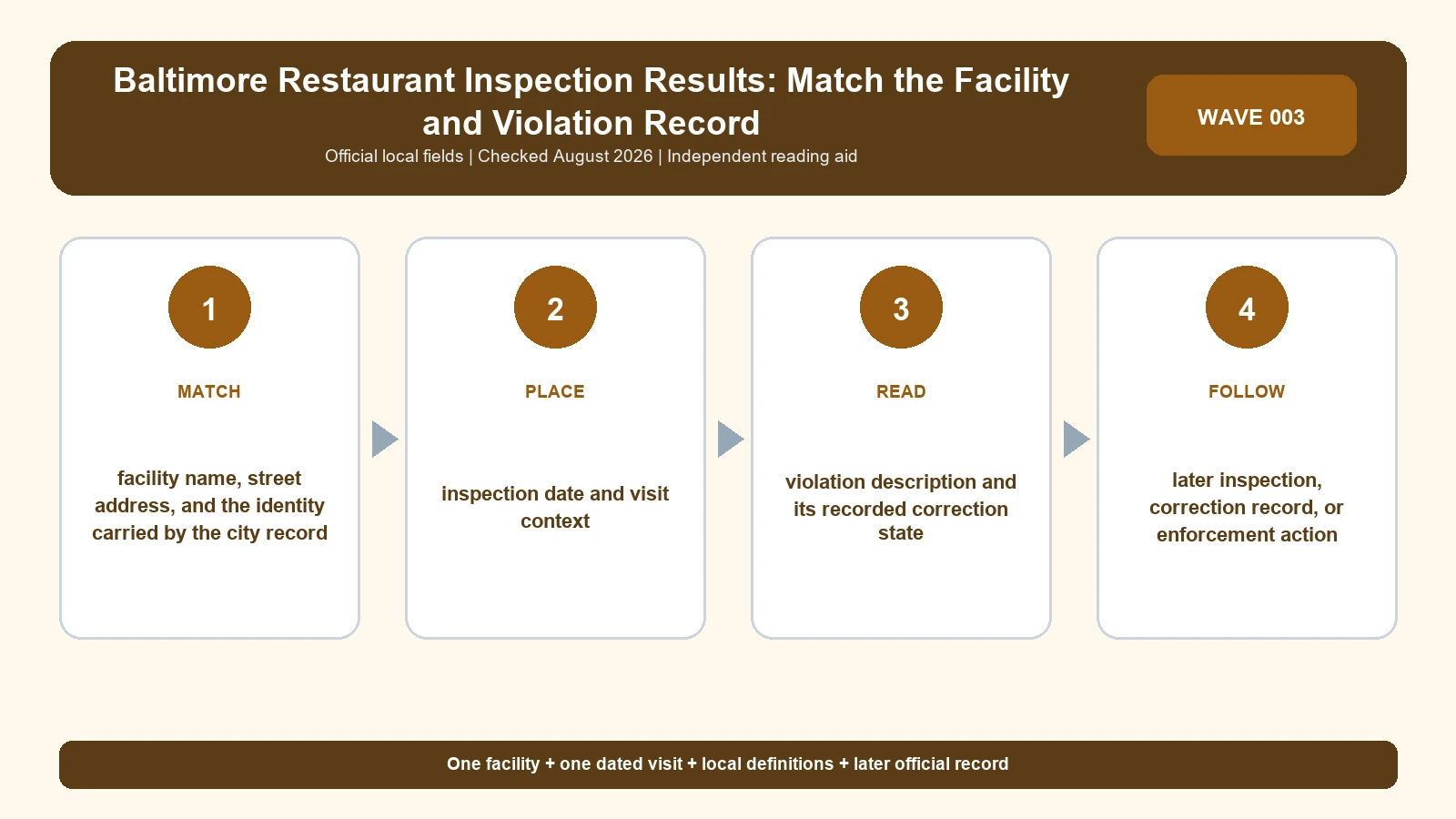
A Baltimore restaurant inspection result is a dated Food Control record for one licensed food facility, not a citywide letter grade. Match the facility and address, preserve the inspection date and violation wording, then check whether the city published a corrective action, later inspection, suspension, or other enforcement event.
Last checked: August 7, 2026.
The Baltimore City Food Facilities Program is the Baltimore City Health Department’s program route and links electronic inspection reports beginning January 1, 2016. Search available records through Baltimore Open Data food-inspection search, and consult the official Baltimore City Law Library Title 6: Food Service Facilities when an inspection notice, correction requirement, suspension, or immediate action needs legal context.
Match the Baltimore food facility before interpreting a row
Baltimore Food Control licenses and regulates more than 5,000 food facilities, not only sit-down restaurants. A search can therefore surface carry-outs, markets, institutions, mobile units, and other operations. Copy the exact facility name and full street address from the official result. If a suite or facility type differs, keep the candidates separate.
| Match element | Value to preserve | Why it matters | Do not assume |
|---|---|---|---|
| Facility name | Name displayed by Baltimore | Locates candidate record | Every similar name is the same operator |
| Street address | Number, street, unit, city | Separates branches and co-located facilities | Address alone proves continuous ownership |
| Facility type | Official type when displayed | Defines the regulated operation | Every food facility is a restaurant |
| Inspection date | Date on the city event | Anchors the observation | It is the open-data update date |
| Record or report key | Identifier shown in the source | Supports a reproducible join | The identifier is a safety score |
When a new operator occupies a former restaurant’s space, the address can remain while the license and facility identity change. Show the possible break in the history. Do not assign the previous operation’s violations to the successor without evidence from the Health Department.
Open the report rather than ranking search rows
The city program page routes users to electronic inspection reports from 2016 onward. A data-catalog search result or map point is an index, not the full interpretation. Open the underlying record, preserve the date and visit context, and copy the complete violation description and any correction instruction available.
| Record layer | Question answered | Evidence to retain | Misreading |
|---|---|---|---|
| Catalog entry | Which official dataset or app may contain the facility? | Dataset title, publisher, update date | It is the inspection report |
| Facility result | Which operation and event matched? | Name, address, event date | It is a restaurant grade |
| Violation detail | What condition did the inspector record? | Full description and cited provision | Count alone describes severity |
| Correction notice | What action and time did the city require? | Notice wording and date | The correction occurred |
| Later event | What did Baltimore publish next? | Follow-up, suspension, clearance, or unknown | Silence means resolution |
Do not create a score from the number of rows. Different violations describe different requirements, and a data export can repeat facility or event fields across item-level records. Count inspections only after identifying the event key and count violations only within the selected report.
Use the violation notice as the action map
Baltimore Health Code section 6-601 says a violation notice identifies the condition, the required corrective action, the time allowed, and the availability of a hearing. Those components should remain distinct in your evidence table. A condition is what the city observed; corrective action is what it directed; the allowed time is not proof that the deadline was missed.
| Notice component | What to copy | Permitted statement | Unsupported statement |
|---|---|---|---|
| Condition | Specific facility condition cited | Baltimore recorded the condition on that visit | The condition remains today |
| Corrective action | Required remedy in the notice | The city directed the named action | The operator completed it |
| Time allowed | Period or deadline stated | Correction was due under that notice | The business ignored the deadline |
| Hearing availability | Procedure named by the notice or code | The code provides a hearing route | A hearing occurred |
If the online record omits the actual notice, do not reconstruct the deadline from the code alone. The code explains legal structure; the facility-specific document applies it. Mark the notice unavailable and ask Food Control when the missing field changes an enforcement conclusion.
Separate correction from suspension
Section 6-602 provides that failure to correct can result in suspension and discontinuation of operations, while section 6-603 allows immediate suspension without prior notice when public health requires it. These are distinct paths. A violation record alone does not establish that either suspension occurred.
| Status concept | Source required | Safe interpretation | Do not infer |
|---|---|---|---|
| Violation recorded | Inspection report | Condition documented on stated date | License suspended |
| Correction required | Facility-specific notice | City directed action within stated time | Deadline missed |
| Suspension after noncorrection | Baltimore suspension action | City imposed suspension under the recorded path | Every open item causes suspension |
| Immediate suspension | Explicit public-health action | City suspended without prior notice on that basis | Any serious-sounding observation qualifies |
When an actual operational action appears, use the restaurant closure and permit-suspension guide. Keep the inspection result and license action in separate rows. The first documents findings; the second changes authority to operate.
Recognize the public history's starting point
Baltimore’s program page says electronic reports are available from January 1, 2016. That does not mean a facility opened then or had no earlier inspections. Label the oldest visible electronic report accordingly. Historical records may require a different request or contact route.
The open-data catalog can also change datasets, apps, or field names. Record the dataset title, publisher, last-updated value when visible, and your access date. A search query URL is useful provenance, but it should not replace the direct facility report when one exists.
Build a Baltimore facility-and-notice card
The linkable asset should combine a facility header with item rows and a notice panel. This makes every claim traceable to a city field and prevents a generic failed-inspection label from hiding the actual condition and required action.
| Asset section | Fields | Audit question |
|---|---|---|
| Facility | Name, address, type, license or record key | Is this the intended regulated operation? |
| Inspection | Date, visit context, report URL | Which event is being summarized? |
| Violation | Cited condition, rule, narrative | What did Baltimore document? |
| Notice | Corrective action, time allowed, hearing route | What was required next? |
| Outcome | Correction, later inspection, suspension, or unknown | What later city evidence exists? |
| Provenance | Program, data record, code citation, access date | Can another reader reproduce it? |
Use blanks honestly. A missing correction field is not unresolved today; a missing suspension field is not proof of no action; and no electronic report before 2016 is not proof that no earlier visit occurred. Every absence needs a scope and checked date.
Use 311 as a complaint route, not inspection proof
Baltimore directs complaints through 311 and CitiTrack. A complaint identifier can help track a request, but the allegation is not an inspection finding until the Health Department records its own observation. Keep complaint, inspection, and enforcement rows separate, even when their dates are close.
For item-level reading, use the food inspection violation guide as an organizer. Baltimore’s official report and code control the facts and legal terms. A complaint narrative or restaurant response belongs in a clearly labeled non-agency column.
What Baltimore records cannot establish
The public record can document a Baltimore inspection, notice, and published action on specific dates. It cannot guarantee present conditions, rate food quality, prove an allegation, reveal every agency interaction, or certify that a missing electronic result means no visit occurred. A historical suspension also does not establish current closure.
Use the Baltimore restaurant inspection lookup guide for retrieval. The defensible reading sequence is facility match, event date and context, condition, corrective action, allowed time, and later official outcome.
Baltimore record questions
Does Baltimore's electronic history start with the first inspection ever?
No. The program page identifies January 1, 2016 as the start of available electronic reports, not the facility’s lifetime history.
Does a correction deadline prove the restaurant missed it?
No. Locate a later city report or enforcement action before describing compliance with the deadline.
Does a 311 complaint prove a violation?
No. It is a complaint route. Use the Health Department’s inspection findings for the official observation.
Audit the Baltimore notice before summarizing the result
Verify that the inspection report and any violation notice belong to the same licensed food facility. The notice should be analyzed as four separate elements: condition, corrective action, time allowed, and hearing availability. The Health Code explains that structure, but only the facility-specific document supplies the actual facts and deadline. A catalog search row or complaint should never fill a missing notice field.
- Match facility name, type, full address, and available record key.
- Open the electronic report instead of citing a catalog preview.
- Preserve the complete violation description.
- Keep required correction and evidence of completed correction separate.
- Require explicit Baltimore action for suspension language.
- Label January 1, 2016 as the electronic-record boundary, not opening date.
Ask a second reader to follow one condition through the report, notice, and later city record. If the response time is absent, leave it unknown. If no follow-up is visible, do not say the deadline was missed. If a 311 complaint preceded the visit, retain it as an allegation or lead until the Health Department’s own observation establishes what was found. This separation protects the facility and the credibility of the asset.
Scope: Baltimore City Food Control inspection, notice, and enforcement records. This independent guide does not issue grades or guarantee current safety.