A restaurant health score only has meaning under the rules of the agency that issued it. Confirm the exact branch and inspection date, then read the local scale, visit type, cited violations, corrections, and every later follow-up. Do not compare the number with another city’s score or treat a dated grade as a guarantee of current conditions.
If you have not found the official record yet, start with the restaurant inspection lookup guide. If you do not know which city, county, or state agency covers the address, use the inspection lookup by city guide before interpreting any rating.
The same “health score” can represent a different kind of evidence
Keep restaurant grades from different authorities on their original scales. New York City grades a scored inspection, King County rates a trend across multiple routine inspections, and the UK schemes publish a dated hygiene rating or compliance outcome. In the United States, the FDA provides a model Food Code and support, while state, local, tribal, and territorial agencies have primary responsibility for restaurant regulation.
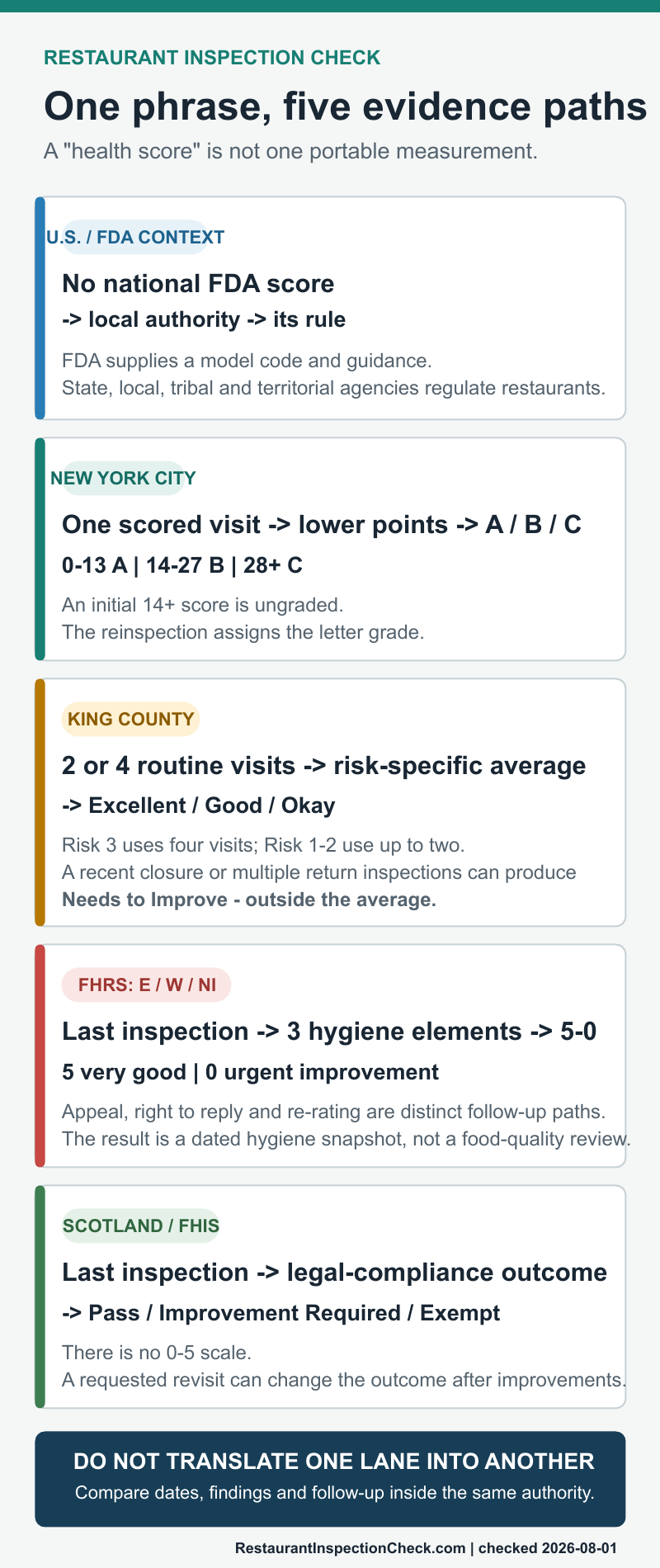
Method and sources: We grouped each program by issuer, public result, direction, evidence window, and follow-up path, then kept every system on its original scale. The official method and lookup links appear in each row. The supporting source set also includes NYC Health Code Chapter 23, the FSA open-data notes, and FHIS safeguards. Last checked August 1, 2026. Review quarterly and after any official method or program-coverage change.
Scope note: This table explains how the named authorities publish and update inspection information. It does not certify a restaurant, predict present conditions, or replace the current record in the responsible authority’s database. Verify the establishment, inspection date, visit type, and later follow-up before quoting a result.
Use New York City as an example, not a universal scale
The NYC Health restaurant-grades page says food-safety violations carry point values and that a lower score corresponds to a better letter grade. The linked ABCEats search lets a reader match a New York City establishment and open its inspection history. That direction and those grades belong to New York City’s method; they should not be copied onto a record from another jurisdiction.
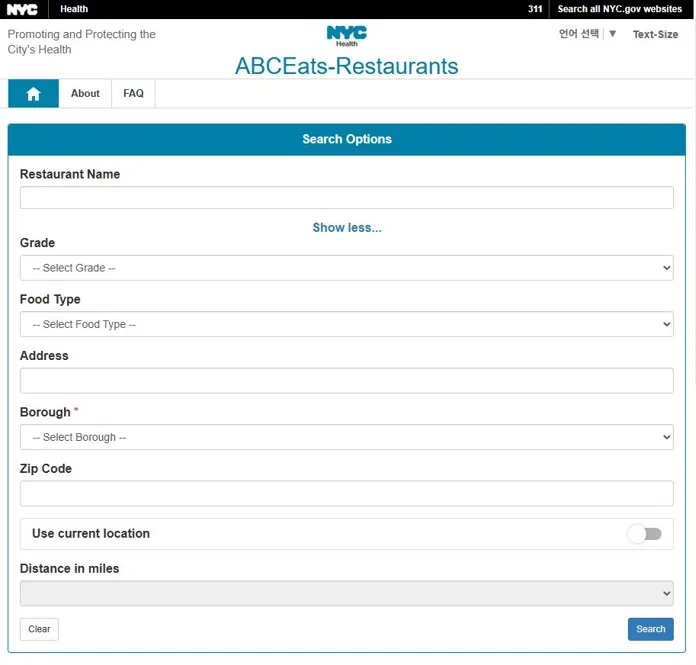
On the result page, keep the restaurant name, street address, inspection date, event type, score, and grade together. A chain name without the branch address can lead to the wrong facility, while a grade without the inspection date can make an old visit look current.
Read the inspection event before the result
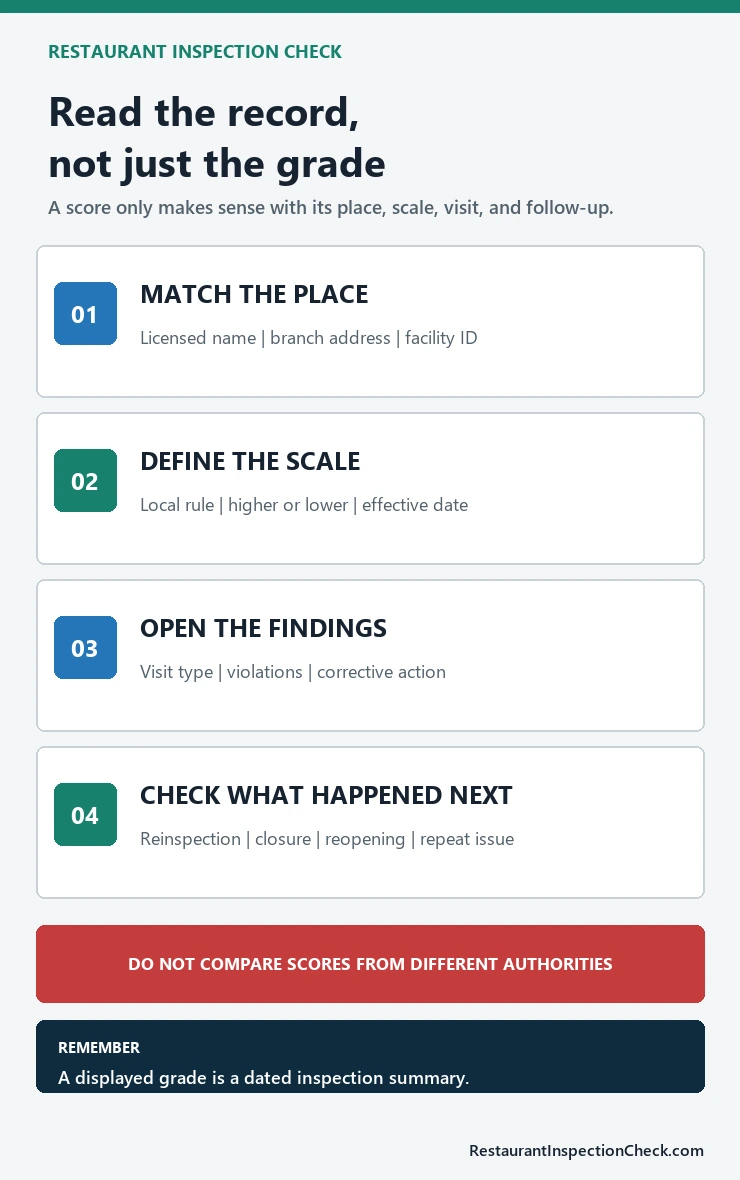
Start with the newest full routine or rating inspection, not simply the first row shown. Public systems often mix routine visits with complaint inspections, reinspections, closures, reopenings, permit actions, and administrative updates.
- Match the licensed facility name and exact street address.
- Open the event and identify its inspection type and date.
- Read the local explanation of the score, grade, colour, stars, or status.
- Open the detailed violations and note which were corrected during the visit.
- Continue forward in time through every reinspection, closure, reopening, appeal, or later routine visit.
Use the restaurant inspection date guide when a portal shows both a visit date and a publication or update date. The visit date tells you when conditions were observed. The portal date only tells you when the public system changed.
Violations and follow-up give the grade its meaning
A score compresses multiple observations into one label. Open the details and separate the cited condition, the authority’s classification, any correction made during the visit, and the later agency response. A violation that was corrected on site is not the same event as a violation left open for reinspection.
| What the portal shows | What to read next | Bounded description |
|---|---|---|
| Grade or score | Local scale, inspection date, and visit type | The official record displayed this result for this dated visit |
| Pass with listed findings | Finding details and correction status | A pass does not mean the report contained no violations |
| Reinspection | The earlier required correction and the new outcome | Describe both dates rather than replacing the first event |
| Closure followed by reopening | Closure reason, effective date, reopening conditions, and later history | A historical closure does not prove the restaurant remains closed |
| No consumer score | Findings, compliance status, and the authority’s publication method | Some programs publish inspection details without a grade |
The food inspection violations guide helps separate a finding from its consequence. When a later event appears, use the restaurant reinspection follow-up guide to keep the sequence intact.
Do not convert scores between cities or countries
A 90, an A, five stars, and a pass are not interchangeable. Authorities can use different thresholds, violation weights, inspection types, display rules, and effective dates. Even two systems that use the same symbol may define it differently.
The UK Food Hygiene Ratings search distinguishes numerical hygiene ratings used in England, Northern Ireland, and Wales from hygiene-status labels used in Scotland. It also says the rating is not a guide to food quality. That is a useful boundary for any system: the published rating must be read under its own official definition.
For a narrower comparison of the terms themselves, use the inspection score versus grade guide or the restaurant letter-grade guide. Neither page should be used as a universal conversion chart.
When the portal shows no current score
A blank score, missing grade, or no search result does not prove that the restaurant escaped inspection. The record may sit under a legal operator, former name, different branch address, mobile-vendor permit, hotel or market department, or another authority.
- Search the street address without the restaurant name.
- Try the legal operator, former trading name, or facility number.
- Confirm that the address is inside the authority’s boundary.
- Check whether the displayed event type normally receives a score.
- Read the portal’s update, migration, archive, and data-quality notes.
- Contact the food-safety program when identity or coverage remains unresolved.
What a restaurant health score cannot prove
A restaurant health score is a dated public record, not a guarantee that the restaurant is safe today. It does not measure taste, service, value, or every condition that may have changed after the inspector left. A past violation does not prove that the same condition continues, and a high or passing result does not eliminate all risk.
If someone is ill or sees an immediate food-safety hazard, use the responsible authority’s complaint or illness-reporting channel. A database lookup is background information; it does not file a complaint or trigger an inspection.
Questions that remain after reading the score
Is a higher restaurant health score always better?
No. The direction depends on the local program. Open the issuing authority’s grading explanation before interpreting the number.
Does an A grade mean there were no violations?
Not necessarily. Read the detailed findings, correction status, and later visits. A summary grade does not replace the inspection report.
Can I compare two branches in different cities?
Only if the same authority, method, event type, and time period apply. Otherwise describe each branch under its own local system without converting the results.
What if the newest row is a reinspection?
Read the earlier inspection that required follow-up, then state both dates and outcomes. The reinspection should not erase the event that caused it.
Official routes reviewed August 1, 2026: FDA Retail Food Protection, NYC Health Restaurant Grades, NYC Health ABCEats, and UK Food Hygiene Ratings. Reopen the issuing authority whenever the live record and this explanation differ.